Clinically reviewed by MDDr. Polydefkis Papaioannou, dentist, Dental11 Zurich · Updated 10/2026
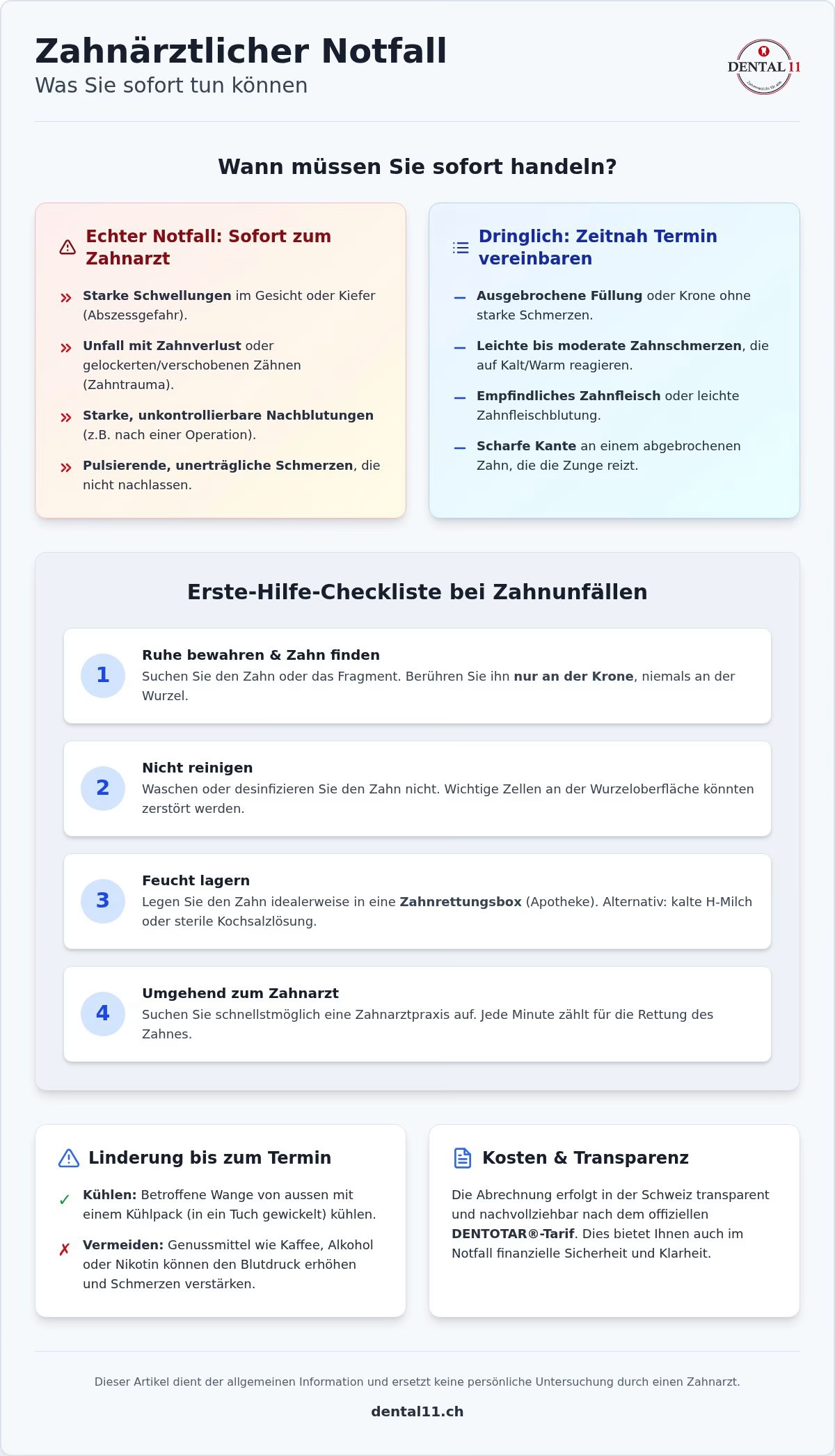
A dental emergency is when a tooth has been knocked out or pushed out of position, when your cheek or jaw swells (especially with fever or difficulty swallowing), when a wound after a tooth extraction will not stop bleeding, or when throbbing pain does not ease despite painkillers. In these cases, call Dental11 in Zurich Enge, Monday to Friday; we will try to see you the same day. At weekends and at night, the dental emergency service of the Canton of Zurich is available on 0800 33 66 55. Sensitivity to cold, a small chip without pain or a lost filling without discomfort can wait until your next regular appointment.
Key points
- Get treatment today: a knocked-out or displaced tooth, swelling with fever, persistent bleeding, pain despite painkillers. Can wait: sensitivity to cold, a small chip, a lost filling without pain.
- Knocked-out tooth: hold it by the crown only, do not clean it, store it in a tooth rescue box or cold milk, and get to the practice within 30 to 60 minutes.
- Dental11 in Zurich Enge: call Monday to Friday, open until 8 pm on Monday and Tuesday. Weekends and nights: Canton of Zurich emergency service 0800 33 66 55.
- Costs under the Dentotar tariff: check-up CHF 99, filling from CHF 250, root canal treatment from CHF 650, tooth extraction from CHF 180. After an accident, accident insurance usually pays.
Checklist: treatment today or can it wait?
Go through the list from top to bottom. If anything in the first group applies, call without waiting.
Today, even outside opening hours
- A tooth has been knocked out, is very loose or has visibly moved.
- Your cheek, jaw or the floor of your mouth is swelling, together with fever, difficulty swallowing or trouble opening your mouth.
- A wound after a tooth extraction is still bleeding after 30 minutes of biting firmly on a gauze pad.
- Throbbing pain that wakes you at night and does not respond to painkillers.
- A tooth has broken off deep down, the nerve is exposed or the tooth is bleeding.
Within the next one to two days
- A crown or temporary crown has come out; the tooth is sensitive but not very painful.
- A filling has been lost and a sharp edge is irritating your tongue or cheek.
- Your gum is swollen in one spot, without fever.
- An aligner or a retainer wire has broken.
At your next regular appointment
- Brief sensitivity to cold that passes after a few seconds.
- A small chip on the biting edge without pain.
- Occasional bleeding gums when brushing.
If in doubt, call. On the phone we can assess your symptoms in two minutes and tell you whether you should come in today.
First aid until your appointment: what you can do yourself
The first few minutes often decide whether a tooth can be saved. These measures bridge the time until treatment, but they do not replace it.
Knocked-out tooth
Hold the tooth by the crown only, never by the root. Do not rinse it, do not dry it and do not wrap it in a tissue. Place it in a tooth rescue box from the pharmacy, otherwise in cold UHT milk or in your mouth next to your cheek. Then go to the practice straight away: the chances of reimplantation are best within 30 to 60 minutes. Baby teeth are not put back in. The steps are explained in detail in the article Knocked-out tooth: first aid step by step.
Broken tooth
Keep the broken fragment moist (in milk or saliva); it can often be bonded back on. Rinse your mouth with lukewarm water, cover any sharp edge with dental wax or sugar-free chewing gum and chew on the other side. More on this in the article Broken tooth: emergency help in Zurich Enge.
Swelling
Cool from the outside with an ice pack wrapped in a cloth, 10 minutes on, 10 minutes off. No heat, no alcohol, no sport. Swelling with fever, difficulty swallowing or shortness of breath is an emergency, even at night: call the emergency service, or 144 if you have difficulty breathing. You can read about the possible causes of swelling in our emergency check for swollen gums.
Bleeding after an extraction
Bite firmly for 30 minutes on a clean gauze pad or a folded cotton handkerchief, not on cotton wool or paper. Do not rinse, do not suck, and keep your head raised. If it is still bleeding after that, call us; if you take blood thinners, tell us straight away.
Lost crown or filling
Keep the crown and bring it with you; it can often be fixed back in place. Until then, brush the tooth gently and avoid sweet, hot and cold foods. Do not attach it yourself with household glue. What helps in the first few hours is explained in the article Lost crown: emergency help in Zurich Enge.
Severe pain
An over-the-counter painkiller taken as directed on the package leaflet is fine until you are treated. Do not place a tablet on your gum, as it burns the mucous membrane. No alcohol, no nicotine, no heat. Painkillers do not remove the cause; inflammation inside a tooth needs treatment, usually a modern root canal treatment with a microscope in Zurich.
Weekends and nights: the Canton of Zurich emergency service
Dental11 is closed at weekends. On Saturdays, Sundays, public holidays and at night, the Canton of Zurich runs a dental emergency service: telephone 0800 33 66 55, around the clock. The call centre will refer you to the practice on duty near you. Night and weekend surcharges apply there under the Dentotar tariff; initial care is usually limited to pain relief, stopping bleeding or stabilising a tooth injured in an accident. You then plan the final treatment, such as a crown, with your own practice. You can read about when a problem can wait until Monday in the article Dentist at the weekend in Zurich.
Costs and insurance in an emergency
In an emergency, too, we charge according to Dentotar, the Swiss dental tariff: each service has a number of tariff points, multiplied by the practice's point value. As a guide at Dental11: check-up CHF 99, filling from CHF 250, root canal treatment from CHF 650, tooth extraction from CHF 180, crown from CHF 1’400; X-rays are charged separately. Before any treatment that goes beyond pain relief, you will receive a written cost estimate. Payment in instalments is possible through the Zahnärztekasse.
Accident: report it immediately
If the emergency is the result of an accident (a fall, a blow, a sports injury, biting on a cherry stone), accident insurance usually covers the treatment: for employees, the employer's UVG insurance, otherwise the accident cover of your health insurance. Report the accident to your employer or insurer on the same day. We document the findings with an X-ray and photos and write the accident report, so that later consequences are covered as well. Otherwise, basic health insurance (KVG) only pays for dental treatment in the case of serious diseases of the masticatory system. We have put together what to do after a dental accident in our dental accident first aid checklist.
What to bring with you
- Your insurance card and, after an accident, details of the date, place and how it happened.
- Your list of medications, especially blood thinners, bisphosphonates and any allergies.
- The broken fragment or the lost crown, kept moist.
What happens at Dental11 in Zurich Enge
You call us, we assess the urgency on the phone and reserve a slot for you, with acute pain on the same day where possible. At the practice we identify the cause with a digital X-ray and relieve the pain first: easing pressure on the tooth, stopping bleeding, splinting or a temporary filling. We then discuss what the tooth needs in the long term, and you receive the cost estimate. Our practice at Waffenplatzstrasse 11 is a few minutes from Sihlcity and Enge station (tram 5, 13, 17, Waffenplatzstrasse stop; Sihlcity car park). Appointments until 8 pm on Monday and Tuesday, from 8 am on Thursday and Friday. We treat patients in German, English and Greek. The benefits of a fully digital dental practice in Zurich show especially in an emergency: findings, X-rays and the cost estimate are ready in a single visit. As a family dentist in Zurich 8002, we also treat children after a fall.
Online booking is intended for planned treatment; if you are in acute pain, please call us.
Frequently asked questions about dental emergencies
How can I get an appointment today in Zurich Enge?
Call Monday to Friday once the practice opens. We see patients in pain on the same day where possible; on the phone we clarify how urgent it is. The online tool is intended for planned appointments. At weekends and at night, the Canton of Zurich emergency service (0800 33 66 55) refers you to the practice on duty.
How much does emergency treatment cost?
That depends on what is needed. Pain relief with an examination and X-ray is often in the range of a check-up (CHF 99) plus the X-ray; root canal treatment starts at CHF 650, a tooth extraction at CHF 180. The cantonal emergency service adds night and weekend surcharges. For anything that goes beyond initial care, you will receive a written cost estimate.
Is my toothache a real emergency?
Yes, if the pain throbs, wakes you at night and does not respond to painkillers, or if swelling develops. A brief twinge with cold is not an emergency, but should be checked at your next appointment. If you are unsure, call us; the assessment on the phone takes two minutes.
Does health insurance pay for an emergency?
Basic health insurance only pays for dental treatment in the case of serious diseases of the masticatory system. After an accident, accident insurance covers it; for this, the accident must be reported promptly and documented by a dentist. Supplementary dental insurance contributes depending on the policy. Payment in instalments is possible through the Zahnärztekasse.
Can I take painkillers for toothache?
Yes, an over-the-counter product taken as directed on the package leaflet bridges the time until treatment. Never place it directly on the gum, and do not take any additional blood-thinning medication before a possible tooth extraction without discussing it with us. If the pain disappears while you are taking it, the cause is still there.
This article is for general information and does not replace an individual dental examination.