
Swollen gums are an emergency if the swelling spreads to the cheek or jaw, if you also have a fever, difficulty swallowing or cannot open your mouth fully, or if pus is coming out. In these cases there is usually an abscess behind it that needs to be opened: call Dental11 in Zürich Enge (Monday to Friday) or, at the weekend, the dental emergency service of the Canton of Zurich on 0800 33 66 55. A localised swelling without fever, for example from gum inflammation or a trapped piece of food, can wait until the next working day; until then, cooling from the outside and rinsing with salt water will help. An assessment at Dental11 costs CHF 99 (check-up).
This guide explains the warning signs, the most common causes from gingivitis to wisdom teeth, first aid until your appointment and how treatment works.
Key points
- Get treatment straight away for: swelling with fever, difficulty swallowing, limited mouth opening or pus. If you have difficulty breathing: call 144.
- Until your appointment: cool the cheek from the outside, rinse with lukewarm salt water, do not squeeze, no heat, no aspirin.
- Most common causes: gum inflammation caused by plaque, periodontal abscess, an erupting wisdom tooth, a dead tooth nerve.
- Dental11 Zürich Enge: assessment with X-rays (check-up CHF 99), draining the abscess or cleaning the pocket, then dental hygiene (CHF 99) for prevention.
- Weekends and nights: dental emergency service of the Canton of Zurich, 0800 33 66 55.
Swollen gums: when is it a dental emergency?
A swelling of the gums is much more than a minor nuisance. It is a clear signal from your body that your immune system is fighting an infection. The cause is often a build-up of bacteria that creates pressure in the tissue. If the swelling is keeping you from concentrating or sleeping, watch the signs closely. Slight redness can be the first stage, but throbbing pain usually points to a more serious process.
Such symptoms are often based on gum inflammation (gingivitis). If it is left untreated, bacteria can work their way deep into the tissue. A local abscess is then often the result. The tissue becomes tense and hot and is extremely sensitive to pressure. Waiting at this stage is risky. Inflammation that is left to drag on can attack the jawbone and, in the worst case, lead to the loss of healthy teeth. Chronic inflammation in the mouth is also considered a risk factor for general conditions such as diabetes or cardiovascular problems.
Symptoms that call for immediate action
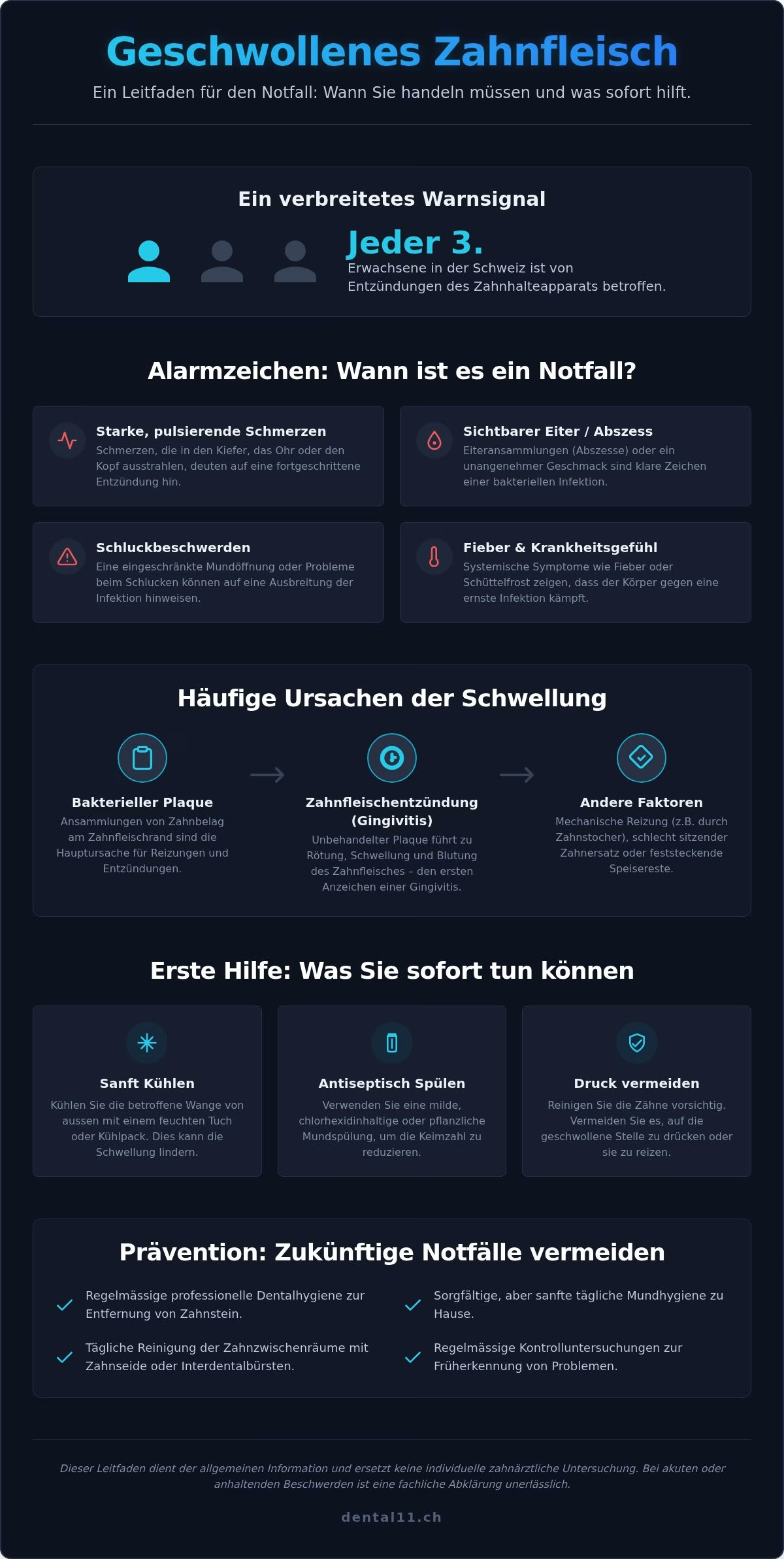
There are clear signs that make a prompt assessment essential. Be careful if the swelling does not stay localised but spreads to the face or jaw. Look out for the following warning signs:
- Severe, pulsating pain that can radiate to the ears.
- Visible pus or an unpleasant taste in the mouth.
- Limited mouth opening or noticeable difficulty swallowing.
- Fever, chills or a general feeling of exhaustion.
These symptoms indicate that the inflammation has already reached the deeper layers of tissue. In such cases a quick diagnosis is crucial to stop the infection spreading further in the body.
Local help in Zürich Enge
In an acute situation, easy access matters. Our practice is at Waffenplatzstrasse 11 in Zürich Enge, a few minutes from Sihlcity and Enge railway station. For patients from District 2 or the neighbouring areas, this means short distances and a stress-free journey. The location offers clear advantages:
- Tram 5, 13 and 17 to the Waffenplatzstrasse stop, S-Bahn to Enge station.
- Sihlcity car park if you come by car.
- Open Monday to Friday, until 8 pm on Mondays and Tuesdays; at weekends, emergency service 0800 33 66 55.
- A calm, professional atmosphere that helps anxious patients in particular to relax.
We place great importance on clear communication about costs and procedures, so that you can concentrate fully on your recovery. If you have acute symptoms, you can book an appointment directly online.
Common causes of swollen gums
When the tissue in the mouth feels tight and painful, people often look desperately for an explanation. A swelling rarely appears without a reason; it is the body's response to external or internal stimuli. In our practice we often see patients come to us with swollen gums as an emergency because they cannot work out the cause themselves. Understanding the triggers is the first step towards the right treatment and feeling well again.
The reasons range from simple mechanical irritation caused by brushing too hard or food stuck between the teeth to complex inflammatory processes. Poorly fitting dental restorations or new dentures can also cause pressure points that make the surrounding tissue swell. In many cases, however, a bacterial infection is behind it, which requires targeted treatment.
Inflammation of the tooth-supporting tissues
The most common cause of swelling is a build-up of plaque along the gum line. If these bacterial deposits are not removed regularly, gum inflammation (gingivitis) develops. It shows up as redness, swelling and frequent bleeding of the gums. Various symptoms and risk factors encourage the transition to periodontitis, in which deep gum pockets form.
In these pockets, bacteria find an ideal, protected hiding place. There they can become encapsulated and form a painful abscess. As these areas cannot be reached with a toothbrush at home, professional cleaning in our modern practice in Zürich Enge is often essential to remove the source of inflammation safely and calm the tissue.
Problems with wisdom teeth
A classic cause of acute problems at the back of the mouth is pericoronitis. It occurs when a wisdom tooth only partially erupts. A small flap of gum forms over the crown, and food debris and bacteria collect underneath it. Because this area is extremely hard to clean, painful swelling develops there particularly easily and can spread to the angle of the jaw.
The danger is that the infection spreads into the surrounding soft tissue. To assess the exact position of the tooth and the extent of the inflammation, we use digital X-rays in our practice. This low-radiation technology allows us to make a precise diagnosis within a few minutes. If you have symptoms like these, you can easily book an appointment online so that we can identify the cause together.
First aid for swollen gums: what you can do straight away
If swollen gums catch you unprepared, calm action is needed. First aid measures can bridge the time until your appointment at our practice in Zürich Enge, but they never replace a professional diagnosis. The first rule is: stay calm and under no circumstances try to open the swelling yourself with sharp objects or your fingers. This can spread germs dangerously and even lead to blood poisoning.
Cooling is often the most effective way to relieve acute symptoms. Use a cold pack or a damp cloth wrapped in a thin towel and place it on the outside of your cheek. Avoid direct contact with ice to prevent frostbite on the skin. At the same time, rinsing with lukewarm salt water or an alcohol-free antiseptic solution from the pharmacy helps. These measures support surface disinfection and can temporarily reduce the pressure in the tissue. As the cause often lies deep in the gum pockets, however, home remedies usually only have a short-term effect.
Dos and don'ts until your appointment
Proper care is important in an emergency too. Keep brushing your teeth carefully, ideally with a very soft toothbrush. This prevents further plaque from building up and feeding the inflammation. During this phase, consistently avoid heat, saunas and strenuous exercise, as increased blood flow can make the throbbing and swelling worse. Nicotine and alcohol also severely impair local wound healing.
Be careful with painkillers. They can mask symptoms, which can make diagnosis more difficult. Only take medication after consulting a professional. Take care with clove oil or tea tree oil too: with open inflammation, these essential oils can further irritate the sensitive tissue and cause chemical burns.
When home remedies are no longer enough
Home remedies have their limits. A swelling caused by an abscess or deep periodontitis rarely heals permanently without dental treatment. The symptoms often return more severely after a short quiet phase. In the following cases, pick up the phone straight away:
- The swelling increases within 12 hours despite cooling.
- Swallowing or speaking is becoming increasingly difficult.
- You notice a foul taste or pus.
Before you call us or the official emergency service of the Canton of Zurich (0800 33 66 55), prepare short answers: How long have you had the swelling? Do you have a fever? Do you take blood thinners? This information helps us to give you the right support as quickly as possible.
Emergency treatment at Dental11 in Zurich
An acute dental emergency is always stressful, especially when the cause is unclear and the pain is hard to bear. At our practice in Zürich Enge, we want to be a calm place for our patients at exactly these moments. If you come to us with swollen gums, a caring welcome and immediate relief of your symptoms are our top priority. We understand that, as well as the physical pain, worries about the costs often play a part. That is why we make the costs clear to you from the very first minute.
For us, transparency is not a slogan but a matter of ethics in daily practice. Before we start any treatment, we discuss the necessary steps and the related costs according to the Dentotar tariff with you: the check-up costs CHF 99, X-rays are charged separately, and dental hygiene as follow-up care costs CHF 99. For larger treatments, payment in instalments through the Zahnärztekasse is possible. This lets you concentrate fully on your recovery without worrying about the immediate financial burden. Our aim is careful treatment that remains accessible to all groups of patients.
What happens at your emergency appointment
Your visit begins with a short, focused medical history. We want to understand how long the swelling has been there and what other symptoms you have. After a gentle clinical examination of the affected area, we immediately take steps to relieve the pain. Depending on the findings, this may be the professional cleaning of a deep gum pocket or draining an abscess to relieve the pressure in the tissue.
We then discuss the next steps. We explain exactly what aftercare is needed at home and whether follow-up appointments make sense for lasting healing. We take the time to answer all your questions clearly, so that you can leave the practice feeling reassured.
Technology for patient comfort
For us, modern dentistry means using new technology in a way that makes you noticeably more comfortable. We use digital X-rays, which are low in radiation and give us very precise images within seconds. This lets us see straight away whether the swelling comes from a tooth root, a wisdom tooth or the tooth-supporting tissues. This diagnostic accuracy is the basis for targeted treatment that is gentle on the tissue.
The atmosphere at our practice in Zürich Enge is deliberately calm, to lower barriers and give anxious patients in particular a sense of security. We use minimally invasive methods to keep the strain on the gums as low as possible. If you need help quickly, you can book your emergency appointment in Zürich Enge directly here.
Prevention: how to avoid gum emergencies in future
Once acute inflammation has been treated successfully, the focus shifts to strengthening your tooth-supporting tissues for the long term. A crisis in the mouth is often a turning point that shows how delicate the biological balance between bacteria and your immune system is. If you have experienced how swollen gums can disrupt everyday life, you know how valuable healthy, pain-free teeth and gums are. Prevention is not a one-off event but the result of consistent cooperation between you and our team.
A well-functioning immune system is the basis for tissue that can regenerate. A balanced diet rich in vitamins and minerals supports the body's defences. Even so, there are areas in the mouth that a toothbrush cannot reach, even with careful care at home. This is where professional measures come in, to lower the risk of renewed, painful inflammation in the long term.
The role of professional dental cleaning
Even with good technique, daily cleaning usually reaches only part of the tooth surfaces. Plaque remains, especially in gum pockets and narrow gaps between the teeth, and over time it hardens into tartar. These deposits act as a reservoir for germs that can continually irritate the tissue. Regular dental hygiene in Zurich is therefore the most important protection against relapses.
During this session we also remove stubborn deposits below the gum line and significantly reduce the bacterial load. This protects against the progression of periodontitis, which often goes unnoticed until acute symptoms appear. Professional cleaning is therefore an essential pillar for keeping your natural teeth for life.
Long-term care at Dental11
At our practice in Zürich Enge we take a preventive approach based on continuity. So that small changes in the tissue are spotted early, before they grow into a painful problem, we recommend one check-up (CHF 99) and one dental hygiene session (CHF 99) per year, more often if you have periodontitis. It is best to book your next appointment directly after the session.
At these regular check-ups we give you individual advice on improving the tools you use for care at home and practical tips for everyday life. This regular review is the most important protection against another acute swelling. We support you with expertise and care on your way to stable oral health.
Act early for your oral health
Swollen gums are your body's invitation to take a closer look and seek professional support in good time. As explained in the previous sections, acting decisively protects you from unnecessary strain and keeps your teeth stable in the long term. In our practice we make sure that, despite the acute situation, you feel safe, respected and well looked after.
If your gums are swollen and keeping you awake at night, we offer caring treatment at our practice in Zürich Enge, a few minutes from Sihlcity. We ensure full clarity on costs through billing according to the Dentotar tariff and take particular time for patients who feel unsure about treatment. Thanks to digital diagnostics, we find the cause promptly and discuss every necessary step with you on an equal footing.
Do not hesitate to put your health first, to prevent the inflammation from spreading. You can book your emergency appointment in Zürich Enge online here and get the reassurance you need for your recovery. We look forward to seeing you return to everyday life feeling well and confident.
Frequently asked questions about swollen gums
What should I do if my gums suddenly swell badly?
If your gums suddenly swell badly, cool the affected cheek from the outside straight away and avoid any physical exertion. Rinsing with lukewarm salt water can reduce the bacterial load for a while, but a professional assessment is essential when your gums are swollen. Book an appointment promptly so that the cause can be identified reliably and the inflammation does not spread.
How much does emergency treatment for gum problems cost in Zurich?
The cost of emergency treatment depends largely on the underlying cause and the procedure needed. A simple examination with digital diagnostics usually costs less than draining an abscess or an intensive cleaning of deep gum pockets. We bill according to the Dentotar tariff: the check-up costs CHF 99, X-rays are charged separately, and the cost of treatment depends on the findings. We inform you in advance about the expected fees so that the costs are clear to you.
Can swollen gums wait until the next morning?
That depends very much on your accompanying symptoms. If you only feel slight irritation, careful cooling overnight can help. If, however, you have a fever, severe throbbing pain, chills or difficulty swallowing, do not hesitate. In such cases prompt treatment is important. Outside our opening hours you can reach the cantonal emergency service on 0800 33 66 55.
Does health insurance cover the cost of a dental emergency?
As a rule, compulsory basic health insurance (KVG) in Switzerland does not cover dental emergencies. The costs usually have to be paid privately. Exceptions apply if you have suitable supplementary insurance or if the emergency is the direct result of an accident. In the latter case, accident insurance (UVG) covers the cost of the necessary treatment. We recommend checking your cover with your insurer in advance.
Do antibiotics help with swollen gums?
Antibiotics can support treatment of a severe bacterial infection, but they rarely remove the mechanical cause, such as deep-seated tartar or infected pockets. Taking them on their own without dental treatment often brings only a temporary improvement in symptoms. The decision on medication is always made by the treating dentist after a thorough examination of the affected area.
How can I recognise an abscess on the gum?
An abscess usually appears as a clearly defined, firm and very tender swelling directly at the gum line. The affected area is often very red, feels hot and may release pus when lightly pressed. An abscess is often accompanied by throbbing pain that gets worse with heat and can spread into the jaw.
This article is for general information only and does not replace a personal dental examination.