If a tooth has broken, keep the broken piece, store it moist (in a tooth rescue box or cold milk), do not clean it, and come to the practice promptly. It is an emergency that needs treatment the same day if the tooth is bleeding, hurts badly when air reaches it, or feels loose. A small chip without pain can wait until the next working day. Dental11 in Zürich Enge repairs small defects with composite bonding, bonds suitable fragments back in place, or restores larger fractures with a crown (from CHF 1’400). At weekends, the Canton of Zurich emergency dental service can help on 0800 33 66 55.
This article explains first aid, how fractures are classified by severity, the treatment options and how costs are covered by accident or health insurance.
Key points
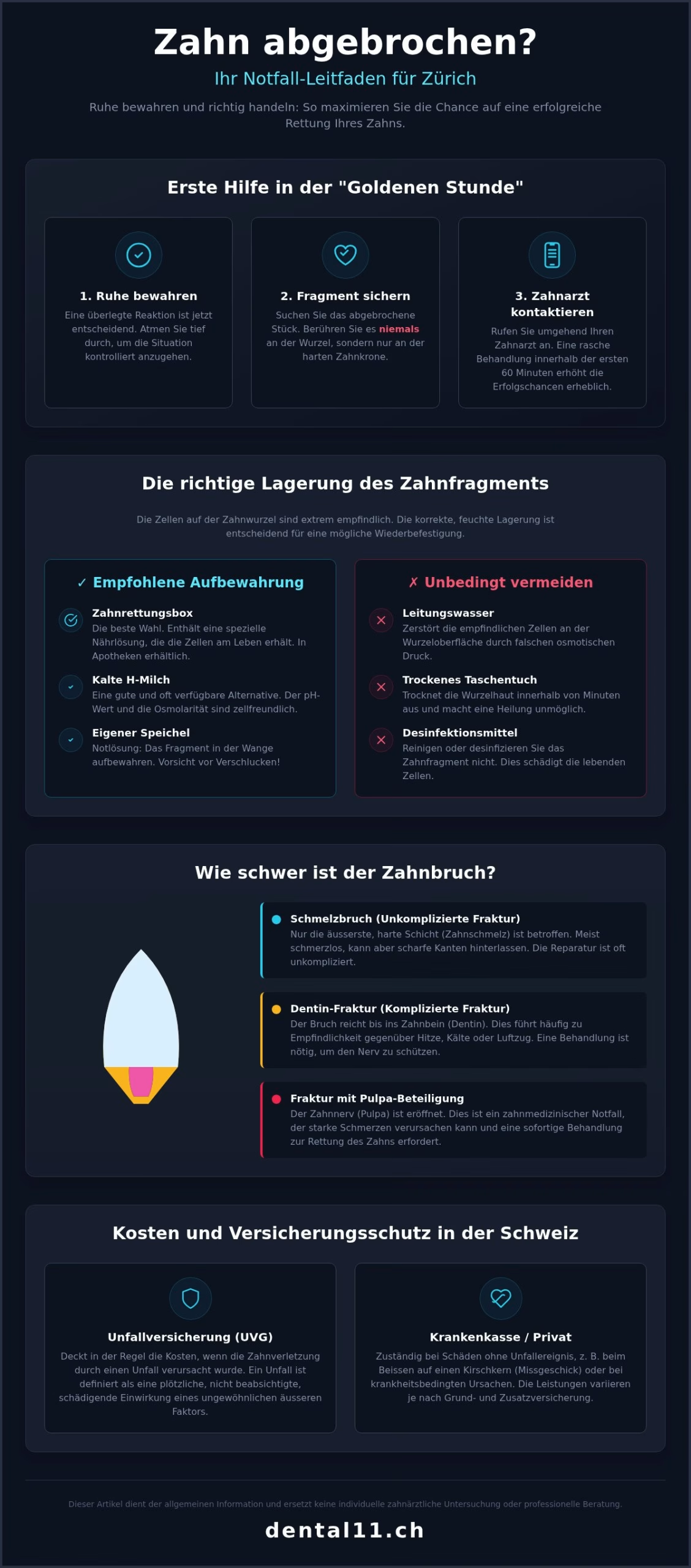
- Hold the broken piece by the crown only and keep it moist (tooth rescue box or cold milk), never in tap water or dry in a tissue.
- Small chip without pain: appointment on the next working day. Bleeding from the tooth, severe pain when air reaches it, or loosening: treatment the same day.
- Dental11 in Zürich Enge treats broken teeth Monday to Friday, on the same day where possible if you are in pain; at weekends: Canton of Zurich emergency dental service 0800 33 66 55.
- Dental11 repairs small defects with composite bonding in one appointment; larger fractures need a crown from CHF 1’400.
- After an accident, accident insurance (UVG) usually pays; biting on a cherry stone or a bone is often classed as dental damage and is then only covered by supplementary dental insurance.
Broken tooth: first aid and emergency steps in Zurich
A broken tooth is a real shock at first. However, modern dentistry today offers good ways to save natural tooth structure and restore the appearance of your smile. The important thing now is to stay calm. A broken tooth emergency in Zurich can often be treated successfully if you make the best use of the first 60 minutes after the accident. In dentistry, we often speak of the "golden hour", when the chances of healing are highest.
First, secure the broken tooth fragment or the whole tooth. Never touch the root surface. It carries sensitive cells that are crucial for the tooth to reattach later or for a stable fixation. Instead, hold the tooth only by the hard crown. Handling it correctly in the first few minutes has a major influence on the success of treatment.
Storage is the most critical part of first aid. The cells on the tooth root are extremely sensitive and dry out quickly in the air. If possible, use one of the following options:
- Tooth rescue box: a recommended choice, as it contains a special nutrient solution (available from pharmacies).
- Cold milk: a suitable alternative if no rescue box is to hand.
- Saliva: if nothing else is available, keep the fragment in your mouth (take care not to swallow it).
Make sure you do not store the tooth in tap water or in a dry tissue. This would destroy the delicate tissue structures within a few minutes.
What to do after a dental accident
If the area is bleeding, you can stop the bleeding by gently biting on a sterile compress or a clean cloth handkerchief. Apply even but gentle pressure. To reduce swelling in the face, cool the area from the outside straight away. Place cold compresses or a cool pack wrapped in a cloth against your cheek. If you need painkillers, take them only after consulting a healthcare professional. Avoid blood-thinning medicines such as aspirin, as they can encourage further bleeding.
Where can I get help quickly in Zürich Enge?
Our practice is at Waffenplatzstrasse 11 in Zürich Enge (8002), a few minutes from Sihlcity and Enge station. Monday to Friday, we try to see patients with a broken tooth on the same day; please call us so that we can prepare everything. At weekends and at night, the Canton of Zurich emergency dental service (0800 33 66 55) will refer you to the practice on duty. You can also request an appointment directly online through our booking calendar if that is easier for you in the situation. We will look after you calmly and with professional expertise.
Diagnosis: how serious is the fracture?
Once you have taken the first immediate steps, the key question is: how serious is the damage really? Not every broken tooth looks as serious from the outside as it may be on the inside. For a tooth fracture, we carry out a thorough examination at our practice in Zürich Enge to determine the exact extent of the injury. This is the only way to establish whether only the appearance or also the vitality of the tooth is at risk.
Modern dentistry distinguishes between different levels of injury. A fracture limited to the enamel affects only the outermost, hard layer of the tooth. Such chips are often painless but can leave sharp edges that irritate the tongue or lips. Once the dentine is exposed, however, people often notice an unpleasant sensitivity to heat, cold or air.
It becomes serious when the dental nerve, known as the pulp, is affected. A clear sign of this is pinpoint bleeding from inside the tooth or strong, throbbing pain. In such cases, acting quickly is essential to prevent infection of the nerve tissue. Age also plays an important role in the diagnosis. We take a different approach with children's milk teeth than with adults. A knocked-out milk tooth, for example, is usually not replanted, so as not to endanger the permanent tooth bud underneath.
Superficial chips vs. deep fractures
Enamel fractures often seem harmless, but they still need professional smoothing or a small filling. This helps us prevent decay at the rough areas. If the fracture extends into the dentine, the protective layer around the nerve is broken. This quite often leads to sharp pain when eating or drinking. It is important to understand that only a professional diagnosis can secure the long-term survival of the tooth, as micro-cracks are often invisible to the naked eye.
When the tooth root is affected
Sometimes the fracture lies below the gum line. A vertical or horizontal root fracture is deceptive, because the tooth can look stable from above. Here we use high-resolution digital X-rays to show the course of the fracture precisely. Depending on the findings, root canal treatment may be needed to save the tooth. If the root is so badly damaged that it cannot be saved, we discuss modern alternatives with you, such as a dental implant as a long-term replacement. If you notice an acute change in one of your teeth, you can book an appointment for an examination here.
Why does a tooth break in the first place?
A healthy tooth rarely breaks without a history. Common causes are old, leaking fillings with decay underneath that hollows the tooth from inside; grinding at night (bruxism), which creates fine cracks; root-canal-treated teeth, which are more brittle than vital teeth; and enamel erosion from acidic drinks or reflux. Biting on a cherry stone or an olive is then only the trigger. That is why, after the repair, we also check your other teeth for cracks and leaking fillings and, if you grind your teeth, discuss a protective splint.
Treatment options: how your smile is restored
Once the diagnosis is clear, we discuss together the right way back to a carefree smile. A broken tooth does not have to mean permanent limitations. If you have saved the tooth fragment and bring it to our practice in time, reattaching it is often a biologically sensible solution. Using special medical bonding techniques, we can often fix your own piece so firmly that the join remains invisible to the naked eye.
For smaller chips where no fragment is left, composite bonding is well suited. We use modern, tooth-coloured resins that are applied in layers and shaped precisely. This method is particularly conservative, as we hardly need to remove any healthy tooth structure. Composite bonding is completed in one appointment.
If the fracture has exposed or damaged the dental nerve, saving the tooth comes first. Modern root canal treatment using digital technology often allows us to keep the tooth stable in the jaw. If there is pain or bleeding from inside the tooth, it is essential to act as quickly as possible to prevent inflammation in the jawbone. We guide you through this with patience and modern diagnostic tools.
Aesthetic restoration with fillings and crowns
For larger defects that can no longer be restored stably with a simple filling, we use ceramic restorations. We use tooth-coloured resins for smaller corrections and all-ceramic materials for more extensive restorations. Ceramic has the advantage of natural light refraction that is hard to tell apart from real tooth enamel. In our detailed guide Crowns and fillings in Zurich, you can find out more about the advantages of these long-lasting restorations.
When the tooth cannot be saved: implants
Despite every effort and modern technology, there are situations in which the tooth root is so badly damaged that saving it would not make medical sense. In such cases, modern implant dentistry offers a good solution. A dental implant (at Dental11 from CHF 4’600 including the crown) acts as an artificial tooth root and prevents the loss of jawbone that can follow tooth loss. In this way we restore not only the appearance but also full chewing function and the stability of your teeth.
Costs and insurance cover in Switzerland
A dental accident is not only emotionally stressful, it often also raises questions about payment. In Switzerland, cost coverage for a broken tooth is clearly regulated, as long as you know the difference between accident insurance and health insurance. While medical care has top priority, clarifying the insurance question early gives you additional peace of mind while you heal.
The legal classification is decisive here. In Switzerland, an event counts as an accident if a sudden, unintended and unusual external impact on the body causes damage. Anyone employed for at least eight hours a week is generally insured through their employer under the Accident Insurance Act (UVG). For people who are not employed, such as students, children or pensioners, the health insurer (KVG) covers the costs, provided accident cover is included in the basic insurance.
At Dental11, we care about you feeling well looked after not only medically but also financially. Before any larger treatment, we prepare a detailed treatment cost plan for you. This way you always keep an overview of the costs of your dental health.
Billing through accident insurance
For the costs to be covered smoothly, the dental visit must be declared explicitly as an accident. After the examination, we give you the necessary documents and record the damage precisely for the insurer. It is important to report the incident to your employer or insurer straight away. A major advantage of UVG cover is that it includes late effects. As dental accidents often need further treatment only years later, complete initial documentation ensures that you remain covered in future.
Accident or dental damage? How the insurances differ
Accident insurance pays only if there was an unusual external impact. A stone in rice or bread counts as an accident. Biting on a cherry stone in a cherry cake, on a bone in meat or on a hard bread crust is usually classed as dental damage, because it is something you have to expect; in that case neither accident insurance nor basic insurance pays, only supplementary dental insurance, if you have it. So note down exactly what happened (what, when, where) and keep the foreign object if possible.
Financial planning and instalment payments
The cost of dental services in Switzerland is based on the Dentotar tariff and the practice's tax point value. At Dental11, the examination costs CHF 99, root canal treatment from CHF 650, a crown from CHF 1’400 and an implant with crown from CHF 4’600. Clear communication is a cornerstone of modern dentistry, which is why we explain the estimated total costs to you in full. For more complex restorations, payment in instalments through the Zahnärztekasse is possible. Paying in instalments can make the treatment you need more accessible without putting pressure on your budget in the short term. If you have questions about cost coverage or our financing options, you can arrange an appointment for a personal consultation.
Your emergency dentist in Zürich Enge: Dental11
When a tooth breaks, every minute counts. Our aim at Dental11 is to support you in this stressful situation not only with sound medical care but also on a personal level. At our practice in Zürich Enge, we are prepared for the particular needs of patients in acute situations. A broken tooth calls for an environment that is calm and at the same time offers efficient, precise solutions. We understand that worries about the appearance and function of your teeth can feel overwhelming at first. That is why we take the time to explain every step of the treatment clearly and without time pressure.
We consistently use modern technology to make your visit as comfortable as possible. Digital diagnostics allow us to assess injuries to the tooth structure or the root straight away, without exposing you to unnecessary strain. This diagnostic accuracy is the basis for gentle treatment that supports the long-term preservation of your tooth. Our team accompanies you step by step, from the first pain relief to the final follow-up care. We see technology mainly as a tool to increase your comfort and achieve good results. Even after the acute treatment, we do not leave you on your own; careful follow-up supports the lasting success of the restoration.
Why Dental11 is a good choice in an emergency
In an emergency, clear and unambiguous communication is essential. As Zurich is an open, international city, we place great importance on speaking several languages. We treat patients in German, English and Greek, so that you can describe your worries, symptoms and pain without language barriers. We combine professional expertise with an empathetic approach, which can be a real relief for anxious patients in an exceptional situation. The practice atmosphere is deliberately welcoming and free of judgement, to create a safe environment for everyone. As a dentist in Zürich Enge, we consistently combine innovation with personal warmth.
Book an appointment now and save your tooth
Do not hesitate if you need help or are unsure how serious your injury is. Our practice is at Waffenplatzstrasse 11, 8002 Zürich Enge, a few minutes from Sihlcity and Enge station (tram 5, 13, 17 to Waffenplatzstrasse, Sihlcity car park). We are open Monday to Friday, until 8 pm on Mondays and Tuesdays. If you have a broken tooth, you can reach us by phone or request an appointment online, so that we can help you quickly. We are here to preserve your smile with care.
Keeping your smile in capable hands
A broken tooth is a stressful situation, but modern dentistry today offers a range of solutions with convincing aesthetic results. Remember to keep the fragment moist and, ideally, to see a professional within the first hour. If you have a broken tooth, we are here to advise and help you at our practice in Zürich Enge. We combine modern digital diagnostics with attentive care to restore the natural function and appearance of your teeth carefully.
We place great importance on financial transparency and actively support you with the documentation for your accident insurance or health insurer. If more extensive restorations are needed, payment in instalments through the Zahnärztekasse allows financial planning that suits your circumstances. Our central location in District 2 makes us quick to reach when every minute counts. You can rely on a team that combines professional expertise with personal warmth.
Book an appointment in Zürich Enge now
We are here for you and guide you patiently through every step of your treatment, so that you can soon enjoy your smile again without worry.
Frequently asked questions about dental emergencies
What should I do if a piece of my tooth has broken off?
Find the broken piece straight away and keep it moist, ideally in a tooth rescue box or in cold milk. Do not touch the fragment on the fractured surface, and contact us promptly to preserve the chances of a good outcome.
Can a broken piece of tooth be bonded back on?
Yes, in many cases reattaching your own fragment is a sensible solution, both biologically and aesthetically. This requires the piece to be in good condition and to fit the fracture line precisely; modern adhesive bonding techniques allow very stable results.
Will insurance pay if a tooth has broken?
In Switzerland, the costs are usually covered by accident insurance (UVG), provided the fracture was caused by a sudden, unforeseen external impact. It is important to report the incident to your employer or insurer straight away to secure your entitlement to cost coverage and cover for late effects.
Is a broken tooth always an emergency?
A tooth fracture should always be examined promptly, which is why we treat it as an emergency. Even if you have no pain, bacteria can enter the tooth through micro-cracks and cause inflammation of the dental nerve or the jawbone.
How much does it cost to repair a broken tooth?
The cost of treatment depends largely on the severity of the injury and can vary with the work involved. As a guide at Dental11: examination CHF 99, crown from CHF 1’400, root canal treatment from CHF 650, implant with crown from CHF 4’600. After the examination, you will receive a cost estimate based on the Dentotar tariff.
How much time do you have to save a broken tooth?
We often achieve good results particularly when treatment takes place within the first 60 minutes. While fragments can often still be bonded after several hours, with a completely knocked-out tooth every minute counts for the survival of the root cells.
What happens if a broken tooth is not treated?
Without treatment, you risk a painful infection of the dental nerve, which can lead to an abscess. In addition, the weakened tooth can crack further under normal chewing forces, which makes saving it more difficult or, in the worst case, impossible.
Will I have pain if only the enamel has broken off?
Fractures limited to the enamel often cause no direct pain, as enamel contains no nerves. However, people often notice sharp edges or increased sensitivity to extreme temperatures once the protective layer has become thinner.
This article is for general information only and does not replace an individual dental examination.