
Clinically reviewed by MDDr.(CZE) Polydefkis Papaioannou, dentist, Dental11 Zurich. Last updated 10/2026
Dental11 in Zürich Enge is closed on Saturdays and Sundays. If you have acute toothache, swelling or a dental injury at the weekend in Zurich, call the dental emergency service of the Canton of Zurich: 0800 33 66 55. The service will refer you to the practice on duty, which also treats emergencies at night, at weekends and on public holidays. Much of what worries you on a Saturday can wait until Monday, however: Dental11 is open until 8 pm on Mondays and Tuesdays, so you can usually get an appointment on the Monday itself.
This guide explains what counts as a dental emergency, what you can do yourself until your appointment, what emergency treatment costs and when you should go to hospital rather than to a dentist. It does not replace an examination.
Key points
- Dental11 is open Monday to Friday (until 8 pm on Mondays and Tuesdays, from 8 am on Thursdays and Fridays) and closed at weekends.
- Canton of Zurich dental emergency service: 0800 33 66 55, around the clock, including Saturdays, Sundays and public holidays.
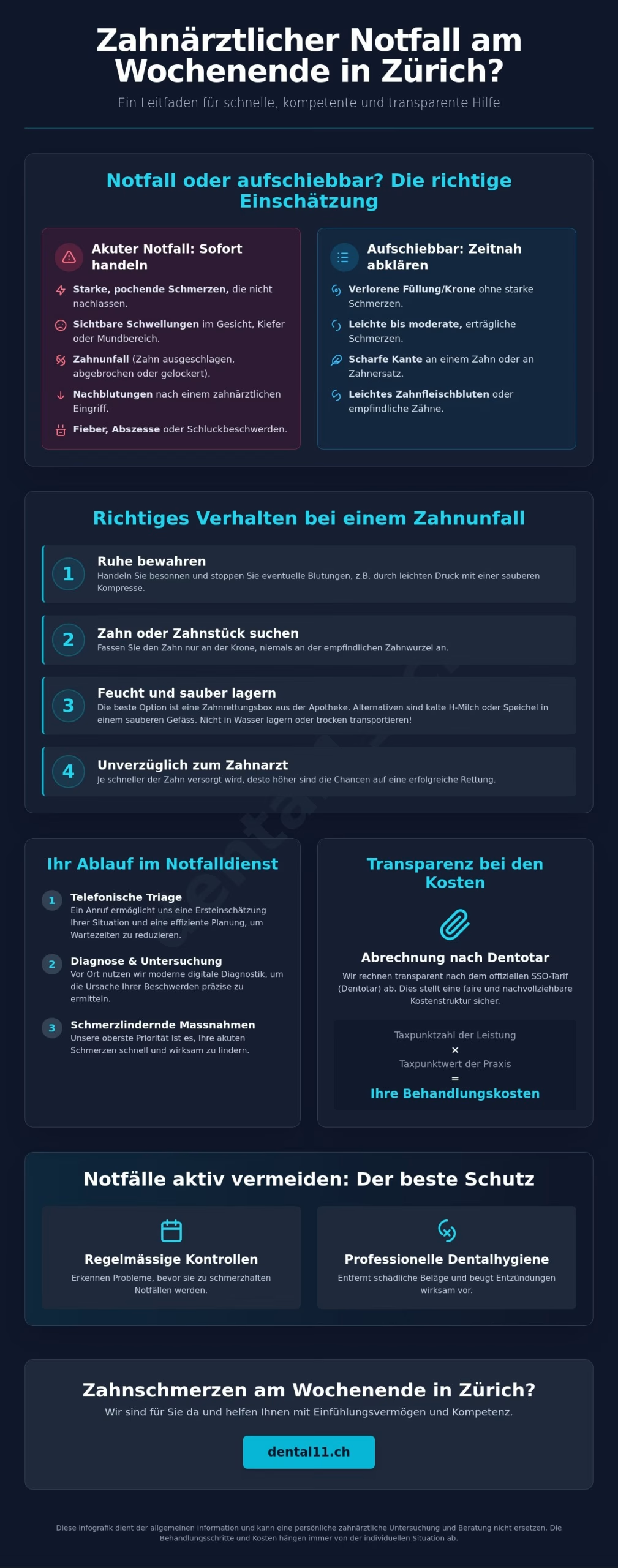
- A real emergency: a knocked-out tooth, swelling with fever, persistent bleeding, pain that does not respond to painkillers. Can wait until Monday: sensitivity to cold, a small chip without pain, a lost filling without discomfort.
- Knocked-out tooth: hold it by the crown only, do not clean it, store it in a tooth rescue box or cold milk, and see a dentist within 30 to 60 minutes.
- Costs are charged according to the Dentotar tariff; the emergency service may add surcharges. After an accident, accident insurance (UVG) pays.
Who can help at the weekend in Zurich?
The Zurich Cantonal Dental Association organises an emergency service in which practices take turns. On 0800 33 66 55 you can find out which practice is on duty and how to get there. Call before you set off: the practice on duty usually gives patients a fixed time to come in. Have the following ready: how long you have had the symptoms, whether you have a fever, which medicines you take (especially blood thinners) and whether an accident was the cause.
You should go to hospital rather than to a dentist if you have swelling that closes your eye or affects your neck, difficulty breathing or swallowing, a high fever with chills, or after a fall with loss of consciousness or a suspected broken jaw. In these cases, call 144 or go straight to the emergency department.
Dental11 does not see patients at the weekend, including emergencies. If you are already a patient of ours, call us on Monday once the practice opens; if you are in acute pain, we will try to treat you the same day.
Emergency or not? The checklist
Call the emergency service today
- Tooth knocked out or displaced: the cells on the root survive only for a short time; every hour reduces the chance of saving the tooth.
- Swelling in the face, especially with fever: a sign of an abscess that needs to be opened.
- Bleeding after a tooth extraction that does not stop after 20 minutes of firm pressure on a gauze pad.
- Throbbing pain that keeps you awake and does not respond to over-the-counter painkillers: usually an inflammation of the tooth nerve, which can only be relieved by opening the tooth.
- Broken tooth with an exposed nerve: recognisable by a red dot on the fractured surface or severe pain when air reaches it.
Can wait until Monday
- Sensitivity to cold or heat without constant pain.
- A small chip in the enamel without pain; cover sharp edges with dental wax from the pharmacy.
- A lost filling or loose crown without pain: keep the crown, do not chew on that side, do not glue it back yourself.
- A broken retainer wire or loose bracket without injury to the lining of the mouth.
- Slight bleeding of the gums.
First aid until your appointment
Knocked-out tooth
- Hold it by the crown only and do not touch the root.
- Do not rinse it, dry it or wrap it in a tissue.
- Place it in a tooth rescue box (available from pharmacies; schools and sports facilities often have one) or in cold milk. If neither is available, keep it in your mouth inside your cheek, but not in children, as they could swallow it.
- See a dentist within 30 to 60 minutes. Baby teeth are not put back in, but should still be examined.
Bleeding and swelling
If there is bleeding, bite on a sterile gauze pad or a clean cotton handkerchief for 20 minutes without interruption. Do not rinse, as this loosens the clot. Cool any swelling from the outside with a cold pack wrapped in a cloth, in intervals of ten minutes. No heat, no sport, no alcohol.
Painkillers
Ibuprofen or paracetamol, taken as directed on the pack, will help until your appointment. Avoid acetylsalicylic acid (aspirin): it thins the blood and makes later treatment more difficult. Do not place a tablet on the tooth or gums, as this causes chemical burns. Clove oil and alcohol should not be put on open wounds.
Home remedies: what helps and what harms
Rinsing with lukewarm salt water (one teaspoon in a glass) or sage tea soothes irritated gums. Clove oil on a cotton bud has a mild numbing effect, but should not be put on open wounds or into a gap left by a tooth. No alcohol, no heat, no tablet on the tooth. With an inflamed nerve (pulpitis), cold often brings brief relief while warmth makes the pain worse; this is useful information to give the emergency service.
How much does emergency treatment cost?
In Switzerland, dental treatment is charged according to the Dentotar, the tariff of the Swiss Dental Association SSO. Each treatment has a fixed number of tariff points, multiplied by the practice’s point value. In the emergency service, depending on the practice, surcharges for nights, weekends and public holidays may be added; ask when you call, and expect to pay on the spot (card, Twint or cash).
For orientation, these are Dental11 prices for follow-up treatment during the week: check-up CHF 99, filling from CHF 250, root canal treatment from CHF 650, tooth extraction from CHF 180, crown from CHF 1’400. X-rays are charged separately according to the Dentotar tariff. You will receive the exact amount as a cost estimate before treatment.
If an accident was the cause (a fall, a blow, biting on something hard), accident insurance usually pays: for employees, the employer’s UVG insurance; for children, students and people not in employment, the health insurer through its accident cover. Report the accident promptly; the dental practice documents the findings for the insurer. Basic health insurance does not pay for emergencies caused by disease (decay, an inflamed nerve, an abscess); a supplementary dental insurance may contribute.
Dental11 on Monday: appointments, directions, prevention
Our practice is at Waffenplatzstrasse 11 in Zürich Enge, a few minutes from Sihlcity and Enge station. You can reach us by tram 5, 13 and 17 (Waffenplatzstrasse stop), by S-Bahn via Enge station, or by car using the Sihlcity car park. We are open Monday to Friday, until 8 pm on Mondays and Tuesdays and from 8 am on Thursdays and Fridays. If you are in acute pain, please call; you can book check-ups and dental hygiene appointments online. We treat patients in German, English and Greek.
After emergency treatment by the duty service, the tooth almost always needs a final restoration: a filling, completion of the root canal treatment or a crown. Bring the report or the X-ray from the emergency practice so that nothing has to be done twice.
Most weekend emergencies have a history: decay that has been developing for months, a leaking filling, a gum pocket. A check-up (CHF 99) and a dental hygiene appointment in Zurich (CHF 99) once a year find these weak spots before they cause trouble on a Saturday evening.
Frequently asked questions
Is Dental11 open on Saturdays?
No. Dental11 is open Monday to Friday, until 8 pm on Mondays and Tuesdays. On Saturdays and Sundays, please contact the Canton of Zurich dental emergency service on 0800 33 66 55.
How much does the weekend emergency service cost?
The practice on duty charges according to the Dentotar tariff and may add surcharges for weekends and nights. The amount depends on the practice and on the work involved, so ask when you call. Payment is usually made on the spot.
My child has knocked out a tooth. Where should we go?
Keep the tooth safe as described above and call 0800 33 66 55 straight away. Permanent teeth are put back in, baby teeth are not; an examination is still needed, because the developing tooth underneath may be injured. Report the accident to your health insurer or accident insurer.
Can I have a dental hygiene appointment at the weekend?
Not at Dental11. Dental hygiene (CHF 99) and check-ups (CHF 99) take place Monday to Friday, and on Mondays and Tuesdays also in the evening until 8 pm.
What should I do about toothache at night?
Take a painkiller as directed on the pack (no aspirin), keep your head raised and cool your cheek. If you have swelling, a fever or unbearable pain, call 0800 33 66 55; the emergency service is available around the clock. If you have difficulty breathing or swallowing, call 144.
What does the emergency service do, and what does it not do?
The aim is pain relief, not the final restoration: with an inflamed nerve, the tooth is opened and a medicated dressing is placed, an abscess is drained, a sharp edge is smoothed, and a knocked-out tooth is put back in and splinted. You receive a short report and the X-ray for further treatment; payment is usually made on the spot. The filling, crown or completion of the root canal treatment then follows at your own dentist during the week.
This article is for general information and does not replace a dental examination.