A collision, a fall, and suddenly a tooth is lying on the ground. In that moment of shock, one question comes up: a tooth has been knocked out, what now? Handle the tooth as gently as possible and have the injury assessed by a dentist promptly. It also matters whether a baby tooth or a permanent tooth is affected.
Feeling unsure is understandable. If the root is touched or the tooth is stored incorrectly, further treatment can become more difficult. A tooth rescue box is suitable for transport if one is available. Until the examination, do not clean the tooth and only hold it by the visible crown.
This article takes you step by step through the most important immediate measures, explains the difference between baby teeth and permanent teeth and shows when a dental assessment is needed. Dental11 offers emergency appointments to assess dental injuries in Zürich Enge near Sihlcity.
Key takeaways
- After a tooth has been knocked out, a clear sequence helps: stay calm, secure the tooth carefully and have the injury assessed by a dentist.
- Whether a baby tooth, a permanent tooth or a loosened tooth is affected influences the next steps. If you are unsure, a dentist should assess the type of tooth and the injury.
- A tooth rescue box can be suitable for transport. What matters is not touching the root and not letting the tooth dry out.
- After a dental accident, Dental11 in Zürich Enge near Sihlcity offers emergency appointments for a dental assessment.
Tooth knocked out: the first aid steps that matter now
A dental accident is frightening. A calm sequence helps you keep track: deal with the situation carefully and arrange a dental assessment. The appropriate further care depends, among other things, on whether a baby tooth or a permanent tooth is affected and whether there are other injuries. General advice cannot replace an examination.
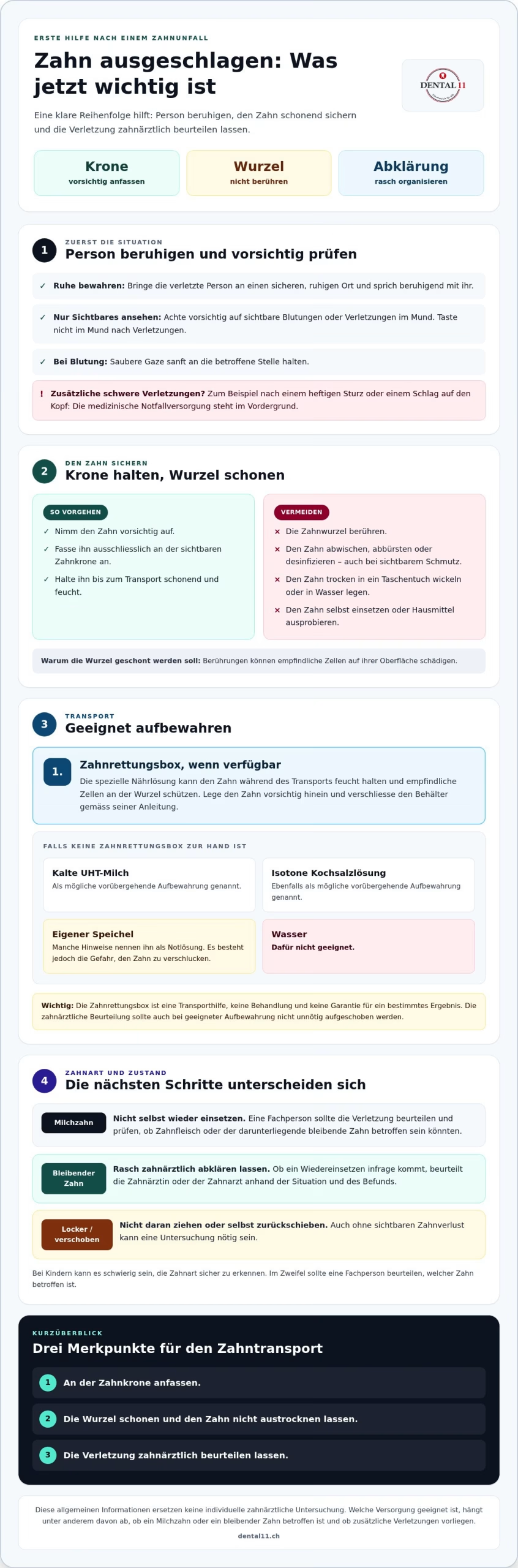
A knocked-out tooth should be assessed by a dentist promptly. As first aid, three things matter at first: reassure the injured person, check the mouth carefully and arrange a dental assessment.
What you can do straight after the dental accident
Proceed carefully and avoid hasty movements. Check whether there is any visible bleeding or injury in the mouth. Also pay attention to whether the person is responsive and whether the accident has caused other symptoms. Do not feel around inside the mouth for injuries and do not try to work out the cause yourself.
- Take the injured person to a safe, quiet place and speak to them calmly.
- Look carefully for visible bleeding and injuries. If there is bleeding, you can gently hold clean gauze against the affected area.
- Arrange a dental assessment without delay. Do not try home remedies and do not treat the tooth yourself.
- If there are other serious injuries, for example after a heavy fall or a blow to the head, emergency medical care comes first.
A dental accident can affect baby teeth or permanent teeth. The overview on tooth loss describes this distinction and possible causes such as accidents. However, the specific situation cannot be assessed reliably on the basis of general information alone.
If it is unclear whether a tooth has been knocked out completely, loosened or displaced, a professional should examine it. Even if the symptoms seem minor at first, a dental assessment is worthwhile: visible signs do not always show the full extent of the injury.
Finding a knocked-out tooth and storing it correctly for transport
If you find the tooth, pick it up carefully and hold it only by the visible crown. The root is sensitive; touching it can damage the cells on its surface. Even if there is dirt on it, do not wipe, brush or disinfect the tooth. A knocked-out permanent tooth should be stored as gently as possible and examined by a dentist promptly.
Correct storage is important, but it does not replace an examination. Do not wrap the tooth dry in a tissue and do not put it in water. Untested home remedies can put additional strain on the sensitive root.
Why a tooth rescue box can be important for transporting the tooth
A tooth rescue box contains a special nutrient solution that can keep the tooth moist during transport and protect sensitive cells on the root. If such a box is available, place the tooth in it carefully and close the container according to its instructions. The box is an aid for transport, not a treatment and not a guarantee of a particular result.
For transport: hold the tooth by the crown, protect the root and do not let the tooth dry out. If no tooth rescue box is to hand, dental recommendations mention cold UHT milk or isotonic saline solution as possible temporary storage media. Water is not suitable. Some sources also mention the person's own saliva as a makeshift option. However, this carries the risk of swallowing the tooth.
Even with suitable storage, the dental assessment should not be put off unnecessarily. Do not spend a long time looking for a particular brand and do not try to put the tooth back in yourself. For an assessment after a dental accident, you can arrange an emergency appointment at Dental11 in Zürich Enge.
Baby tooth or permanent tooth: what the injury means for the next steps
Whether a baby tooth or a permanent tooth is affected makes an important difference to the further assessment. A tooth that is still in the mouth but seems loose or displaced should also be examined. This overview gives initial guidance but does not replace a dental examination.
- Knocked-out baby tooth: Do not put it back in yourself. A professional should assess the injury and check whether the gums or the permanent tooth underneath could also be affected.
- Knocked-out permanent tooth: Have it assessed by a dentist promptly. Whether the tooth can be put back in is decided by the dentist on the basis of the situation and the findings.
- Loosened or displaced tooth: Do not pull on it and do not try to push it back yourself. An examination may be needed even if no tooth has visibly been lost.
Why the type of tooth matters for treatment
Baby teeth and permanent teeth have different functions and relate differently to the development of the dentition. A baby tooth is therefore not simply treated like a permanent tooth. In children, it can also be difficult to identify the type of tooth with certainty. If in doubt, a professional should assess this rather than you attempting treatment yourself.
After the examination, further check-ups or treatment steps can be discussed depending on the findings. Which steps make sense depends, for example, on whether the tooth has been knocked out, loosened or displaced and whether the surrounding tissue has been injured. This cannot be judged reliably from appearance or pain alone.
Dizziness, vomiting or marked drowsiness after a fall should also be taken seriously. If serious injuries are possible, a medical assessment comes first. As a general rule: the type of tooth matters, but whether you have an examination should not depend on whether you are in severe pain.
After an acute dental accident, you can arrange an emergency appointment at Dental11 in Zürich Enge. The appropriate care is determined after an individual examination.
Dental care after a dental accident in Zurich: what happens next
First aid can bring order to the situation. A dental examination shows which structures are affected and which care may be suitable. The dentist can examine your mouth and ask about how the accident happened, which teeth are affected and what symptoms you have. Depending on the findings, further tests may be useful. Digital X-rays and high-resolution imaging are available at Dental11; whether an image is needed is decided case by case.
If possible, make a note of when and how the accident happened. Bring the knocked-out tooth or tooth fragments to the examination if you have found them. Information about visible injuries or other symptoms can also help to assess the situation. Do not delay the assessment just because the pain is mild or eases at first.
Emergency appointment at Dental11 in Zürich Enge
For an acute dental injury, Dental11 offers emergency appointments for a dental assessment. The practice is in Zürich Enge, a few minutes' walk from Sihlcity. It is a point of contact for patients from Zurich District 2, Wollishofen, Wiedikon, Zurich South, Leimbach, Brunaupark, Giesshübel and Adliswil. You can book an appointment online or by phone. When you book, briefly describe the accident and mention any visible symptoms.
If you have lost a tooth, treat the first aid steps as guidance and have your specific situation assessed by a professional. An examination can clarify whether a baby tooth, a permanent tooth or the surrounding tissue is affected. At Dental11 you can book an emergency appointment online for this.
Taking the next step with confidence
After a dental accident, it is understandable to feel unsure at first. The question of what to do after a tooth has been knocked out can be answered in general terms; which care is right for you, however, depends on an individual examination. Act calmly and have the injury assessed by a dentist rather than relying only on your first impression or on how much it hurts.
Dental11 offers emergency appointments for acute dental problems. The practice is in Zürich Enge, a few minutes' walk from Sihlcity. Book an emergency appointment online at Dental11 so that the situation can be assessed by a professional. An individual assessment helps you put the next step into context and discuss it calmly.
Frequently asked questions about a knocked-out tooth
What can I do if I cannot find the knocked-out tooth?
Only search where you can look safely, and do not lose time on a long search. Even without the tooth, the injury should be examined by a dentist, because the gums, neighbouring teeth or other areas of the mouth may be affected. When you make the appointment, mention that the tooth is missing. Also mention any other injuries or symptoms so that the situation can be assessed appropriately.
Do I still need to see a dentist if the knocked-out tooth does not hurt?
Yes. The absence of pain does not rule out a significant injury, so the severity of the symptoms is not the only thing that matters. A dental examination helps to assess your individual situation. Do not wait to see whether pain or swelling develops. This guide does not replace an examination; after an acute dental accident you can arrange an emergency appointment in Zurich.
What should I do if the tooth is only loose after the accident?
Have a loose or displaced tooth assessed by a dentist as well. This is a different injury from a tooth that has been knocked out completely and may call for different next steps. Do not keep moving the tooth with your tongue or fingers, and do not try to straighten it yourself. Make a note of which tooth is affected and how the accident happened. Treatment depends on the individual findings.
When should I also seek emergency medical help after a dental accident?
If there are serious accompanying injuries, impaired consciousness or heavy bleeding, general emergency medical care should take priority. A dental accident can come with other injuries, for example after a bad fall. If you are unsure how serious the situation is, have it assessed by a medical professional urgently. A dental assessment remains important once any other injuries have been taken care of.
This article is for general information only and does not replace a personal dental examination. Which treatment is appropriate and how the situation develops depends on the findings. A particular treatment result cannot be promised.