Clinically reviewed by MDDr. Polydefkis Papaioannou, dentist, Dental11 Zurich · Updated 10/2026
After a dental accident in Zurich, three things matter: hold the tooth or fragment by the crown only, do not clean it, and keep it moist straight away (a tooth rescue box from the pharmacy or cold milk, no water, no tissue). Then see a dentist within 30 to 60 minutes: Monday to Friday, call Dental11 in Zürich Enge; at weekends and at night, call the dental emergency service of the Canton of Zurich on 0800 33 66 55. A knocked-out permanent tooth can heal back in if it reaches the practice quickly and has been stored correctly; a baby tooth is not put back. Report the accident to your accident insurance (UVG) or health insurer, even if the damage looks minor: otherwise nobody will pay for later consequences.
This guide takes you from first aid through the visit to the practice to the insurance report and long-term treatment.
Key points
- Knocked-out tooth: hold it by the crown only, do not clean it, store it in a tooth rescue box or cold milk, and see a dentist within 30 to 60 minutes. Do not put baby teeth back in.
- Bleeding: bite firmly on a gauze pad for 20 minutes. Swelling: cool from the outside. No aspirin.
- Who can help: Dental11 Zürich Enge Monday to Friday (call us), weekends and nights the emergency service of the Canton of Zurich on 0800 33 66 55, and 144 in case of unconsciousness or a suspected jaw fracture.
- Insurance: employees are covered by their employer's accident insurance (UVG), children and people not in employment by their health insurer. Always report the accident, even if there is no visible damage.
- Treatment afterwards: reattaching the fragment or rebuilding with composite, crown from CHF 1’400, and if the tooth is lost, an implant with crown from CHF 4’600 (in adolescents only once growth is complete).
Stay calm: the first minutes after a dental accident
A dental accident usually happens completely unexpectedly and, understandably, causes stress at first. In this situation, however, it is important to stay as calm as you can. Take a deep breath. Panic makes proper first aid harder and often leads to hasty mistakes that could put the tooth at risk. The question of what to do after a dental accident is best answered with a clear head. First make the scene safe so that no further injuries occur. If the affected area is bleeding, apply gentle pressure with clean gauze or a clean cloth handkerchief to stop the bleeding.
Medically, this kind of injury is called anterior tooth trauma, as falls or blows usually affect the visible front teeth. Look for the tooth or any broken fragments straight after the accident. Never touch the root of the tooth; hold the tooth by the crown only. Any contact with the sensitive root surface can significantly reduce the chances of healing. Then contact a dentist in Zurich without delay for a professional first assessment.
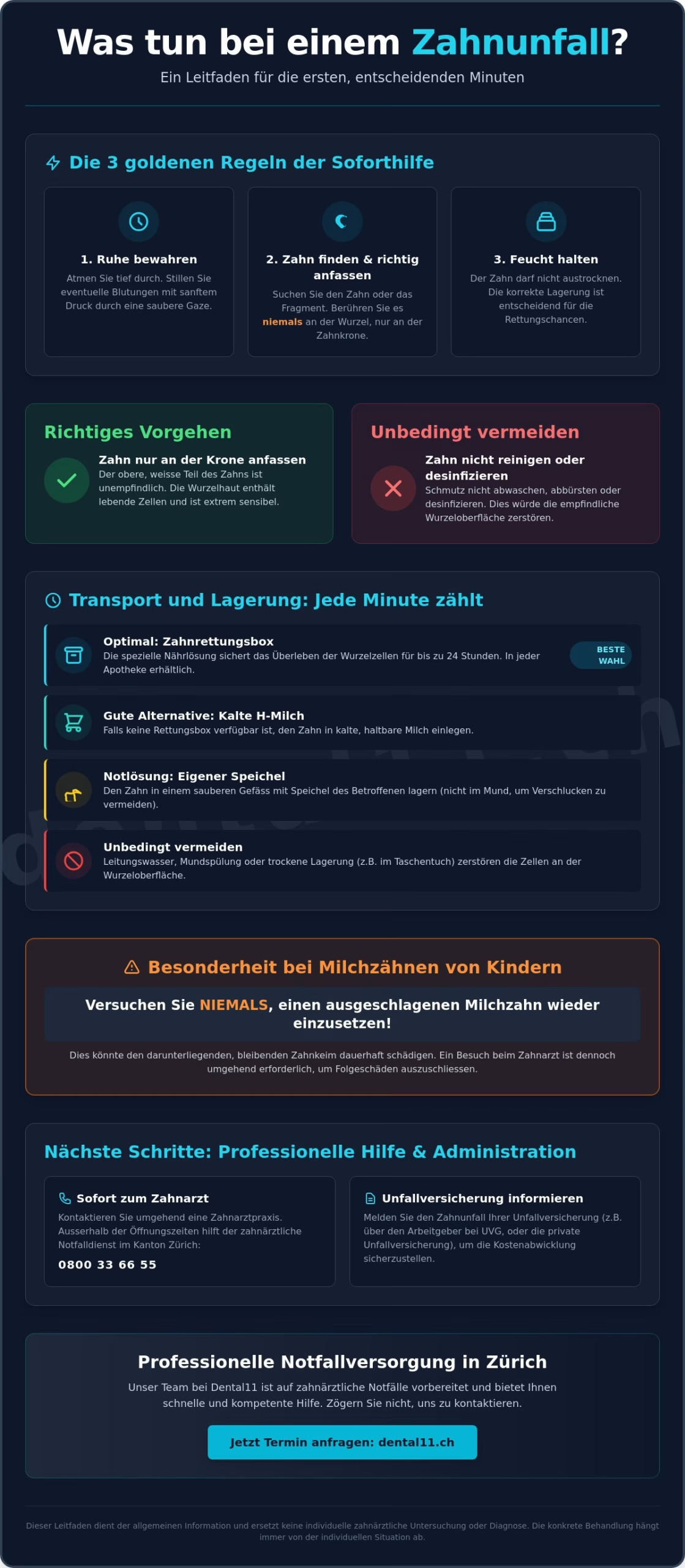
The 3 key rules of first aid
To give the tooth the best possible chance of being saved, follow these three points:
- Hold the crown: Hold the tooth or fragment only by the upper, white part. The root membrane contains living cells that are essential for the tooth to heal back in.
- Do not clean it: Even if the tooth has fallen in dirt or on the ground, do not try to wash, brush or disinfect it. This would destroy the sensitive root surface.
- Keep the tooth moist: A tooth that dries out dies within a few minutes. Time plays a decisive role here. Ideally use a tooth rescue box from the pharmacy, or keep the fragment moist in cold milk.
Baby tooth injuries in children: what is different
When children fall, their baby teeth are often affected. An important exception applies here: never try to put a completely knocked-out baby tooth back into the jaw. This could cause lasting damage to the developing permanent teeth underneath. A visit to the dentist straight away is still essential to rule out damage to the jaw or infection. Calm your child with a gentle voice and watch for signs of concussion, such as nausea or dizziness.
Broken or knocked-out tooth? How to save the tooth structure
In a dental accident, we distinguish medically between a fracture, where only part of the crown has broken off, and an avulsion. Avulsion means that the whole tooth, including the root, has been knocked out of the jaw. In both cases, quick action is needed. Medically, it is clear that the survival of the sensitive cells on the root surface depends largely on correct storage. These cells, known as the root membrane, are extremely sensitive to drying out.
The critical threshold is around 30 minutes. If the root surface stays dry for longer, the cells die, which makes successful replantation of the tooth almost impossible. Ideally, reach for a tooth rescue box straight away. This box contains a special nutrient solution that can keep the cells alive for up to 24 hours. Since accidents often happen during sport or at school, every household and every first aid kit in Zurich should have one. It is available in almost every pharmacy and is the safest way to transport a tooth.
Storage and transport: what to avoid
If you do not have a rescue box to hand, you will need to improvise, but beware of well-meant mistakes. Never wrap the tooth in a dry tissue or cotton wool. This immediately draws the necessary moisture out of the root membrane and causes the cells to die within minutes. Tap water is also unsuitable. Because of osmotic pressure, the cells literally burst in water. As a stopgap, cold UHT milk or a physiological saline solution from the pharmacy is suitable. We only recommend keeping the tooth in the mouth, for example in the cheek pouch, with reservations and only for adults, because of the risk of swallowing it during a shock reaction.
Securing broken pieces of tooth correctly
If only a piece of the tooth has broken off, you should still look for it and keep it. Modern dentistry often makes it possible to reattach your own tooth fragments permanently and with a natural appearance. This is usually the gentlest solution for the tooth structure. Fragments should also be kept moist, for example in saline solution or milk, to prevent the piece from discolouring. Avoid chewing on the affected tooth until it has been assessed by a dentist.
Loose or displaced tooth: do not push it back yourself
Not every dental accident ends with a knocked-out tooth. At the practice, a loosened tooth is fixed to the neighbouring teeth with a flexible splint for a few weeks so that the root membrane can heal. A displaced tooth is repositioned promptly and also splinted; the longer you wait, the more difficult this becomes. Do not try to push the tooth into position yourself, and chew only on the other side until your appointment.
Emergency dentist in Zürich Enge: help at Dental11
Once the first immediate measures have been taken at the scene of the accident, the next step is decisive for keeping your teeth in the long term. Many patients come directly to us in Zürich Enge. In an acute, stressful situation you need a practice that not only works carefully but can also be reached quickly and easily. Our central location in Zürich Enge allows patients from across the city and the surrounding area to get professional help within a short time.
After a dental accident, call us Monday to Friday from the time the practice opens; we try to see you straight away, because with a knocked-out tooth every minute counts. At weekends and at night, the dental emergency service of the Canton of Zurich on 0800 33 66 55 will refer you to the practice on duty. For follow-up checks, you can book an appointment online.
At the practice, we use modern diagnostic methods to assess precisely the extent of the damage to the tooth structure, root and jawbone. Our team treats every patient with care and empathy. We are especially prepared to support children and people with dental anxiety gently in these difficult moments. A calm atmosphere and clear explanations help to reduce the initial stress and to agree on the necessary treatment steps together.
Directions and access in Zürich Enge
Our practice is at Waffenplatzstrasse 11 in Zürich Enge, a few minutes from Sihlcity and Enge railway station. If you come by car, park in the Sihlcity car park; by public transport, take tram 5, 13 or 17 to Waffenplatzstrasse, or the S-Bahn to Enge station. We are open Monday to Friday, until 8 pm on Mondays and Tuesdays.
What to bring to your emergency appointment
To make the first examination and later billing with the insurers as smooth as possible, prepare the following documents and items if you can:
- The injured tooth or the fragments you have kept (ideally in a tooth rescue box or stored as described above).
- Your current health insurance or accident insurance (UVG) card.
- Details of how the accident happened (time, place and type of incident) for the medical records.
- If available: the accident report already completed by your employer or school.
Reporting a dental accident: insurance, costs and paperwork
In the rush after a fall or impact, medical questions understandably come first. But once first aid is complete, administrative matters come to the fore. Many patients are unsure who will pay the costs and which documents are needed. In Switzerland, the distinction between health insurance (KVG) and accident insurance (UVG) is central. While employees are compulsorily insured against accidents through their employer, cover for children, students or people not in employment usually runs through the health insurer.
Behaving correctly after a dental accident therefore also includes reporting the incident properly. We value transparent costs and actively support you with the documentation the insurer needs. Legally, a dental accident counts as a sudden, unforeseen event. For the insurer to cover the costs, the course of the accident must be recorded precisely. Report the incident to your employer, the school or your insurer without delay, even if the damage seems minor at first.
The administrative process after the accident
For billing to go smoothly, request and complete your insurer's accident form promptly. We are happy to help you enter the medical details and diagnoses correctly. Keep all receipts, X-rays and reports safe. If you are self-employed, it is important to check in advance whether you have supplementary accident cover, as basic health insurance often involves a deductible and excess. Complete documentation from the start is the best protection against later uncertainty about cost coverage.
Late effects and why a "minor" accident must be reported
The real consequences of an impact often only become apparent years later. A tooth can gradually discolour, or inflammation can develop at the root tip that only causes pain after a long time. If the original accident was not officially reported at the time, getting the costs of these late effects covered is extremely difficult. Only a registered incident secures your entitlement to later benefits. After a trauma, you should therefore plan regular check-ups with your dentist in Zurich to monitor the condition of the tissues supporting the tooth over the long term.
Long-term treatment after a dental accident
The acute phase after the incident is over, but the path to fully restoring your quality of life often only begins now. After first aid, many patients wonder how they can regain their original appearance and full biting strength. Modern dentistry offers a range of options to restore both appearance and function. We draw up a tailored treatment plan for each patient that takes into account the specific consequences of the accident and their individual wishes.
Our aim is treatment that blends in with your natural row of teeth. From minimally invasive corrections to complex tooth replacement, we use modern techniques to support the structure of your teeth. Sometimes an impact also slightly shifts the neighbouring teeth. In such cases, aligner treatment with ClearCorrect (from CHF 3’499) can be a discreet option for gently correcting the position of the teeth. This way we make sure your teeth not only function well but also look good.
Crowns and fillings: stabilising the tooth
For smaller fractures or chips, modern composite materials are often used. These special resins can be matched precisely to the colour of your teeth, so that the transitions are almost invisible. If the tooth structure has been more severely damaged by the accident, a crown (from CHF 1’400) offers the protection needed to prevent further fractures in the long term. Find out more about crowns and fillings in Zurich and how these measures can help to stabilise the tooth permanently.
Dental implants after tooth loss
If a tooth could not be saved despite every effort, implants are a high-quality solution. A dental implant takes over the function of the natural root and so prevents the loss of jawbone that often follows tooth loss. When chewing and speaking, it feels like your own tooth. Important to know: in children and adolescents, an implant can only be placed once jaw growth is fully complete. An implant with crown at Dental11 costs from CHF 4’600; we advise you in Zürich Enge on the requirements and the procedure.
Your way back to a confident smile
A dental accident is an exceptional situation that calls for quick and level-headed action. With the right first aid, such as storing the tooth in a tooth rescue box and not cleaning the root surface, you lay the foundation for successful treatment. Also remember the administrative side: reporting early to your insurer protects you from financial burdens caused by possible late effects, which often only appear years after the event.
If you are unsure what the right option is after a dental accident in Zurich, Dental11 is a reliable point of contact. In Zürich Enge, a few minutes from Sihlcity and Enge railway station, we combine modern technology with a transparent cost structure and genuine empathy. Our team does everything it can to preserve your natural tooth structure or replace it functionally. Every treatment is tailored to your specific situation.
Do not hesitate to seek professional help to avoid long-term complications. Book your emergency appointment at Dental11 in Zurich now. We support you competently and with care on your way to recovery.
Frequently asked questions about dental accidents
What is a tooth rescue box and where can I get one in Zurich?
A tooth rescue box is a special transport container holding a medical nutrient solution that keeps the cells on the tooth root alive for up to 24 hours. In Zurich you can get one in almost any pharmacy or chemist's, and at weekends for example at the Bahnhof-Apotheke in the main railway station, which is open every day. It makes sense to keep a box in your home medicine cabinet, in your sports bag and in your club's first aid kit. It is the safest way to store a knocked-out tooth so that it can still be put back later.
Does health insurance cover the costs of a dental accident?
In Switzerland, cost coverage depends on your employment status. Employees are insured through their employer's compulsory accident insurance (UVG), which usually covers the full treatment costs. For children, students or people not in employment, cover runs through the health insurer (KVG), and the patient often has to pay the deductible and excess.
Can a knocked-out tooth really grow back in?
Yes, a completely knocked-out tooth can heal firmly back into the jaw under the right conditions. What matters is that the root membrane cells do not dry out and that a dentist replants and splints the tooth as quickly as possible. The chances of success depend heavily on correct storage and how quickly first aid is given.
What should I do if the dental accident happened abroad?
If you have an accident abroad, see a local dentist straight away for the necessary first treatment. Ask for detailed documentation, X-rays and a receipted invoice in a widely spoken language. Once you are back, report the incident to your Swiss insurer and arrange a follow-up check in Zurich to assess the long-term vitality of the tooth.
How much time do I have to see a dentist after an accident?
With a knocked-out tooth every minute counts; the chances of healing are best with treatment within the first 30 to 60 minutes. For broken pieces or loose teeth, you should also see a dentist on the same day. Call us (Monday to Friday), or at weekends and at night call the emergency service of the Canton of Zurich on 0800 33 66 55.
Do I need to report a dental accident even if there is no visible damage?
An official accident report is strongly advisable even if the teeth seem uninjured, as late effects such as root inflammation often only appear after months or years. Without prompt registration of the accident, insurers often refuse later to cover the costs of extensive treatment. A short examination therefore protects you legally and financially.
How much does emergency treatment cost at Dental11 in Zurich?
Our practice bills the costs of dental emergencies transparently according to the official Swiss dental tariff, Dentotar. As a guide: examination CHF 99, root canal treatment from CHF 650, crown from CHF 1’400, implant with crown from CHF 4’600; X-rays are charged separately. We inform you about the expected costs before treatment and support you with correct billing to your accident insurance or health insurer.
Can a broken tooth simply be glued back on?
Modern dentistry often makes it possible to reattach your own tooth fragments almost invisibly using special composite bonding techniques. It is important that you find the broken piece and keep it moist so that it retains its natural colour. This method preserves a great deal of tooth structure and restores the original appearance of your tooth very effectively.
This article is for general information only and does not replace an individual dental examination.