Imagine you notice a fine crack or a chipped corner on a molar while eating—a tooth that has already been filled several times. In that moment, your thoughts often revolve around whether a simple repair is still enough or whether a dental crown is necessary. It is entirely understandable that you may hesitate to sacrifice valuable tooth structure for a crown or worry about the investment in a city like Zurich. Nobody wants to take hasty steps when it comes to their oral health.
At Dental11, we share your goal of preserving your teeth. In this guide, you will learn exactly in which medical situations a crown truly makes sense and how we use modern technology to protect your natural tooth structure as much as possible. We provide you with an honest decision-making aid, including transparent insights into pricing in CHF and gentle treatment options. Learn what modern alternatives exist and how precise diagnostics can give you confidence. This article serves for general information and does not replace individual dental examination.
Key takeaways
- Find out at what level of damage a dental crown becomes necessary to medically stabilise your natural tooth and protect it from further damage.
- Get to know our tooth-preserving philosophy, in which we use precise digital diagnostics in Zurich to retain as much healthy tooth structure as possible.
- Discover modern alternatives such as inlays or partial crowns, which can often offer a gentler solution than a classic full crown as a golden middle ground.
- Gain insight into Dental11’s transparent consultation process, which provides you with a sound basis for decisions on treatment options and cost structures.
- Understand why a custom-made crown is a sustainable investment in the long-term preservation of your teeth and your overall oral health.
Indications: When a dental crown becomes medically necessary
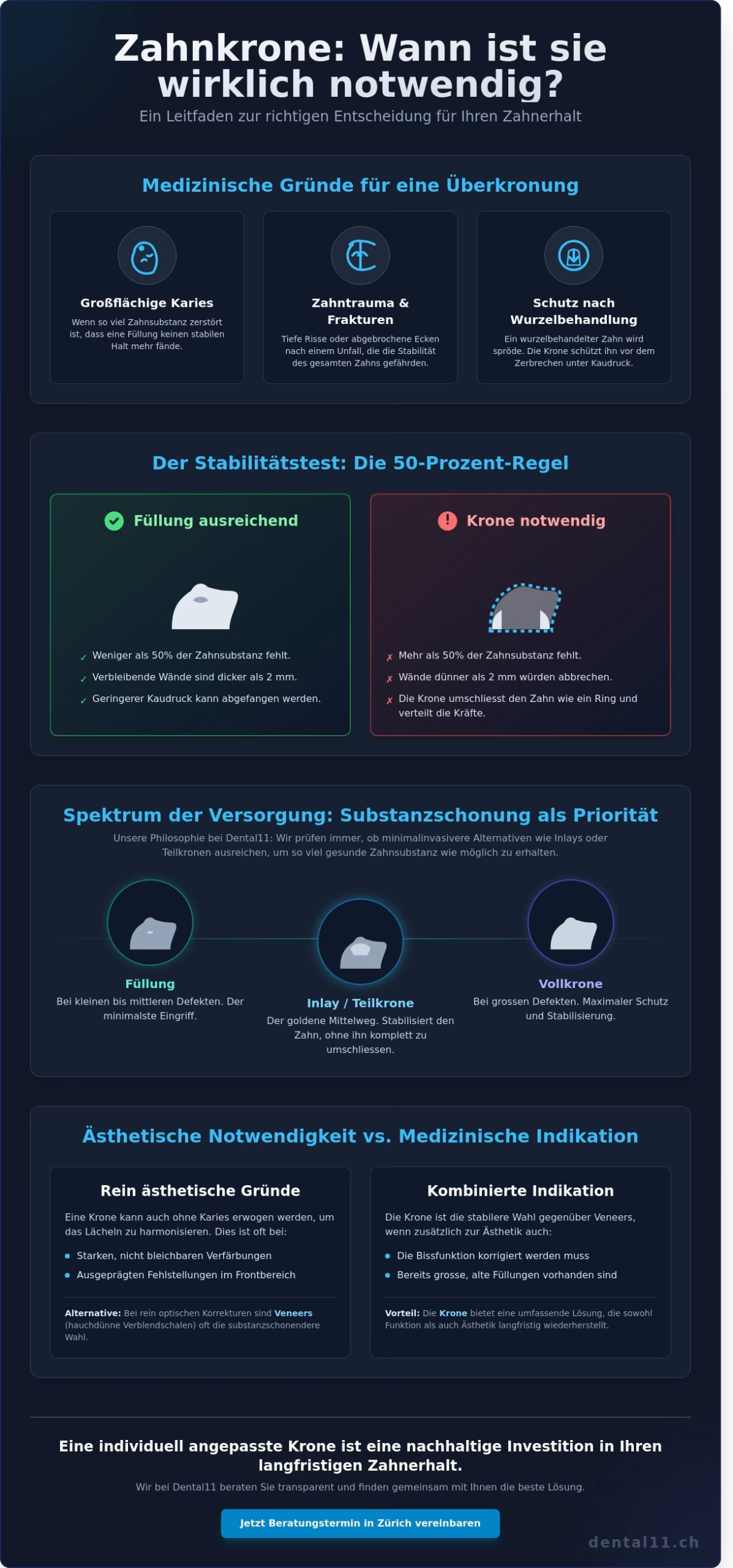
A dental crown functions like a custom-made protective cap for your tooth. It is used whenever the natural tooth structure is so weakened that a conventional filling no longer provides sufficient support. What is a dental crown? At its core, it is a fixed dental restoration that fully restores the shape, function and aesthetics of a damaged tooth. In our practice in Zurich, we see patients every day for whom a dental crown becomes necessary to ensure the tooth’s long-term preservation and prevent impending tooth loss.
There are three primary medical reasons why we recommend this treatment:
- Extensive tooth decay: When bacterial destruction has progressed so far that there is no longer enough healthy structure for a stable filling.
- Dental trauma and fractures: After accidents or biting on hard objects, deep cracks can form in the enamel, jeopardising the stability of the entire tooth.
- Protection after root canal treatment: A root-treated tooth becomes brittle over time because it is no longer supplied from within. A crown protects it from simply breaking under load.
The stability test: When fillings fail
A tooth’s structural stability is crucial for its ability to withstand chewing forces. In modern dentistry, we often apply the so-called 50% rule. If more than half of the natural tooth structure is missing, or the remaining side walls are thinner than two millimetres, a filling is usually no longer sufficient. The chewing pressure—especially in the molar region, where peak forces can be enormous—would simply shear off the thin walls without protection. A crown, by contrast, encloses the tooth like a stable ring and distributes the forces evenly across the entire structure. This significantly improves the long-term prognosis. A well-maintained crown can often stabilise the tooth for two decades or longer.
Aesthetic necessity vs. medical indication
Sometimes a dental crown is necessary even though there is no acute decay. Severe discolouration that can no longer be corrected with professional whitening, or pronounced misalignments, can be an indication. Especially in the front teeth, a harmonious smile is crucial to many patients’ self-confidence. We often compare this with veneers. While veneers are ultra-thin shells for purely cosmetic corrections, a crown is the much more stable choice when the bite function also needs to be corrected or when larger old fillings are already present. In Zurich, we advise you transparently on the different materials so that the crown blends seamlessly into your row of teeth.
Note: This article is for general information only and does not replace an individual dental examination or specific medical advice.
Tooth preservation: Why we at Dental11 always review all alternatives first
Our philosophy at Dental11 in Zurich is clear: preserving your natural tooth structure is our top priority. Every milligram of healthy enamel is valuable and cannot be replaced identically by any artificial material. Many patients come to us worried that grinding down a tooth for a crown is akin to an “amputation” of the tooth. We take these concerns seriously. We never prepare a tooth lightly. We do everything we can to find minimally invasive ways to stabilise your tooth structure without removing unnecessary tissue.
That is why we always clarify whether a dental crown is necessary according to the principle of proportionality. We carefully assess whether alternative restorations such as partial crowns or onlays are sufficient to restore function. We only recommend a crown when the tooth’s structural load-bearing capacity can no longer be ensured. Medical specialist portals such as the Cleveland Clinic point out that a restoration becomes medically necessary when there is a risk of a fracture that could cost the entire tooth. In such cases, the crown serves as a protective shield that holds the remaining tooth together.
Digital precision in Zurich Enge
In our practice in Zurich Enge, we do not rely on vague estimates. We use high-resolution digital images and intraoral scanners to assess the condition of your teeth. This technology replaces the classic impression with impression material, which is often perceived as unpleasant. Digital scans allow us to plan with micrometre precision. We show you the damage directly on the monitor and explain each step transparently. This visualisation helps you understand why a dental crown may be necessary or which alternatives are still possible.
Thanks to precise digital capture, we achieve excellent margin detection. This is crucial to prevent secondary decay at the transition between tooth and crown. The more accurately the crown fits, the longer-lasting the result. We combine this technology with minimally invasive preparation techniques. We use special magnifying loupes and fine instruments to remove only as much tooth structure as is technically absolutely necessary.
When a filling is still the better choice
For smaller defects or early-stage decay, high-quality composite fillings are often the more sensible solution. These materials allow us to repair the tooth while preserving tooth structure. You can find detailed information in our article on dental filling materials. However, fillings reach their limits when the mechanical load during chewing becomes too great. If more than 50% of the natural crown is missing, a filling can no longer reliably dissipate chewing forces. The tooth could break under the load.
The decision always depends on the individual situation and the remaining stability. We weigh the benefits and risks for you so that you can make an informed choice. If you are unsure whether your tooth can still be saved with a filling, we will be happy to advise you personally in our practice. You can easily book an appointment online to have your situation professionally assessed.
This article is for general information only and does not replace an individual dental examination. The optimal treatment depends on your individual findings.
Crown or alternative? Inlays and partial crowns compared
Not every type of damage immediately makes a full dental crown necessary. In modern dentistry in Zurich, we increasingly rely on minimally invasive procedures to preserve as much natural tooth structure as possible. Inlays and onlays are used when decay or a fracture is extensive, but the load-bearing tooth walls are still stable enough. These laboratory-made ceramic restorations offer a precision of fit that is hardly achievable with conventional filling materials.
The partial crown represents the golden middle ground. It is chosen when the chewing surface is already significantly affected, but the side walls of the tooth are still intact. Before we make a decision, various alternatives can be considered to find the most sensible solution for you. The choice of material is crucial for later durability and aesthetic integration:
- Zirconia: This material is extremely fracture-resistant and biocompatible. It is ideal for the posterior region, where high chewing forces act.
- Glass-ceramic: It offers the highest aesthetics thanks to its natural light refraction. It is ideal for visible areas in the upper and lower jaw.
- Gold alloys: Gold is the classic in dental technology. It is extremely durable and gentle on opposing teeth, but for aesthetic reasons it is used less often today for visible teeth.
Comparison: Full crown vs. partial crown
The key difference between these two restorations lies in the degree of tooth reduction. With a full crown, we have to prepare the tooth all around, which often means a loss of around 60% to 70% of the natural hard tissue. A partial crown, by contrast, preserves healthy areas and, in particular, maintains the natural transition to the gumline. In terms of price, both options in Switzerland are often in a similar range, as the laboratory work involved is comparably extensive. For a high-quality restoration in Zurich, expect costs starting at around CHF 1,200 per unit. While stability is the focus in the molar region, for incisors we usually prefer full crowns or ultra-thin veneers for a harmonious overall appearance.
Durability of dental restorations in Switzerland
Dental restorations made in Switzerland are renowned worldwide for the highest precision. However, how long a crown or partial crown lasts is not a matter of chance, but the result of material quality and home care. On average, modern ceramic crowns last 15 to 20 years—often significantly longer. The exact dental crown lifespan depends largely on how consistently the crown margins are cleaned. Bacterial plaque at the transition between crown and gum can lead to secondary decay. Regular professional dental hygiene in our practice is therefore the best insurance for your restoration. This ensures the fit remains stable and inflammation is prevented early.
This article is for general information only and does not replace an individual dental examination. Whether a treatment is suitable depends on your personal medical situation.
The decision process: How the consultation at Dental11 works
The path to a stable and aesthetic restoration begins with a clear process. In our practice in Sihlcity, we take the time your dental health deserves. Whether a dental crown is necessary cannot be decided in passing. It requires precise diagnostics and an open conversation about your expectations.
- Step 1: Comprehensive clinical examination and medical history: We analyse the condition of the affected tooth and the surrounding tissue. Using high-resolution digital images, we obtain an accurate picture of the tooth structure.
- Step 2: Transparent information: We explain the advantages and disadvantages of different materials. We also speak openly about possible risks and the long-term prognosis for your tooth.
- Step 3: Individual treatment and cost plan: You receive a detailed breakdown of all services. We calculate fairly according to the official SSO tariff of the Swiss Dental Association.
- Step 4: Joint decision: We do not pressure you into treatment. You decide at your own pace which path is right for you.
Transparent cost planning for patients in Zurich
The costs of dental services in Switzerland are clearly regulated by the SSO tariff. The total price is made up of the practice’s tariff point value, the complexity of the procedure and the laboratory costs for producing the crown. We place great importance on ensuring there are no hidden fees. If a dental crown becomes necessary and complex rehabilitation is required, we are happy to discuss individual instalment payment options. This keeps your oral health financially predictable and transparent, even for demanding treatments.
Anxious patients and comfort during treatment
We know that the thought of a crown can cause discomfort for many patients. That is why our practice philosophy focuses on particularly empathetic care. We create a calm atmosphere in which your concerns are taken seriously. Modern anaesthesia methods enable a gentle experience tailored to your individual needs. We explain every step of the treatment in advance. It is important to us that you feel safe and well informed at all times. We take plenty of time for your questions, because trust is the basis for every good outcome.
This article serves for general information and does not replace individual dental examination.
Conclusion: Your path to long-term tooth preservation in Zurich Sihlcity
Choosing a dental restoration is always an investment in your quality of life and long-term health. When a dental crown becomes necessary depends largely on the extent of damage to your natural tooth structure. When extensive fillings reach their structural limits, a crown provides the necessary protection to effectively prevent impending tooth loss. In our practice in Zurich, we do not view a crown as an isolated repair, but as part of a sustainable concept. A high-quality all-ceramic restoration can, with conscientious care, remain stable in your jaw for many years—often even decades.
Preserving your own teeth is the foundation of our daily work at Dental11. We use state-of-the-art methods to preserve as much healthy structure as possible. Nevertheless, there are clear clinical situations in which a crown is the smartest medical choice to restore full chewing function and natural aesthetics. We place great importance on fair conditions and transparent cost planning in CHF. This way, even before treatment begins, you know exactly what investment to expect—without hidden fees burdening your recovery process.
In addition to technical precision, regular preventive care is the most important factor for success. Even the best dental work needs a healthy environment. Through professional teeth cleanings and close follow-up checks, we ensure that your crown and the surrounding gums remain healthy. Our central location directly in Sihlcity (District 2) makes it easy to integrate these important appointments into your daily routine—whether during your lunch break or after work.
Why Dental11 is the right choice for your dental crown
We combine high-resolution digital diagnostics with genuine human empathy. Our goal is treatment that is tailored to your needs—especially if you have previously been hesitant about visiting the dentist. Thanks to modern intraoral scanners, you can avoid the often unpleasant conventional impression material. We create a respectful atmosphere in which we explain every step and communicate with you as an equal. Our team is international and looks forward to welcoming you to our modern practice.
Next steps: Book a consultation appointment
Are you unsure whether a dental crown is necessary in your current situation? We warmly invite you to obtain a non-binding second opinion with us. In a calm consultation, we analyse your findings and show you all available options, including possible alternatives to a crown. Transparency is our promise to you. Use our simple online tool to book your appointment directly and conveniently.
Note: This article is for general information and does not replace individual medical advice or an examination. The actual medical necessity of a treatment can only be determined through a personal diagnosis.
Your path to long-term dental health in Zurich Sihlcity
At Dental11, we always prioritise preserving your natural tooth structure. A crown is often the safest solution to stabilise severely damaged teeth in the long term and protect them from further fracture. Nevertheless, our experts carefully assess in each individual case whether tooth-preserving alternatives such as inlays or partial crowns are sufficient for your situation. State-of-the-art digital technology supports us in making precise diagnoses and finding the treatment option that is right for you.
We make the decision together as to whether a dental crown is necessary after a thorough consultation. You benefit from transparent cost planning with no hidden fees and particularly empathetic care from our experienced dentists. Located right by Sihlcity in District 2, we offer you a calm atmosphere where your needs are the focus. We ensure that you feel safe and well informed at every step.
Book an appointment for a consultation in Zurich Sihlcity now
We look forward to welcoming you personally to our modern practice soon and working together to support your sustainable oral health. This article is for general information only and does not replace an individual dental examination.
Frequently asked questions about dental crowns
Is inserting a dental crown painful?
Treatment for a dental crown is usually carried out under local anaesthesia, so you will hardly feel anything during preparation and placement. After the appointment, the tooth may be slightly sensitive to cold or heat for about 2 to 3 days, which is completely normal. At Dental11, we place great importance on empathetic care and a calm atmosphere to make your visit as pleasant as possible.
How long does it take for a dental crown to be completed?
In most cases, we need two appointments about 7 to 14 days apart to complete the treatment. At the first visit, we prepare the tooth and take a precise digital impression; at the second appointment, you receive the final crown. Thanks to modern digital technology, we can often avoid the unpleasant impression material, making the entire process significantly more comfortable and efficient for you.
Can you still get tooth decay under a dental crown?
Yes. Decay can develop at the transition between the gum and the crown margin if bacteria are not thoroughly removed there. Around 10% of all crowns have to be replaced within 15 years due to secondary decay at the margin. Careful oral hygiene with interdental brushes and regular professional teeth cleanings are therefore crucial to keep the tooth under the restoration healthy in the long term.
What happens if I do not have a necessary crown done?
If a dental crown is necessary and treatment is postponed, the unstable tooth may fracture under everyday chewing forces. A deep fracture can mean the tooth has to be removed completely, often resulting in more complex treatments such as bridges or implants. Timely restoration protects the remaining tooth structure and helps you avoid unnecessary pain from inflammation or exposed tooth nerves.
Does health insurance in Switzerland cover the costs for a dental crown?
In Switzerland, mandatory basic health insurance (KVG) covers the costs of crowns only in rare exceptional cases, such as severe, unavoidable diseases of the chewing system. In most cases, patients pay the costs themselves or use private supplementary dental insurance, which—depending on the plan—covers 50% to 80% of the bill. We always provide you with a transparent cost estimate in CHF in advance so that you have full planning certainty for your investment.
How can I tell myself whether my tooth needs a crown?
A clear sign that a dental crown may be necessary is very large fillings that have already been repaired several times, or fine cracks in the enamel. If you feel a sharp pain when biting down, or if more than 50% of the natural tooth structure has already been lost, a conventional filling often no longer provides enough stability. We can provide a reliable diagnosis using high-resolution digital diagnostics directly at our practice in Zurich.
Is there a guarantee on the crown’s durability at Dental11?
In Switzerland, statutory guarantees for medical services are not common, as treatment outcomes depend on individual factors. However, we use only high-quality materials and precise digital procedures, meaning a well-maintained crown lasts on average 10 to 15 years or longer. We support you with regular check-ups to optimise the longevity of your restoration through careful preventive care.
What is the difference between a crown and an implant?
A crown protects and stabilises your own tooth that is still present, while an implant is an artificial root that replaces a completely missing tooth. We always prefer preserving your natural tooth structure as long as your own root is healthy and firmly anchored in the jaw. An implant is only used when a gap needs to be closed or when the tooth can no longer be saved due to severe damage.
This article is for general information purposes only and does not replace an individual dental examination. Actual results and costs may vary depending on the individual case.