Root canal treatment consists of four steps: local anaesthesia, isolating the tooth with a rubber sheet (rubber dam), cleaning and disinfecting the root canals and, finally, a filling that seals out bacteria. A session takes 60 to 90 minutes; two appointments are usually needed. At Dental11 in Zürich Enge, root canal treatment costs from CHF 650, depending on the tooth and the number of canals. The treatment is carried out under local anaesthesia and is generally well tolerated.
In this article we show you what happens in each step, how long it takes, what it costs and what to look out for afterwards. From precise 3D diagnosis to healing, we keep every step transparent for you.
Key points
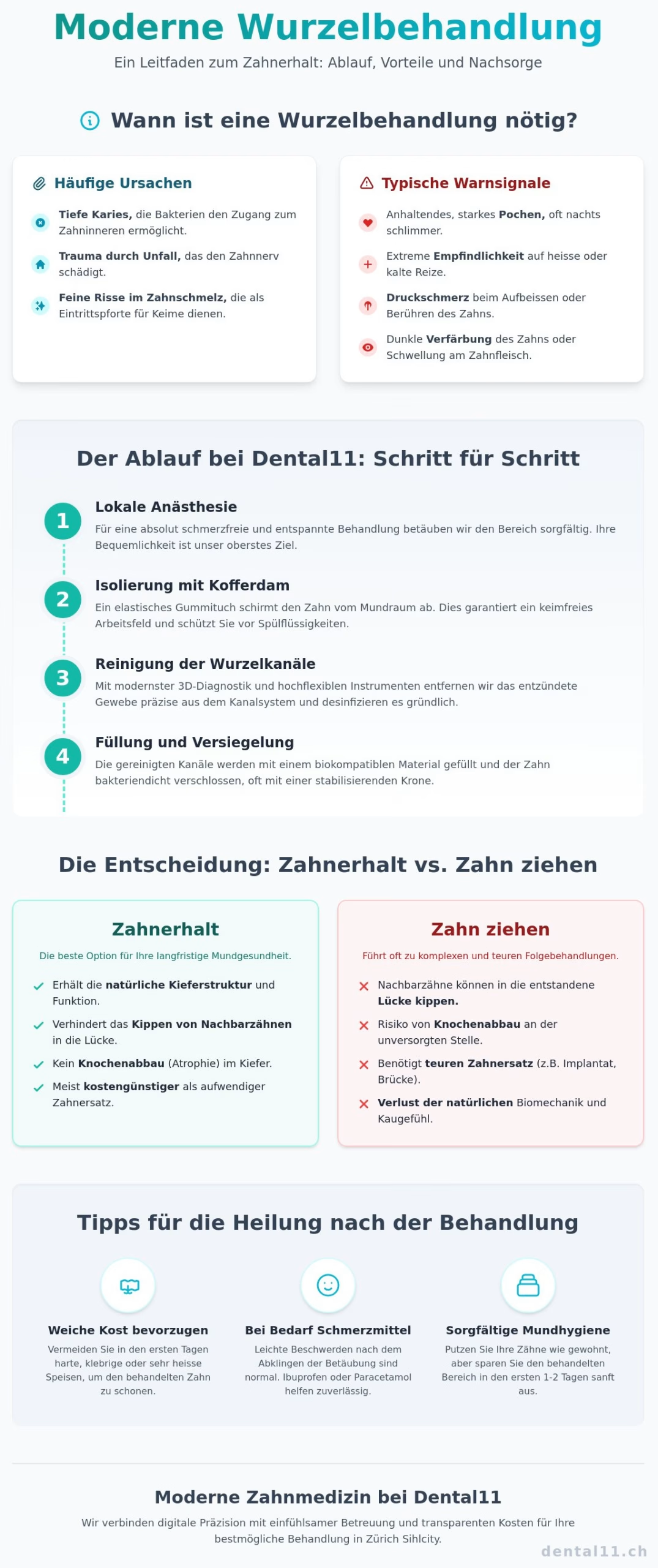
- Four steps: anaesthesia, rubber dam, cleaning and disinfecting the canals, filling.
- Duration: 60 to 90 minutes per session, usually two appointments with a medicated dressing in between.
- Costs at Dental11: from CHF 650; a subsequent crown from CHF 1’400. For comparison: extraction from CHF 180, implant with crown from CHF 4’600.
- Typical warning signs: throbbing at night, pain when biting, sensitivity to heat and cold, swelling.
- Afterwards: only eat once the anaesthetic has worn off; tenderness to pressure for a few days is normal.
Why root canal treatment? Understanding causes and symptoms
Root canal treatment is often the last way to save a natural tooth for the long term. In endodontics we focus on the inside of the tooth, known as the pulp. When bacteria reach this area, inflammation can develop that may damage the nerve. Root canal treatment is a procedure in which the infected tissue is removed from inside the tooth so that the tooth can remain in the jaw. The entire procedure aims to stop the infection and preserve the tooth.
Patients often report specific warning signs that point to inflammation. Typical symptoms include:
- Persistent throbbing in the tooth, which often gets worse at night.
- Marked sensitivity to cold or hot food and drinks.
- Pain when biting down or a feeling of pressure in the jaw.
- Dark discolouration of the tooth or swelling of the gums.
The causes of such symptoms vary. Most often the trigger is deep decay that has broken through the protective enamel. Trauma from accidents or fine cracks in the enamel can also give bacteria access to the inside of the tooth. Waiting is not a good strategy in these cases. Without treatment, painful abscesses can form. In the worst case, chronic inflammation leads to loss of jawbone around the root of the tooth.
When is treatment in Zurich unavoidable?
At our practice, Dental11, we use high-resolution digital X-rays to assess the condition of your tooth roots accurately. This diagnosis is crucial for distinguishing between reversible and irreversible pulpitis. While mild irritation sometimes settles down, irreversible inflammation requires prompt treatment. Our main aim in modern dentistry is always to preserve your natural tooth structure, as no replacement can perfectly copy the biomechanics of a real tooth.
Root canal treatment or extraction: weighing up the options
Many patients wonder whether pulling the tooth would be the simpler solution. However, keeping the tooth offers clear benefits for the structure of your jaw. A missing tooth can cause neighbouring teeth to tilt into the gap or the bone in that area to recede.
A cost comparison also shows that root canal treatment is usually the more economical choice: at Dental11 it costs from CHF 650 plus a crown from CHF 1’400, whereas an implant with crown costs from CHF 4’600. At our practice at Waffenplatzstrasse 11 we take time for individual advice. We explain all the options transparently, so that you can make an informed decision about your oral health.
The root canal procedure at Dental11 in Zurich
Root canal treatment is often the last option for keeping a natural tooth for the long term. At our practice, Dental11 in Zürich Enge, we make sure that you feel safe and well informed throughout the process. Our procedure is divided into four steps.
- Step 1: Local anaesthesia. Before we begin, we carefully numb the affected tooth and the surrounding tissue. Our aim is to make the treatment as relaxed as possible for you. We wait until the anaesthetic has taken full effect.
- Step 2: Isolating the tooth with a rubber dam. We place an elastic rubber sheet around the tooth being treated. This protection is essential for keeping the area free of germs, as it prevents bacteria from saliva getting into the open tooth. At the same time, it stops you from swallowing rinsing solutions.
- Step 3: Opening and cleaning the root canals. We gain access to the canal system and remove the inflamed or dead tissue. Because the canals are often finer than a hair, we work under magnification. Removing all tissue remnants is crucial for long-term success.
- Step 4: Disinfection and a seal against bacteria. After mechanical cleaning, we rinse the cavities thoroughly. Once the tooth is fully disinfected, we fill the canals with a biocompatible material to prevent germs from getting in again.
Modern technology for precise work
At Dental11 we use digital tools to increase the accuracy of the treatment. We use electronic length measurement, which measures the course of the canal more precisely than a conventional X-ray. For anatomically difficult, strongly curved canals we use highly flexible nickel-titanium files. These instruments are less prone to breaking and follow the natural course of the root much better than rigid steel files. To reduce germs as far as possible, we use ultrasonically activated rinsing solutions. The vibrations help the liquid reach even the smallest branches that would be inaccessible mechanically.
Time required and number of sessions
A session usually lasts between 60 and 90 minutes. The exact time depends on the number of root canals and the complexity of the inflammation. Two appointments are often needed for long-term success. At the first visit we concentrate on relieving pain and the initial cleaning. A medicated dressing then usually stays in the tooth for a few days to eliminate any remaining bacteria. Only once the tooth is completely free of symptoms do we carry out the final seal. At our practice in Zürich Enge, appointments are available on Mondays and Tuesdays until 8 pm, so that the treatment fits into your daily routine.
You can arrange a consultation online via Book an appointment.
Keeping or losing the tooth? Root canal treatment compared
Many patients in Zurich wonder whether an implant might be the simpler solution. Modern dentistry, however, gives a clear picture. A natural tooth is hard to replace in terms of how it feels when chewing and how it is integrated biologically. When you compare the options, keeping your own tooth offers important advantages over replacements such as bridges or implants.
With carefully performed initial treatment, the prospects of success are high, and a root-treated tooth can last many years with good care. A bridge, by contrast, requires the healthy neighbouring teeth to be ground down, which means losing valuable tooth structure. An implant involves a surgical procedure and a healing period of usually 3 to 6 months. While the procedure at Dental11 is tailored to you, the aim always remains the same: to preserve your natural tooth structure as gently as possible.
A properly treated tooth can often last a lifetime with good care and regular preventive check-ups. It fits seamlessly into the dental arch and prevents the jawbone in that area from receding, as often happens after tooth loss.
The role of the crown after treatment
Once the inflamed tissue has been removed, the tooth is no longer vital. Over time it becomes more brittle and loses elasticity, which increases the risk of fractures. To ensure stability in the long term, a crown is usually the recommended solution. At Dental11 we prefer to use all-ceramic crowns. This material can be matched precisely to the colour of your neighbouring teeth and gives a natural-looking result. You will find detailed information in our guide to crowns and fillings in Zurich.
Repeat root canal treatment (revision)
Sometimes a tooth that has already had root canal treatment shows symptoms again years later, or inflammation at the root tip does not heal completely. In such cases a revision is a second chance for your tooth. The old filling material is carefully removed, and the canal system is cleaned and disinfected again. At our practice in Zürich Enge we use modern endodontic methods to treat complex cases as well. Even though a revision involves more work, the effort to keep your natural teeth is almost always worthwhile.
After treatment: tips for everyday life in Zurich
As soon as the actual treatment at our practice is complete, the important recovery phase begins. Your body needs time to resolve the inflammation completely. In the first few hours after the procedure, protecting the treated tooth comes first. Because the local anaesthetic affects your sensation, you should wait to eat until the numbness has completely disappeared. This way you avoid biting your cheek or tongue. Ideally, avoid strongly staining foods, very hot drinks and nicotine for the first 24 hours so as not to interfere with healing.
Most patients in Zurich can return to their normal routine the next day, often even straight after the appointment. For physically very demanding work or intensive sport, we recommend a short break of about 24 to 48 hours. This prevents your blood pressure from rising sharply and possibly causing throbbing around the tooth. Light exercise in the fresh air, on the other hand, is not a problem.
Managing pain and healing
It is normal for the tooth to be sensitive to pressure in the first few days after treatment. This mild discomfort can usually be controlled well with common pain-relieving medication. Home remedies such as gently cooling the cheek with a soft cloth can also help the tissue relax. When cleaning your teeth, take care to clean the treated area gently. An electric toothbrush can often be guided more delicately than a manual one.
However, if you develop severe swelling, fever or pulsating pain that does not ease despite medication, this is a signal from your body. In such cases a prompt check-up is advisable. Our guide explains what is normal with pain after root canal treatment and when you should see a dentist.
Practical information for patients in Zurich
Our practice is in Zürich Enge, a few minutes from Sihlcity and Enge station, and you can reach us during opening hours if you have urgent questions after the procedure. For us, root canal treatment does not end when you leave the treatment chair; aftercare is explicitly part of it.
Professional dental cleaning plays an important role in the long-term success of the treatment. Once the tooth has received its final restoration, we recommend attending regular preventive appointments. This protects not only the root-treated tooth but also supports your overall oral health. A clean mouth with few bacteria is effective protection against renewed inflammation.
Root canal treatment at Dental11 in Zürich Enge
Anyone looking into the root canal procedure is usually searching not only for medical facts but also for a practice that gives them a sense of security. This is where we start at Dental11 in Zürich Enge. Our approach combines digital precision with considerate care that puts people first. We know that keeping a natural tooth is a matter of trust. That is why we use modern technical aids such as high-resolution digital diagnostics to plan every step of the treatment as accurately as possible.
Transparency plays a central role at our practice, especially when it comes to costs. We bill according to the Swiss Dentotar tariff; root canal treatment costs from CHF 650, and the subsequent crown from CHF 1’400. Before treatment starts, we prepare a written cost estimate for you. This clear process ensures that you always keep full control over what you invest in your dental health. We avoid hidden fees and offer fair terms for all patient groups. Our price overview shows in detail how the costs of root canal treatment in Zurich are made up.
Our practice in Zürich Enge, a few minutes from Sihlcity and Enge station, is easy to reach by tram, S-Bahn and car. You are welcome to visit us for a consultation with no obligation. Together we discuss your individual situation and show you how we can keep your natural tooth in the long term.
Why Dental11 for your root canal treatment?
Our experienced team is known for patience and understanding. We take the time needed to answer all your questions about the procedure in detail and to address any anxieties. The calm atmosphere at our practice is a particular relief for patients with dental anxiety. We treat patients in German, English and Greek.
Next steps towards keeping your tooth
The path to healthy teeth starts with a first conversation. We make it as easy as possible for you to find the right time for your visit. You can book your appointment directly online through our system and secure a slot that fits your schedule. For more information about our approach and our values, we also recommend taking a look at our Zurich dentist guide. There you will learn more about our commitment to quality and transparency in modern dentistry.
Your next steps for keeping your teeth in the long term
Keeping your natural teeth is the foundation of long-term oral health. Thanks to modern technology, root canal treatment today is a precise process aimed at saving your tooth for the long term. A clearly structured procedure at Dental11 gives you orientation and security at every stage. We use high-resolution digital diagnostics to locate the fine canals accurately and clean them thoroughly.
Our team in Zurich places great importance on a relaxed atmosphere. We take plenty of time for your questions and guide you considerately through the appointment, so that you always feel in good hands. Billing is transparent and follows the Swiss Dentotar tariff. Because every medical case is different, the specific results, risks and costs always depend on your personal situation.
Take charge of your dental health now. We support you with professional expertise and modern equipment to help you preserve your smile. We look forward to welcoming you in person soon.
Book your consultation at Dental11 in Zürich Enge now
Frequently asked questions about root canal treatment
Is root canal treatment painful?
Thanks to local anaesthesia, modern root canal treatment is usually not painful. At Dental11 we place great importance on considerate care, so that you feel safe and relaxed throughout the procedure. The anaesthetic reliably switches off pain sensation in the affected area. After treatment you may notice a slight feeling of pressure, which usually fades by itself within a few days.
How long does the whole root canal procedure take?
The duration depends largely on the anatomy of your tooth and the degree of inflammation. In most cases we plan 60 to 90 minutes per session. Two appointments are often needed to disinfect the canal system thoroughly and then seal it tightly against bacteria. In complex cases a third session can be sensible to achieve a good result for keeping your tooth.
How much does root canal treatment cost in Zurich?
At Dental11, root canal treatment costs from CHF 650. The exact amount depends on the number of root canals and the level of difficulty: a molar with three or four canals takes more time than an incisor with one canal. A crown from CHF 1’400 is usually added. Billing follows the Dentotar tariff. After an initial examination we give you a transparent cost estimate, so that you keep full control over your expenses and benefit from our fair terms.
Can I drive or go back to work straight after the treatment?
You can normally return to your usual activities or drive straight after the appointment. It is important, however, to wait until the local anaesthetic has completely worn off. This usually takes two to four hours. During this time you should avoid hot drinks and solid food to prevent accidentally biting your lip or cheek.
What are the chances of keeping the tooth?
With carefully performed treatment, the chances of keeping the tooth in the long term are high, provided the canals are completely cleaned and tightly filled and the tooth is then stabilised with a crown. We use modern digital technology to increase precision and improve the chance of lasting healing.
What happens if I do not have the root canal treatment?
Without appropriate therapy, the bacterial infection spreads further into the jawbone. This can lead to severe pain, swelling or the formation of an abscess. In the long term, losing the tooth is unavoidable because the surrounding tissue is destroyed. There is also a risk that bacteria place a strain on other organs via the bloodstream. Timely treatment therefore protects not only your tooth but your overall health.
Does health insurance in Switzerland cover the costs?
In Switzerland, root canal treatment is usually not part of the benefits of compulsory basic health insurance (OKP). As a rule, the costs have to be paid privately, unless the treatment is the result of an accident or of a serious illness treated as equivalent to a congenital condition. If you have supplementary dental insurance, it will cover part of the costs depending on your policy. We are happy to help you clarify the cover with your insurer in advance.
How should I care for the tooth after treatment?
After treatment you should care for the tooth just as carefully as your healthy teeth. Thorough cleaning with a toothbrush and interdental brushes is essential to prevent new inflammation. Because root-treated teeth can become more brittle over time, we often recommend a crown later on for stability. Regular check-ups and professional teeth cleaning at our practice in Zurich help keep the treated tooth healthy in the long term.
This article is for general information only and does not replace an individual dental examination.