
An inflamed tooth nerve (pulpitis) shows itself through throbbing pain that gets worse when lying down and with warmth, and that hardly responds to painkillers. If the tooth reacts only briefly to cold and then settles again, the nerve can often still be saved by removing the decay and filling the tooth (from CHF 250). If the pain persists or comes on spontaneously, the nerve is irreversibly inflamed and only root canal treatment can keep the tooth: at Dental11 in Zürich Enge it costs from CHF 650, takes 60 to 90 minutes per session and usually needs one or two appointments. If the pain suddenly stops by itself, the nerve has usually died; the infection remains and still has to be treated.
This article explains the symptoms, the causes, how treatment works, what you can do until your appointment and what it costs.
Key points
- Symptoms: throbbing pain, worse when lying down and with warmth, a long-lasting reaction to cold or heat, pain when biting. Sudden freedom from pain usually means the nerve has died.
- Reversible pulpitis: removal of decay, filling (from CHF 250). Irreversible pulpitis: root canal treatment (from CHF 650), often followed by a crown (from CHF 1’400).
- Procedure: anaesthesia, opening the tooth, cleaning and disinfecting the canals, electronic length measurement, tight filling. 60 to 90 minutes, one or two sessions.
- Dental11 Zürich Enge: Monday to Friday, call us if you are in pain. Weekends and nights: emergency dental service of the Canton of Zurich, 0800 33 66 55.
- Costs according to Dentotar; basic health insurance does not pay, instalment payment is possible through the Zahnärztekasse.
Symptoms of an inflamed tooth nerve: how to recognise pulpitis
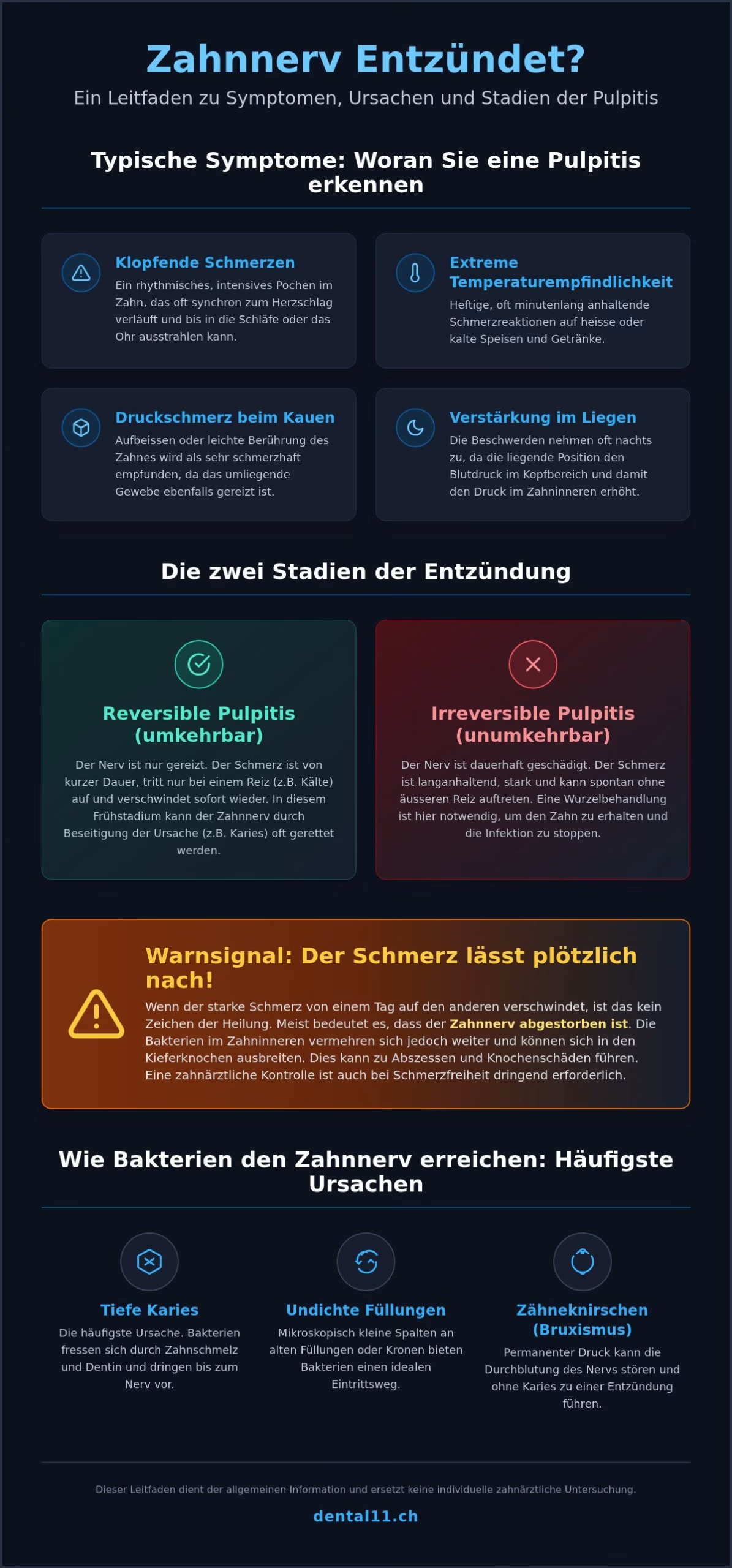
An inflamed tooth nerve rarely announces itself quietly. It usually starts with a slight twinge that within a short time turns into severe, throbbing pain. This pulsing often follows the rhythm of the heartbeat and makes it very hard to concentrate. Because the inflamed tissue inside the tooth swells but has no room to expand within the hard tooth structure, high pressure builds up inside. This pressure is the main cause of the distressing symptoms.
Typical signs that the inflamed tooth nerve needs treatment are:
- Throbbing pain: a rhythmic pounding that often radiates to the ear or temple.
- Marked sensitivity to temperature: strong reactions to hot coffee or cold drinks, with the pain often lingering for minutes.
- Pain that worsens when lying down: many patients report that the symptoms increase at night. Lying down raises blood pressure in the head, which further increases the pressure inside the tooth.
- Pain on pressure when chewing: biting becomes an ordeal, because the tooth and the surrounding tissue are highly sensitive.
The difference between reversible and irreversible pulpitis
In dentistry we distinguish between two stages of inflammation. Pulpitis is considered reversible if the nerve reacts only briefly to stimuli such as cold and then settles again. At this early stage we can often still save the nerve by removing the cause, for example decay. With irreversible inflammation, on the other hand, the pain persists or occurs spontaneously without an external trigger. In this case root canal treatment is unavoidable to keep the tooth in the jaw for the long term. An early diagnosis at Dental11 in Zürich Enge makes it considerably easier to save the tooth and prevents unnecessary complications.
When the pain suddenly eases: a warning sign
Many patients feel relieved when severe pain disappears from one day to the next. But be careful: in this case, freedom from pain is not a sign of healing. It usually means that the tooth nerve has died. This is referred to as a “dead tooth”. The bacteria inside the root canal do not disappear, however. They continue to multiply and can spread beyond the root tip into the jawbone. There, painful abscesses or chronic inflammation can develop and damage the bone over time. Even if you have no acute symptoms at the moment, an X-ray check with us is essential to stop the infection from spreading.
With these symptoms you should not wait until the pain becomes unbearable; make an appointment so that we can find the cause promptly.
Causes of inflammation: how bacteria reach the tooth nerve
A healthy tooth is built like a well-protected fortress. The hard enamel and the dentine beneath it protect the living interior, the tooth nerve, from external influences. If this protective layer is damaged, however, bacteria can enter easily. So that treatment of the inflamed nerve can be targeted, we first identify at our practice in Zürich Enge exactly how the bacteria got in. These are often gradual processes that go unnoticed for months or years.
Besides classic decay, leaking filling margins or old crowns can also become a problem. Over time, microscopically small gaps form there. They provide ideal conditions for bacteria that a toothbrush can no longer reach. Mechanical strain also plays a significant role. People who grind their teeth at night (bruxism) put the tissue under considerable pressure. This constant stress can disturb the blood supply to the nerve and eventually lead to inflammation, even when there is no decay.
Decay as the main cause of nerve damage
In most cases, deep decay paves the way for an infection of the pulp. The bacteria produce acids that eat their way first through the enamel and then through the softer dentine. As soon as the decay bacteria reach the fine tubules in the dentine, the nerve is not far away. Regular professional dental cleaning in Zurich markedly reduces the risk of such deep defects. Professional cleaning removes plaque even from hard-to-reach areas before it can permanently damage the enamel.
Trauma and cracks: when the tooth looks healthy from outside
Sometimes the cause is not a lack of care but a mechanical event. A fall during sport or a blow to the jaw can cause hairline cracks in the enamel. These fractures are often so fine that they cannot be seen in the mirror, yet they still let bacteria in. In modern dentistry we use high-resolution diagnostics to detect such microscopically small cracks. If a tooth suddenly becomes sensitive even though it looks intact from outside, caution is advised. An early check can help stop the inflammation in time.
Chemical irritants or strong heat during extensive dental treatment can also irritate the nerve. As every tooth reacts differently, a careful review of the history is essential. If you are unsure whether an old defect or a grinding problem is causing your symptoms, you can make an appointment with us at any time to get clarity.
Treatment at Dental11: modern endodontics to save your tooth
Once the diagnosis has been made, the main goal of our practice in Zürich Enge is to preserve your natural tooth structure. Modern treatment of an inflamed tooth nerve, also called endodontics, is today a highly precise procedure that goes well beyond the methods of earlier decades. For us, every tooth is individual and worth keeping. With current technology we can thoroughly clean even complex, branched root canal systems and so lay the foundation for long-term stability.
The success of the treatment depends largely on removing the infected tissue completely. For this we use flexible, machine-driven nickel-titanium instruments that adapt gently to the natural curvature of your root canals. At the same time we use modern, sonically activated irrigation solutions. These reach even the smallest side canals that conventional instruments cannot access, and neutralise the remaining bacteria there.
Digital diagnostics and precision in Zürich Enge
Visibility is a decisive factor for the quality of our work. In modern root canal treatment we do not rely on the naked eye or estimates. High-resolution digital X-rays give us a precise picture of the anatomy beforehand, while the radiation dose is considerably lower than with analogue methods. During the procedure we use electronic length determination. This digital measuring method determines the exact depth of the root canal to within a fraction of a millimetre. This precision is essential, because only a canal that has been cleaned and filled right up to the root tip offers lasting protection against new inflammation.
The procedure: what to expect during treatment
We place great importance on a calm atmosphere in which you can feel at ease. First, the affected area is numbed with local anaesthesia, so that you will feel little of the actual procedure. Once the anaesthetic has taken effect, we create an access to the inside of the tooth. The time needed varies with the number of root canals and the degree of inflammation; we usually plan 60 to 90 minutes per session. In some cases two appointments are necessary so that a medicated dressing can take effect before the tooth is finally sealed.
After complete disinfection, the canals are sealed tightly against bacteria with a biocompatible material (gutta-percha). Since a root-treated tooth can become more brittle over time, we then discuss with you whether a crown or partial crown makes sense to secure its stability in the long term. If you have acute symptoms, you can book an appointment directly for an initial assessment.
Rubber dam: the tooth is isolated
During treatment we place a thin rubber sheet (rubber dam) around the tooth. It keeps saliva, and with it new bacteria, out of the opened canals and prevents you from swallowing irrigation solution. For you this means that you can breathe normally through your nose and swallow during the session, and your mouth stays dry. The flexible nickel-titanium instruments also follow curved canals; if needed, a medicated dressing is placed and the tooth is temporarily sealed until the second appointment.
After an accident, accident insurance pays
If the nerve has died after a fall, a blow or biting on something hard, accident insurance (UVG, or the accident cover of your health insurance if you are not employed) usually covers the root canal treatment and the crown. Report the accident promptly and have the tooth documented, even if it does not hurt yet: a nerve can die months after the trauma, and without an accident report the connection is difficult to prove later on.
Emergency toothache: prompt help in Zürich Enge
Acute toothache rarely keeps to office hours or appointment schedules. When the throbbing in the jaw becomes unbearable and radiates into the temples, quick action is needed. Our practice Dental11 is located at Waffenplatzstrasse 11 in Zürich Enge, a few minutes from Sihlcity and Enge station (tram 5, 13, 17 to Waffenplatzstrasse). From Monday to Friday we try to treat patients in pain on the same day; please call us for this. At weekends and at night, the dental emergency service of the Canton of Zurich on 0800 33 66 55 refers you to the practice on duty.
Many patients first try to bridge the time with over-the-counter painkillers. This is understandable in the short term, but it carries a risk. Medication only fights the symptom; it does not cure the bacterial cause inside the tooth. It masks the pain while the inflammation continues to progress beneath the surface. Without professional treatment of the inflamed nerve, the infection can spread to the jawbone or lead to an abscess. Treating it early is therefore a safe way to keep your natural tooth in the long term.
The emergency appointment at Dental11
At an emergency appointment we focus first on relieving the pain straight away. By opening the tooth in a targeted way under local anaesthesia, we relieve the high pressure on the nerve tissue. This step often brings immediate relief. Urgent action is needed especially with marked swelling in the face or fever, as these can be signs that the infection is spreading through the body. If you have swelling with fever, or difficulty breathing or swallowing, you should go to a hospital emergency department. If you have acute symptoms, please call us; for appointments that can be planned, you can book online.
Tips to bridge the time until treatment
Until you reach our practice, simple measures can help to influence the intensity of the pain. Gently cooling the affected cheek from the outside narrows the blood vessels and can slightly reduce swelling. Avoid direct contact of ice with the skin or the tooth itself, however. It is also advisable to avoid physical exertion, sport and strong heat from a sauna or direct sunlight. Warmth increases blood flow and therefore often intensifies the throbbing pain. These tips are only meant to bridge the time until treatment.
If you are unsure whether your case is an emergency, do not hesitate to contact us. We will assess your situation professionally and make sure that you receive the right help as quickly as possible.
Costs and transparency: investing in keeping your tooth
For many patients in Switzerland, uncertainty about the costs adds to the burden of the toothache itself. At our practice Dental11 in Zürich Enge we deal with this subject openly. Careful treatment of an inflamed tooth nerve is an investment in your long-term oral health. It is important to us that you know exactly what financial framework to expect before the first treatment step. Every treatment is based on thorough diagnostics and an individual treatment plan.
The question often arises whether root canal treatment makes economic sense compared with removing the tooth and placing an implant. Keeping the tooth does involve costs at first, but in the long term it is usually the more affordable and biologically more valuable solution. An implant or a bridge often requires considerably more money and time. In addition, after successful endodontic treatment your natural chewing sensation is fully preserved, because the periodontal ligament with its sensitive nerve fibres remains in the jawbone.
Why keeping your own tooth is worthwhile
The biological benefit of your own tooth cannot be replaced. The fine receptors in the periodontal ligament tell the brain exactly how hard you can bite. This natural feedback is missing with artificial tooth replacement. As an experienced dentist in Zurich, we therefore do everything we can to save your natural tooth structure. Besides function, prevention plays a role: a preserved tooth prevents neighbouring teeth from tilting into gaps and the jawbone from receding due to lack of load. Root canal treatment at Dental11 costs from CHF 650; a molar with four canals costs more than a front tooth with one canal. The crown afterwards costs from CHF 1’400. For comparison: tooth extraction from CHF 180 plus an implant with crown from CHF 4’600.
Financial planning at Dental11
We bill according to Dentotar, the tariff of the Swiss Dental Association SSO. The total cost is made up of the number of tariff points multiplied by the practice’s tariff point value. In a cost estimate we list the individual items for you: root canal treatment from CHF 650, X-rays separately, crown from CHF 1’400. Basic health insurance does not pay; instalment payment is possible through the Zahnärztekasse.
If you have questions about the costs or would like a second opinion on a planned treatment, we will be glad to advise you in person at our practice in Zürich Enge.
Your path to lasting dental health and well-being
Thanks to modern endodontic methods, an inflamed tooth nerve is no longer a reason to give up a natural tooth too early. With digital precision and attentive care, we can successfully stop the infection in most cases and preserve your tooth structure. It is particularly important to take early warning signs such as throbbing or persistent sensitivity to temperature seriously. At Dental11 in Zürich Enge we offer you professionally sound treatment of the inflamed tooth nerve, with the long-term preservation of your teeth at its centre.
Our practice works with full cost transparency according to Dentotar: root canal treatment from CHF 650, crown from CHF 1’400. This way you can concentrate on your recovery without financial uncertainty. Whether it is an acute emergency or planned restorative work, our team looks after you with patience and expertise in a calm, welcoming atmosphere. Take an active role in your dental health to avoid complications early on. Make your appointment at Dental11 in Zürich Enge now and give your smile the professional attention it deserves. We look forward to welcoming you in person soon.
Frequently asked questions about an inflamed tooth nerve
Is treatment of an inflamed tooth nerve painful?
The treatment is carried out under effective local anaesthesia, so as a rule you will not feel pain during the procedure. Our aim at Dental11 is to relieve the acute pain of the inflammation straight away and to make the treatment as gentle as possible for you. Once the anaesthetic wears off, the tooth may be slightly tender to pressure for a few days; this can usually be managed well with common measures.
How long does healing take after nerve treatment?
The acute symptoms usually disappear right after the first session, once the pressure inside the tooth has been relieved. Full regeneration of the tissue at the root tip is a biological process that can take a few weeks or months, depending on how severe the infection was. During this time you will normally not notice any restrictions in daily life, provided the tooth has been sealed against bacteria.
What happens if an inflamed tooth nerve is not treated?
Without proper treatment, the bacteria spread unchecked through the canal system and eventually reach the jawbone. This can lead to painful abscesses, swelling in the face and progressive loss of bone. In the long term the tooth will be lost, which often makes more extensive follow-up treatment such as implants or bridges necessary to restore chewing function.
Can an inflamed tooth nerve heal on its own?
In irreversible pulpitis, a permanently inflamed nerve does not heal by itself, because the tissue inside the narrow root canal does not have enough capacity to heal. The pain may ease for a while when the nerve dies, but the infection inside the tooth remains and continues to put your health at risk. Only professional treatment of the inflamed nerve can remove the source of the bacteria for good and preserve the tooth.
Does insurance cover the cost of root canal treatment in Switzerland?
As a rule, compulsory basic health insurance does not cover root canal treatment, as it is considered a private service. Billing follows the Dentotar tariff; at Dental11, root canal treatment costs from CHF 650. If you have a supplementary insurance policy for dental care, part of the cost is often reimbursed. We recommend that you check this with your insurer in advance, and we are happy to prepare a cost estimate for you.
How many appointments are needed for a complete root canal treatment?
In most cases one to two appointments are enough for complete treatment. The exact number depends on the anatomy of your tooth, the number of root canals and how far the infection has progressed. In complex cases we plan an additional session so that a medicated dressing can take effect and reduce bacteria as far as possible before the final seal.
Can I eat and drink straight after the treatment?
You should wait until the local anaesthetic has completely worn off before eating, to avoid injury. Because sensation in your lips and tongue is temporarily reduced, you could otherwise bite yourself or burn yourself on hot food without noticing. Drinking is usually possible straight away, as long as drinks are not very hot or ice cold and do not irritate the treated area.
Are there alternatives to root canal treatment for pulpitis?
The only medical alternative to root canal treatment for advanced inflammation is removing the affected tooth. Since keeping your own tooth is almost always the better solution biologically and functionally, extraction is only considered if the tooth can no longer be restored. A missing tooth should be replaced promptly to prevent bone loss and teeth shifting out of position.
Can a root canal treatment be repeated?
Yes. If a root-treated tooth becomes inflamed again years later, because bacteria survived in a side canal or the filling has started to leak, we remove the old root filling, disinfect the canal system again and seal it once more (retreatment). If the inflammation at the root tip still does not heal, an apicoectomy remains as a surgical step. Both are often the last option for keeping the tooth.
Does a root-treated tooth turn dark?
Less often than in the past, because remaining tissue inside the tooth is now carefully removed. If a front tooth does turn grey, we lighten it from the inside with internal bleaching: the agent is placed inside the hollow tooth and changed after a few days until the colour matches the neighbouring teeth. A crown is not needed for this.
What helps healing after the treatment?
Wait until the anaesthetic has worn off before eating, avoid sport, alcohol and smoking on the day of treatment, and brush the tooth normally but gently.
This article is for general information only and does not replace an individual dental examination.