Clinically reviewed by MDDr. Polydefkis Papaioannou, dentist, Dental11 Zurich · Updated 10/2026
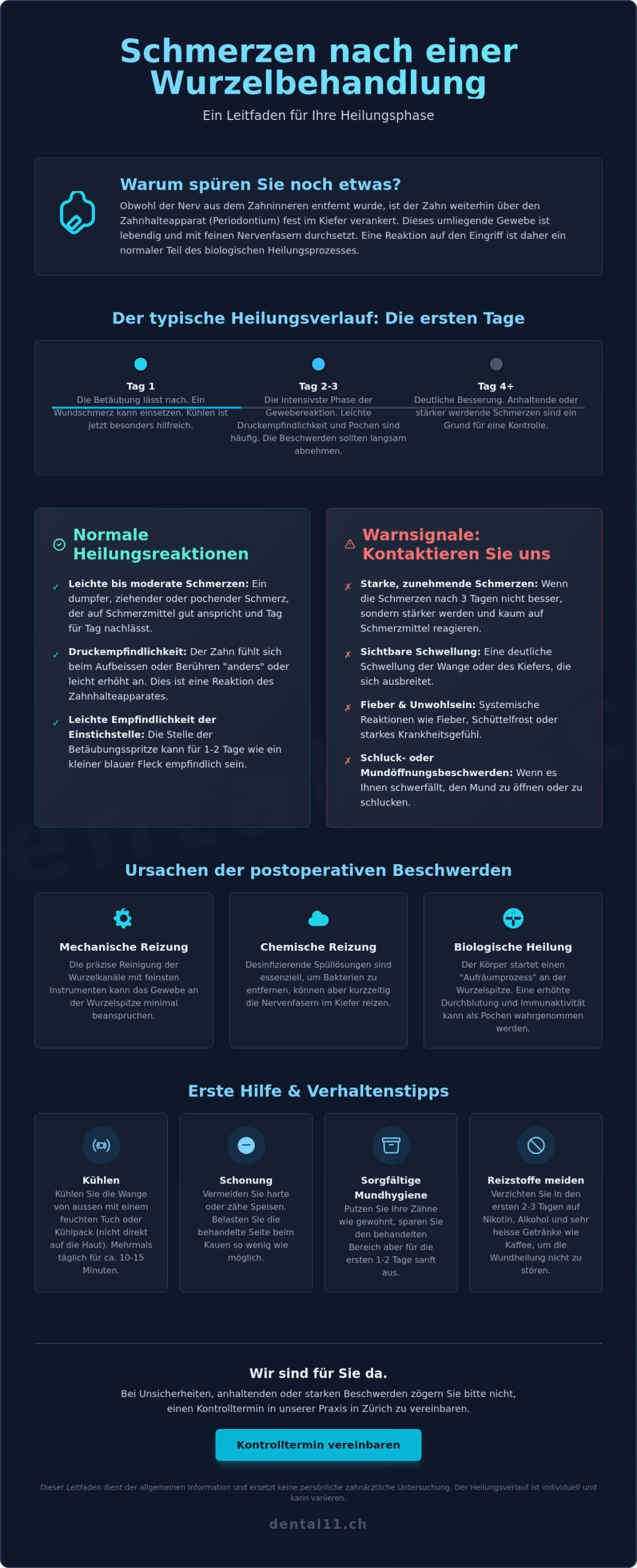
Mild to moderate pain after a root canal treatment is normal: tenderness when biting and a dull throbbing for three to seven days, strongest in the first 48 hours and then easing. Ibuprofen usually helps. Not normal, and a reason to call us: pain that gets worse again after an initial improvement, a swollen cheek, fever, or symptoms that have not eased after a week.
In this article you will learn which symptoms after a root canal treatment are part of the body’s natural healing process and when a visit to our practice in Zürich Enge is advisable. We explain how to interpret your symptoms, give clear criteria for a short-notice check-up and share gentle tips for relief at home. This gives you the reassurance you need during your recovery.
Key points
- Normal: tenderness and throbbing for three to seven days, less from day to day.
- Why: the nerve has been removed, but the periodontal ligament around the root tip is irritated and still senses pressure.
- Warning signs: pain increases again, swelling, fever, a fistula, painkillers do not work. In that case, call us.
- What helps: ibuprofen (not aspirin), cooling in 10-minute intervals, sleeping with your head raised, not chewing on the tooth, no nicotine.
- Dental11 Zürich Enge: reachable on Mondays and Tuesdays until 8 pm; a check-up after root canal treatment is part of the treatment.
Pain after a root canal treatment: why the tooth still “lives”
It is a common misconception that a root-filled tooth can no longer cause any sensation. The inflamed tissue inside, the pulp, has been removed, but the tooth remains firmly anchored in your jaw by the periodontal ligament. This surrounding tissue is very much alive and contains fine nerve fibres. Moderate pain after a root canal treatment is therefore normal and often simply a biological response to the procedure. The tooth itself is no longer vital, but its “surroundings” still react sensitively to changes.
Within the first 24 to 72 hours after your appointment at our practice, your body goes through the first phase of healing. During this time, the tissue at the root tip readjusts to the stimuli it receives. Moderate wound pain in this phase is no cause for concern. Rather, it shows that your body’s healing processes are active in stabilising the affected area. How intense this sensation is depends on your individual situation and on how severe the original inflammation was. If the symptoms continue beyond this period or become stronger, you can book an appointment to be safe and have your healing checked.
The role of the periodontal ligament
The periodontal ligament, known in technical terms as the periodontium, is a complex system of fibres and nerves. It contains specialised mechanoreceptors. These tiny sensors register pressure and touch very precisely. They are the reason you still feel it when you bite on the treated tooth. Even though the treatment has removed the source of pain inside the tooth, the periodontium continues to report mechanical loads to the brain. If the tissue around the root tip was irritated by a previous infection, these receptors are briefly oversensitive. This explains the often described “foreign body sensation” or increased sensitivity to pressure in the first days after treatment.
Irritation from the treatment itself
A modern root canal treatment is a precise procedure, but it does put strain on the surrounding tissue. To remove bacteria effectively, the canals have to be shaped mechanically with very fine files. This can cause minimal mechanical strain at the root tip. We also use disinfecting rinsing solutions to remove even microscopic germs. This chemical cleaning is essential for keeping the tooth in the long term, but it can briefly irritate the nerve fibres in the jawbone. Think of this temporary discomfort as part of your body’s necessary “clean-up process”. Modern endodontics in Zurich uses technology to keep these stimuli as low as possible, but some reaction of the tissue is biologically hard to avoid. Our separate article explains how an inflamed dental nerve develops and how it is treated.
Causes of discomfort: from throbbing to pain on pressure
As the local anaesthetic gradually wears off, various sensations often appear that can be unsettling for patients. In most cases this pain is normal and can be traced back to specific biological processes. It is important to distinguish between a dull throbbing, a sharp pain when biting down and muscular discomfort. Each of these symptoms has a specific cause in your body’s complex healing process.
A common reason for discomfort is the reaction to the local anaesthetic itself. The injection site can be tender for one to two days or leave a slight feeling of pressure in the tissue. This is comparable to a small bruise that hurts a little when touched. Pain in the first few days is usual, as long as it becomes less intense and is not accompanied by severe swelling.
Throbbing and pulsing: the biology of healing
A rhythmic throbbing in the jaw usually indicates increased blood flow. To fight the inflammation at the root tip and repair the tissue, the body widens the blood vessels in the jawbone. However, as bone is a firm tissue that cannot expand, the increased volume of blood creates noticeable internal pressure. Physical exertion or sport can briefly intensify this feeling, because blood pressure rises. As a rule, this throbbing should ease clearly within the first 48 hours. Individual variation is considerable; it depends largely on how pronounced the original infection was before the procedure.
Tension in the jaw and neck
People often underestimate how much the physical strain during the session affects the musculoskeletal system. A root canal treatment requires precision and time. Keeping the mouth open for a long time overloads the jaw muscles and the fine ligaments of the jaw joint. This can lead to radiating pain that extends into the neck or temples. In addition, psychological stress and the fear of losing the tooth often cause patients to grind their teeth unconsciously after the appointment. This puts additional stress on the already irritated periodontal ligament. Simple relaxation exercises, such as gently massaging the cheek muscles or applying mild warmth to the neck, can help here.
Normal healing vs. warning signs: when you should contact us
While moderate discomfort is normal in the first few days, it is important to watch how it develops over time. A healthy healing process is marked by symptoms that become noticeably less intense from day to day. If, however, you find that the pain suddenly increases again after an initial improvement or changes in character, you should pay attention. A reliable indicator is the so-called “night pain” test: if the pain becomes so intense that it keeps you from sleeping or wakes you at night, this usually points to a process that goes beyond normal wound pain.
Particular caution is needed if the pain is accompanied by general warning signs. Clear swelling of the gum or cheek, often described as a “swollen cheek”, and fever are clear alarm signals from your body. These symptoms can indicate an infection that is starting and needs to be assessed clinically without delay. If the symptoms persist unchanged for more than a week, we also recommend that you book an appointment to be safe. At our practice in Zurich, modern diagnostics allow us to determine quickly whether healing is progressing as it should. If symptoms only appear weeks after the treatment, read our article Pain weeks after a root canal treatment: possible causes.
Checklist for patients
Structured self-observation helps you assess your situation better. Use these three points as a guide:
- Pain intensity: rate how you feel on a scale from 1 to 10. A value that stays above 6 or increases should be checked.
- Medication: check whether common medicines such as ibuprofen or paracetamol reliably relieve the symptoms. If they have no effect despite correct dosage, this is a warning sign.
- Tissue check: look at your gum in the mirror. Watch for strong redness, small white bumps (fistulas) or fluid coming out.
Possible complications in detail
Although a carefully performed root canal treatment has good chances of success, there are biological factors that can make the process more difficult. In some cases, bacteria remain in microscopic lateral canals with very complex anatomical branching. An undetected vertical fracture of the tooth root can also cause persistent problems. Occasionally the jawbone reacts sensitively to slight overfilling or underfilling of the canal system. These factors are not a sign of general failure, but they often require fine adjustment or a retreatment to keep the tooth in the long term.
First aid and practical tips after the procedure
The time directly after you leave our practice is important for smooth healing. Even though slight pain is normal, your own behaviour can contribute considerably to reducing discomfort and supporting tissue recovery. Taking care of your body in the first 24 to 48 hours lays the foundation for keeping your tooth in the long term.
To keep the pressure in the jaw low, it is advisable to sleep with your upper body slightly raised on the first night. An extra pillow can already help to reduce blood flow to the head and so ease the throbbing. You should also avoid nicotine, caffeine and alcohol for at least 24 hours. These substances can affect blood flow negatively or increase the risk of bleeding, which delays healing unnecessarily.
Medication in Switzerland
In consultation with your dentist, taking anti-inflammatory painkillers can be useful. In Switzerland, ibuprofen is often used, as it not only relieves pain but also reduces swelling. It is important, however, to avoid products containing acetylsalicylic acid (such as aspirin), unless a doctor has explicitly prescribed otherwise. These substances thin the blood and can encourage bleeding in the treated area. If you have pre-existing conditions or regularly take other medicines, we discuss the right medication with you individually to rule out interactions.
Home remedies and gentle care
In addition to conventional medicine, gentle home remedies can provide good support. Rinsing with lukewarm sage or chamomile tea soothes irritated gums and supports disinfection in a natural way. Daily oral hygiene, however, calls for a gentle touch. For one to two days, avoid using an electric toothbrush directly on the treated area to prevent mechanical irritation. Clean between your teeth carefully with floss or interdental brushes, but leave out the area immediately around the affected tooth if it is still very sensitive to pressure.
Precision at Dental11: why we take pain seriously
At our practice in Zürich Enge, we understand that worrying about your tooth is often emotionally stressful. We therefore explain clearly to our patients to what extent moderate pain is normal. Our aim is to give you the reassurance you need through professional expertise and a calm atmosphere. We consistently make use of technological advances to reduce the causes of post-operative discomfort as far as possible during the procedure itself.
An important part of our precise way of working is cone beam computed tomography (CBCT). This modern 3D X-ray technology gives us a detailed view of your individual tooth and jaw anatomy. This allows us to detect even microscopic lateral canals or anatomical variations that often remain hidden on conventional 2D images. This diagnosis is complemented by machine shaping of the canals with highly flexible nickel-titanium files and ultrasonically activated rinsing solutions. This combination allows thorough cleaning right down to the root tip, which keeps the biological strain on the surrounding tissue to a minimum.
Your check-up in Zürich Enge
If you experience acute symptoms after your procedure that go beyond what is expected, we will not leave you on your own. Call us: we can be reached on Mondays and Tuesdays until 8 pm, and on Thursdays and Fridays from 8 am. At weekends, the dental emergency service of the Canton of Zurich can help on 0800 33 66 55. Whether it is an unexpected feeling of pressure or swelling that is starting, a prompt clinical assessment provides clarity and prevents complications. For non-urgent questions, you can use our online booking tool to arrange a check-up. We take the time to assess your symptoms professionally and, if necessary, start supportive measures straight away.
Long-term security through aftercare
For us, preserving a tooth does not end when the root filling is complete. The long-term stability of the treated tooth requires structured aftercare. This includes regular X-ray check-ups to verify objectively that the jawbone has healed. Equally important is including the tooth in your regular professional teeth cleaning in Zurich. Professional teeth cleaning not only protects the gums but also secures the foundation of your tooth. We place great importance on transparent costs based on the Dentotar tariff (root canal treatment from CHF 650, crown from CHF 1’400) and advise you in detail if a retreatment should be necessary in complex cases. Your oral health and well-being are at the centre of every step we take.
Working together to save your tooth: reassurance after treatment
Moderate discomfort in the first days after your procedure is often a sign that your body is actively healing. As we have seen, slight pain after a root canal treatment is normal, as long as it steadily subsides and is not accompanied by severe swelling or fever. With our experience in endodontics and modern CBCT X-ray technology, we can record the anatomy of your tooth precisely in advance to support your individual healing as well as possible.
If you are still unsure or notice warning signs that go beyond the usual, we will not leave you on your own. Our practice in Zürich Enge, a few minutes from Sihlcity and Enge station, is easy to reach, so that we can assess your situation professionally and give you reassurance. Book your appointment at Dental11 in Zürich Enge now, so that we can review your recovery together.
We accompany you with care and warmth through every stage of your treatment.
Frequently asked questions about healing
How long does pain usually last after a root canal treatment?
Mild to moderate discomfort usually lasts three to seven days. This time is needed for the tissue at the root tip to settle after the intensive procedure. Pain is normal in the first 48 hours; after that, however, the intensity should ease noticeably from day to day. If the symptoms continue unchanged after a week, a short check-up at our practice is advisable.
Can I eat or drink straight after the treatment?
You should definitely wait to eat until the local anaesthetic has fully worn off. As your lips and cheeks are temporarily numb, there is a considerable risk of injury from biting them without noticing. You can drink straight away, but avoid very hot drinks for the first few hours. These could increase blood flow in the treated area unnecessarily and make the throbbing in your jaw worse.
Why does it hurt when I bite down, even though the nerve has been removed?
The pain when biting does not come from the removed dental nerve but from the highly sensitive periodontal ligament. The fibres and receptors in the jawbone that hold the tooth in place continue to register mechanical pressure very precisely. If the tissue around the root tip is still irritated from the previous inflammation or the procedure, it reacts sensitively to any load. This sensation usually fades as the bone area heals.
What can I do if the swelling increases after the procedure?
Mild swelling can often be eased effectively by consistent cooling in ten-minute intervals. If the swelling increases considerably, feels hard or is accompanied by fever, however, please contact us straight away. These signs can point to an infection that requires supportive therapy or a clinical rinse to stabilise the healing process. We give such emergencies priority at our practice in Zürich Enge.
Which painkillers are most suitable, and which should I avoid?
Anti-inflammatory agents such as ibuprofen have proven effective for dental discomfort, as they act directly where the tissue is irritated. You should avoid painkillers containing acetylsalicylic acid (such as aspirin), as these inhibit blood clotting and can increase the risk of bleeding in the treated area. We discuss the exact choice of medication with you individually, taking into account your medical history and any allergies.
Can a root-filled tooth start hurting again years later?
Yes, symptoms can return even years after a successful treatment. Possible causes include new bacteria entering through a leaking crown, or fine cracks in the tooth root. In such cases, precise diagnosis with 3D X-ray imaging (CBCT) is essential to assess whether the tooth can be saved by a retreatment or other measures. Often the inflammation can be stopped again with modern procedures.
What can be behind pain that only appears weeks later?
If symptoms appear after a pain-free phase, the most common causes are: a filling or crown that is too high and makes contact first when you bite (this can be adjusted in a few minutes); a leaking temporary filling that lets bacteria back into the canal; a missed lateral canal or inflammation at the root tip that does not heal; a fine crack in the tooth; or a neighbouring tooth whose pain radiates. An examination with a bite check and an X-ray shows which of these applies. Make a note of when the pain started, whether chewing or cold triggers it and whether swelling has appeared; if there is swelling or fever, contact us the same day.
When does a root canal treatment need to be repeated (retreatment)?
A retreatment becomes necessary if the original inflammation at the root tip does not heal completely or if new germs enter the canal system. This can happen if anatomically complex lateral canals could not be reached during the first treatment because of technical limitations. The aim of retreatment is to remove the old root filling, disinfect the system thoroughly again and seal it tightly against bacteria, so that the tooth can be preserved in the long term.
Does health insurance in Switzerland pay for treating pain after the procedure?
In Switzerland, dental treatment is generally not covered by compulsory basic health insurance (OKP). Exceptions apply only to severe, unavoidable diseases of the masticatory system or after accidents. Patients with private supplementary dental insurance can submit the costs depending on their plan. We are happy to prepare a transparent cost estimate based on the Dentotar tariff, so that you can follow the financial side of your treatment in detail.
This article is for general information only and does not replace an individual dental examination.