Medically reviewed by MDDr. Polydefkis Papaioannou, dentist, Dental11 Zurich · Updated 10/2026
Three methods whiten teeth effectively: in-office bleaching at the practice (one session, from CHF 299 at Dental11), home bleaching with a custom-made tray over two to four weeks, and internal bleaching for a single root-canal-treated tooth. Under the Swiss FDHA Ordinance on Cosmetic Products, products sold over the counter may contain no more than 0.1% hydrogen peroxide; anything stronger belongs under the supervision of a dentist.
In this guide you will find out about current bleaching methods, how safe they are and how to choose the right approach for your situation. We give you a clear overview of the procedure and of the conditions for a responsible treatment.
Key points
- In-office bleaching: one session of 90 to 120 minutes, from CHF 299. Home bleaching: a tray worn over two to four weeks.
- Examination and dental hygiene first (CHF 99): tooth decay, leaking fillings and gum inflammation must be treated beforehand.
- Fillings, crowns and veneers do not become lighter; for deep discolouration or enamel defects, veneers are the alternative.
- Home remedies such as activated charcoal or lemon juice damage the enamel and do not whiten teeth permanently.
Understanding tooth discolouration: why a professional diagnosis matters
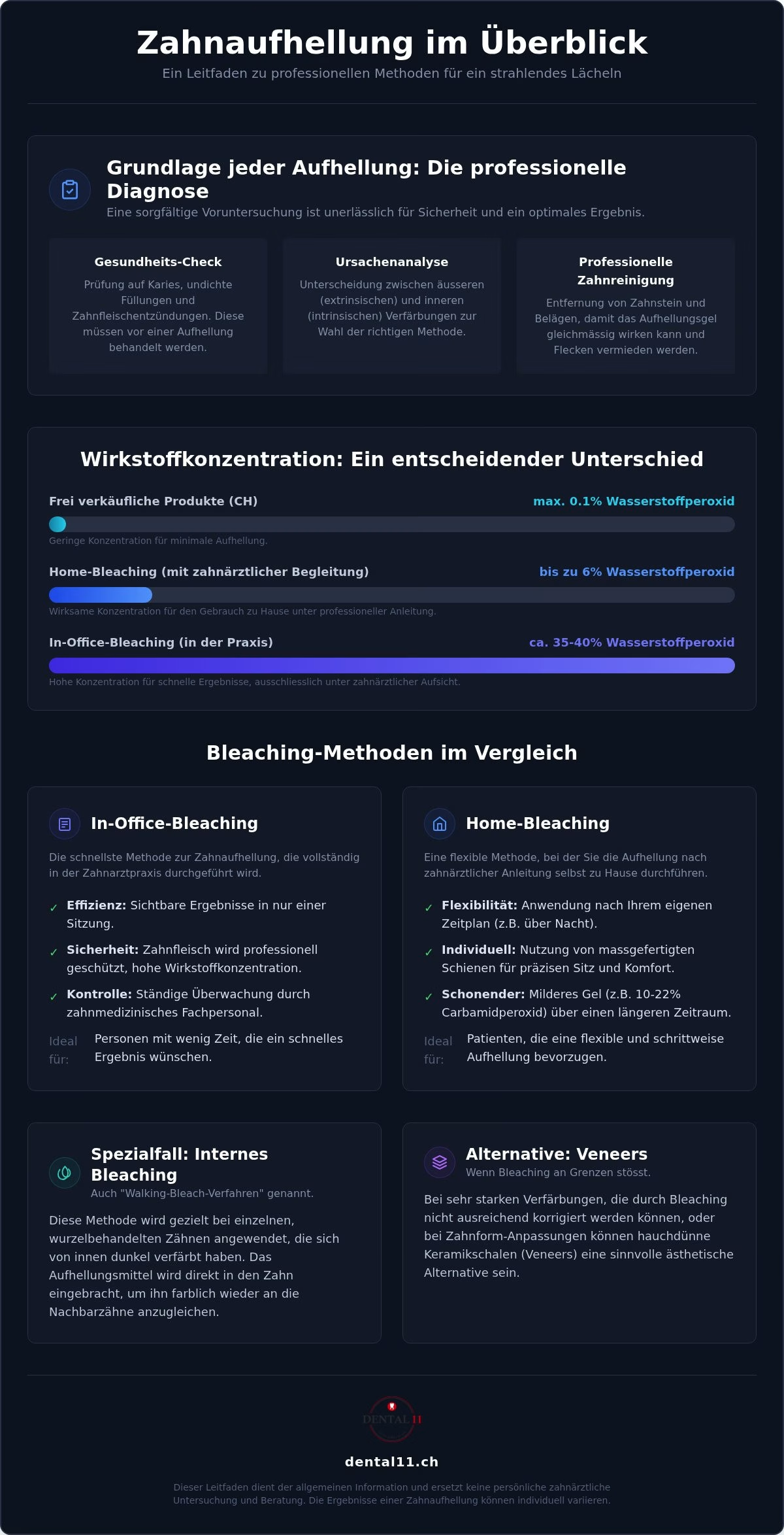
Not all discolouration is the same. Before we compare the different whitening methods, we look at what causes the colour of your teeth. We distinguish between extrinsic and intrinsic discolouration. Pigments from coffee, tea or tobacco settle on the surface of the tooth, whereas intrinsic changes lie deeper within the tooth structure. Genetics or natural ageing often play a part. Medical tooth whitening (bleaching) works on exactly this, but it requires healthy teeth as a basis.
A careful preliminary examination protects your teeth. In Switzerland we follow the guidelines of the SSO (Swiss Dental Association) to keep the treatment safe. We check closely for tooth decay, leaking filling margins or gum inflammation. These must be treated first so that the bleaching agent cannot reach the sensitive inner part of the tooth. Please also note that existing restorations such as crowns, bridges or fillings do not change colour. A harmonious overall result therefore needs careful planning.
The role of dental hygiene before bleaching
Professional dental hygiene in Zurich is the foundation for any cosmetic procedure. We remove stubborn deposits and tartar so that the whitening gel can act evenly on the enamel. Without this cleaning, patches could appear, because surface deposits block the gel. It is the first step towards a fresh feeling in your mouth and an even result.
Individual conditions and limits
The result you can achieve depends largely on the structure of your enamel and on your starting shade. When we assess the different whitening methods, your comfort comes first. If your enamel is very thin or the necks of your teeth are exposed, we choose particularly gentle methods. We tell you honestly what is possible in your situation. Sometimes other approaches make more sense, so that your aesthetic wishes stay in line with the long-term health of your teeth.
Bleaching methods compared: in-office, home bleaching and internal bleaching
Which method suits you depends on your goals and your daily routine. In Switzerland, bleaching agents are governed by the FDHA Ordinance on Cosmetic Products: products containing more than 0.1% and up to 6% hydrogen peroxide may only be supplied after a dental examination. For in-office bleaching, the practice uses considerably more concentrated gels while protecting the gums, which makes a result possible in a single session. Professional whitening methods are characterised above all by this controlled setting and the targeted protection of the gums.
In-office or home bleaching: which suits your lifestyle?
With home bleaching, you use custom-made trays and a milder gel based on carbamide peroxide. This method gives you flexibility in everyday life, but it has to be used over several days or nights. The in-office method, on the other hand, is more efficient for patients with a full diary, as the whitening is done in a single session. Results vary from person to person, so we are happy to advise you personally on your options. You can book a consultation in Zurich at any time.
A special case: whitening after root canal treatment
Individual teeth can look darker over time after endodontic treatment. Internal bleaching helps here. In this so-called walking bleach technique, the whitening agent is placed directly inside the hollow tooth. It is a well-established method that is often carried out after modern root canal treatment to match the colour of the tooth to its neighbours again. This way the appearance is preserved without having to replace tooth structure with a crown. The agent stays in the tooth for a few days until the desired shade is reached.
In-office bleaching in four steps
- Recording the shade: we record the starting colour with a shade guide and check the enamel for fine cracks, so that no gel can reach deeper layers.
- Protecting the gums: a liquid resin (liquid dam) is applied to the gum line and hardened with light.
- Applying the gel: the whitening gel acts in several rounds of 15 to 20 minutes each; we check the shade between rounds.
- Finishing: polishing and fluoride treatment harden the enamel, and remineralising pastes soothe sensitive areas. After that, the white diet applies for 48 hours.
When we advise against bleaching
Not every mouth is ready for whitening. We postpone or advise against it in cases of untreated tooth decay and leaking filling margins, acute gum inflammation or periodontitis, severely exposed and sensitive tooth necks, and during pregnancy and breastfeeding. In these cases the cause is treated first; bleaching follows once the teeth and gums are healthy.
Veneers or bleaching? Aesthetic alternatives and safety
Sometimes conventional whitening reaches anatomical limits. When we compare the different whitening methods, it becomes clear that chemical methods mainly act on the colour pigments in the enamel. In cases of severe enamel defects, misaligned teeth or deep discolouration caused by medication, bleaching is often not enough. The German Dental Association's information on bleaching also makes clear that results depend heavily on the individual starting point. In such cases, veneers offer a long-lasting way to create a harmonious appearance.
Be careful with so-called miracle products. Home remedies such as activated charcoal or lemon juice are often abrasive or attack the tooth structure chemically. This quite often leads to damage and increased sensitivity to cold. Instead, we rely on combined treatments. We often achieve the desired result through gentle bleaching combined with aligners to correct the position of the teeth. This preserves the natural tooth structure while we improve the appearance in a targeted way.
The comparison: chemical whitening or ceramic veneers
Both methods have specific advantages, which we weigh up for each patient:
- Bleaching: less invasive and less expensive, but needs to be refreshed regularly to maintain the effect.
- Veneers: correct shape and colour over the long term and resist new staining, but require minimal preparation of the teeth.
You will find more detail in our article on veneers in Zurich.
Special occasions: whitening your teeth for your wedding
Allow enough time before your big day. We recommend discussing cosmetic treatments about two to three months in advance, so that everything can be completed without rushing. You will find details in our guide to improving your smile for your wedding.
Checklist for your consultation
Make a note of five things before your appointment, and the consultation becomes concrete:
- Gums: redness, bleeding when brushing or swelling.
- Symptoms: sensitive teeth, suspected decay, pain in individual teeth.
- Existing restorations: fillings, crowns or veneers, especially in the visible area.
- History: previous whitening, including with shop-bought products, and how your teeth reacted.
- Expectations: what bothers you about the colour of your teeth and what result you have in mind.
Transparent costs and the procedure at Dental11 in Zurich
At our practice in Zürich Enge, we place great importance on honest and clear communication. When you compare the different whitening methods, cost often plays a decisive role in your planning. At Dental11 you receive a written quote in advance: in-office bleaching from CHF 299, preparatory dental hygiene CHF 99, check-up CHF 99. As cosmetic treatments are not covered by compulsory health insurance in Switzerland, we offer payment in instalments through the Zahnärztekasse to ease the financial burden. This keeps your path to a fresh smile financially predictable and transparent.
The right aftercare is essential for a lasting result. For the first 48 hours after treatment we recommend the so-called "white diet". During this time, avoid strongly staining foods such as red wine, coffee, black tea or curry, as the enamel can briefly absorb pigments more easily. Regular professional cleaning at our practice also helps the whitening last longer and supports your general oral health.
Your appointment for a brighter smile in Zürich Enge
Our practice is in Zürich Enge, a few minutes from Sihlcity and Enge station, and is open until 8 pm on Mondays and Tuesdays. With our online booking tool you can easily book an appointment for a no-obligation initial consultation or for the preparatory dental hygiene. In a personal conversation we answer all your questions and draw up a treatment plan tailored to your anatomy.
Common concerns: sensitivity after treatment
Many patients worry about temporary sensitivity. By using modern, gentle gels and a final fluoride treatment, we keep this risk low. We adjust the concentration and contact time of the bleaching agent to the structure of your enamel. If mild sensitivity does occur, it usually subsides within 24 hours. If you generally have sensitive teeth, our guide to bleaching for sensitive teeth in Zurich explains how we adapt the treatment for sensitive patients. We guide you carefully through the whole process so that you feel safe and well looked after at all times.
Your path to a healthy and safe smile
Choosing professional whitening is always a decision for the long-term health of your teeth as well. Anyone who compares the different whitening methods soon sees that a sound diagnosis and professional supervision are the basis for a harmonious result, which can vary from person to person. Whether you choose efficient in-office bleaching or the flexible tray method at home depends entirely on your personal wishes and your daily routine. What always matters is protecting your enamel with medically tested methods.
At Dental11 in Zürich Enge, we support you with modern digital diagnostics and a clear focus on your wellbeing. We are fully transparent about costs and offer convenient payment in instalments through the Zahnärztekasse, so that quality care remains accessible to you. Our practice is in Zürich Enge, a few minutes from Sihlcity and Enge station.
Book your consultation for professional tooth whitening in Zurich now and let us find the right approach for your smile together. We look forward to advising you personally in a relaxed atmosphere.
Frequently asked questions about tooth whitening
How long does the result of professional tooth whitening last?
Professional tooth whitening usually lasts between one and three years, although results vary from person to person. How long it lasts depends largely on your habits, particularly how much coffee, tea or tobacco you consume. Regular preventive appointments at our practice in Zürich Enge help maintain the result. Good oral hygiene at home also helps the whiter shade last longer and slows the formation of new stains.
Is bleaching harmful to the enamel or the gums?
When carried out properly at a dental practice, bleaching is not harmful to your teeth. We protect the gums carefully and use modern gels that only break down colour pigments in the enamel without attacking the tooth structure. A professional preliminary examination ensures that there are no risks such as undetected tooth decay. This way we provide a safe setting for your cosmetic treatment in Zürich Enge, while always keeping the long-term health of your teeth in mind.
Can fillings or crowns be whitened too?
No, artificial materials such as composite fillings, ceramic crowns or bridges do not change colour with bleaching. As only the natural enamel reacts to the active ingredients, visible differences in colour may appear after treatment. We discuss this in detail during your initial consultation at Dental11. If necessary, we plan to replace older restorations so that your smile looks harmonious and even after whitening.
What is the difference between power bleaching and home bleaching?
Power bleaching is carried out at the practice with a highly concentrated gel for quick results, whereas home bleaching uses custom-made trays. When you compare the different whitening methods, the tray method offers more flexibility, as it is used at home over several days. The in-office method, by contrast, suits patients who prefer intensive care in a single session. We are happy to advise you in Zurich on which option suits your lifestyle.
Is a dental cleaning necessary before every bleaching treatment?
Almost always advisable, but not always necessary: if your last dental hygiene appointment was only a few weeks ago and no deposits are visible, bleaching can follow directly. Otherwise we first remove tartar and stains (CHF 99), because the gel does not work on coated areas and the result becomes patchy. Only on a clean surface can the true starting shade be assessed.
How long should I wait after a dental cleaning before bleaching?
One to two weeks. During this time the gums settle and the surface, briefly roughened by polishing, remineralises. If your teeth are sensitive after the cleaning, wait until the sensitivity has subsided and let us know before the bleaching.
How much does professional bleaching cost at Dental11?
In-office bleaching at Dental11 costs from CHF 299; the exact amount depends on the chosen method and the individual effort involved. At Dental11 we place great importance on clear, understandable costs and give you a transparent cost estimate after the preliminary examination in Zurich. To make the treatment easier to plan, we also offer flexible payment in instalments through the Zahnärztekasse. This gives you access to modern cosmetic dentistry on fair and clear terms. If, besides ordinary discolouration, you also have chalky spots, our article on removing white spots on teeth in Zurich explains how minimally invasive methods can help.
This article is for general information only and does not replace an individual dental examination.