Medically reviewed by MDDr. Polydefkis Papaioannou, dentist, Dental11 Zurich · Updated 10/2026
Teeth whitening is possible even if your teeth are sensitive, provided that tooth decay, leaking fillings and exposed tooth necks have been ruled out or treated beforehand and a pH-neutral gel in an adjusted concentration is used. Use a toothpaste for sensitive teeth for two weeks beforehand, have a dental hygiene session (CHF 99) and fluoride treatment directly before, then avoid extreme temperatures for 48 hours afterwards: this way, sensitivity usually lasts no more than one to two days. At Dental11 in Zürich Enge, whitening costs from CHF 299.
Gentle whitening and sensitive teeth are not a contradiction, as long as the treatment is based on a tailored medical approach. In this article you will learn how careful preliminary examinations and the use of special desensitising gels can noticeably improve comfort during treatment. We give you an insight into current methods that protect the enamel and are adapted to your individual needs at our practice in Zürich Enge.
Key takeaways
- Sensitivity is usually caused by exposed dentinal tubules; tooth decay, leaking fillings and exposed tooth necks are ruled out or treated before whitening.
- At Dental11, whitening costs from CHF 299; a dental hygiene session (CHF 99) is required beforehand so that the gel works evenly.
- Use a toothpaste for sensitive teeth for two weeks beforehand and have a fluoride treatment directly before whitening: this way, sensitivity usually lasts no more than one to two days.
- For 48 hours after whitening, avoid very cold or very hot drinks and strongly staining foods such as coffee, red wine or turmeric.
Why are teeth sensitive, and is whitening still possible?
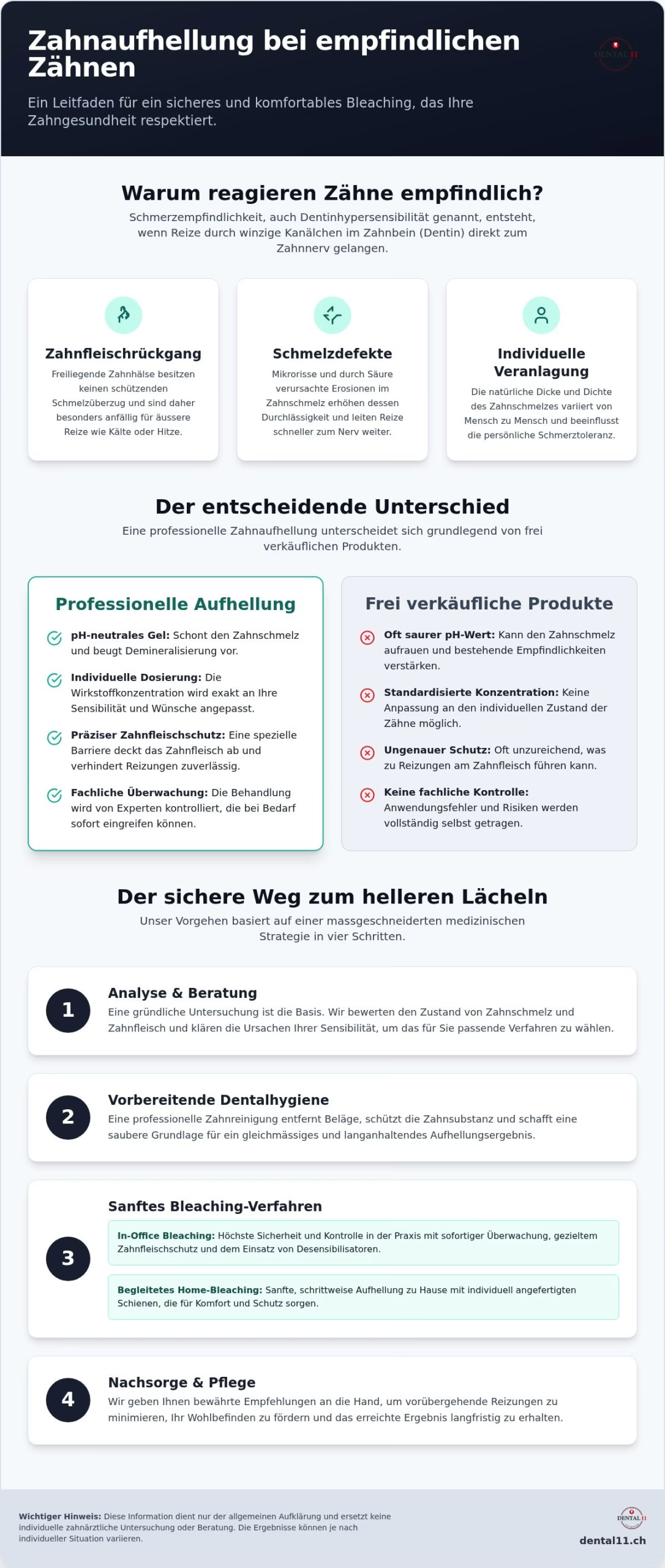
Tooth sensitivity, known in dentistry as dentine hypersensitivity, is usually caused by exposed dentinal tubules. These microscopic channels pass external stimuli such as cold, heat or sweetness directly to the tooth nerve. During whitening, the peroxides in the gel use the same pathways, which can cause short-lived irritation. Professional whitening for sensitive teeth addresses exactly this point: we distinguish between a harmless, temporary reaction and hypersensitivity that needs treatment.
At its core, teeth whitening is a controlled oxidation of colour pigments inside the tooth. In our practice we make sure that this chemical process does not put unnecessary strain on the tooth nerve. A thorough diagnosis beforehand is therefore essential to assess the current condition of your enamel and gums.
Causes of sensitive teeth
- Receding gums: exposed tooth necks have no protective enamel layer, which makes them particularly susceptible to stimuli.
- Micro-cracks and erosion: small defects in the enamel, often caused by acidic foods or grinding your teeth at night, make the tooth structure more permeable.
- Individual tooth structure: the thickness and density of enamel vary considerably from person to person, which affects pain tolerance.
The role of pH in teeth whitening
One factor in sensitivity that is often underestimated is the pH of the whitening product. Many over-the-counter home whitening products are acidic, which can demineralise the enamel and make existing discomfort worse. At Dental11, by contrast, we use pH-neutral gels developed specifically for sensitive teeth. These medically controlled procedures protect the tooth structure and noticeably reduce the risk of sharp pain during application.
The right method depends largely on your individual situation. By adjusting the concentration of the active ingredient, we can achieve a result that balances your aesthetic wishes with the health of your teeth.
Professional whitening methods for sensitive teeth in Zurich
Professional teeth whitening in a controlled setting differs considerably from do-it-yourself solutions found online. Professional methods allow us to match the intensity of the treatment precisely to your individual pain tolerance. For sensitive teeth, our practice in Zürich Enge relies on close monitoring.
During the process, we use desensitising agents such as potassium nitrate or high-concentration fluoride. These help to temporarily dampen the transmission of stimuli to the tooth nerve. If irritation occurs during the application, we can stop the treatment immediately or adjust the concentration of the active ingredient.
In-office whitening vs. home whitening
In-office power whitening gives sensitive patients good control, as we apply the active ingredient precisely and check progress every minute. Alternatively, gentle home whitening under our supervision lightens the teeth gradually over several days. For this, we use a digital impression to make custom-fitted trays that prevent the gel from spreading onto the gums.
Additional protection for the gums
Careful gum protection is essential to avoid irritating sensitive tooth necks. We carefully cover the gums with a special barrier before starting the actual whitening. This care protects the surrounding tissue and makes the treatment calmer for you. If you are unsure which method suits your teeth, you can book a personal consultation here.
Preparation and aftercare: how we prevent irritation
Successful whitening for sensitive teeth begins weeks before the actual appointment. Preparation is the foundation for keeping irritation to a minimum. The first step is always a professional dental hygiene session. It thoroughly removes tartar and biofilm, which is what allows the whitening agent to work evenly. Without this basis, discolouration could fade unevenly, because the gel would not be in direct contact with the tooth surface everywhere.
The importance of dental hygiene in Zurich
We use this appointment for a detailed diagnostic check. Undetected micro-cracks, tooth decay or leaking filling margins are often responsible for sharp, sudden sensitivity. This medical check beforehand ensures that there are no hidden sources of pain before the chemical whitening begins.
For active desensitisation, we follow a two-step approach. We recommend that patients with high sensitivity start using special toothpastes containing hydroxyapatite or potassium nitrate 14 days beforehand to seal the dentinal tubules. Directly before whitening, we carry out a targeted fluoride treatment that strengthens the enamel.
Tips for the days after whitening
After whitening, the tooth structure is demineralised for a short time and therefore more sensitive to stimuli. Avoid very cold or very hot drinks for the first 48 hours so as not to put unnecessary stress on the tooth nerve. The "white diet" is also important: avoid strongly pigmented foods such as turmeric, berries or red wine, as these could now penetrate the enamel more easily. Soothing gels with special minerals can help the enamel remineralise faster and make you more comfortable.
Cosmetic dentistry at Dental11: your path to a brighter smile in Zürich Enge
At Dental11 we know that patients with sensitive teeth often feel uncertain about wanting whiter teeth. In our practice in Zürich Enge we create a calm atmosphere that leaves room for your individual concerns. Whitening for sensitive teeth is not an automated standard procedure for us. It is a tailored medical service that combines technical precision with a caring approach. We take the time to take your concerns seriously and make the process as comfortable as possible.
Why Dental11 is a good choice for sensitive patients
Our many years of experience in treating dentine hypersensitivity form the basis of every treatment. We understand that the fear of sharp, sudden pain is a major barrier. That is why we use our modern digital equipment not only for aesthetic results, but above all to make you more comfortable during the session. We place great importance on preserving the integrity of your tooth structure. Our focus is consistently on long-term dental health rather than on short-term effects alone. We explain the options, individual risks and costs to you clearly beforehand, so that no questions remain open.
Next steps towards your consultation
The path to gentle whitening begins with a thorough initial consultation. In this appointment we assess the current condition of your teeth and discuss which method suits your level of sensitivity. Appointments are available Monday to Friday, until 8 pm on Mondays and Tuesdays and from 8 am on Thursdays and Fridays. Because clear and traceable costs are important to us, we can also tell you about payment in instalments, which is available through the Zahnärztekasse. Simply book your appointment online and receive individual advice from our team.
Your path to a brighter smile begins with trust
Sensitive teeth need not stand in the way of cosmetic whitening. As we have seen, the key lies in careful preparation and choosing the right method. A professional dental hygiene session and the use of pH-neutral gels can noticeably reduce the strain on the tooth structure. Whitening at Dental11 relies on this medical care to give you a comfortable treatment that respects your individual situation.
Our practice in Zürich Enge, a few minutes from Sihlcity and Enge railway station, combines modern digital dentistry with clear communication about costs; payment in instalments is available through the Zahnärztekasse. We invite you to discuss your questions in a personal consultation and to find a solution together that suits your pain tolerance. Book your consultation for gentle whitening in Zürich Enge now and take the first step in a relaxed setting. We look forward to welcoming you personally and attentively at our practice.
Frequently asked questions about teeth whitening
How long does sensitivity usually last after whitening?
Sensitivity after teeth whitening usually disappears completely within 24 to 48 hours. This temporary reaction is often due to slight dehydration of the enamel during the process. At our practice in Zürich Enge we use special desensitising gels to keep this period as short as possible. If the twinges last longer, we are available for a follow-up check. However, the duration depends greatly on your individual situation.
Can whitening permanently damage my teeth if they are already sensitive?
Professionally performed whitening, when applied correctly, does not cause permanent damage to the tooth structure. We use only medically tested, pH-neutral gels that protect the enamel. A thorough preliminary examination ensures that there are no contraindications such as tooth decay. Without professional supervision, for example with aggressive home products, there is a higher risk of irritation.
Which foods should I avoid directly after teeth whitening?
For the first two days after treatment, you should avoid strongly staining foods and drinks. These include coffee, black tea, red wine, curry and berries, as the enamel absorbs pigments more easily for a short time. We recommend the so-called white diet with rice, light-coloured pasta and water. Also avoid very cold or very hot food so as not to irritate the tooth nerve unnecessarily after whitening and to stay comfortable.
Does Swiss health insurance cover the cost of whitening for sensitive teeth?
Compulsory basic health insurance in Switzerland does not cover the cost of teeth whitening, as it is a purely cosmetic procedure. Existing tooth sensitivity does not change this classification. Supplementary insurance occasionally makes a contribution, which you should check individually beforehand. At Dental11, whitening costs from CHF 299; payment in instalments is available through the Zahnärztekasse.
Are there alternatives to whitening if my teeth are too sensitive?
If chemical whitening is not an option because of very high sensitivity, a professional dental hygiene session offers an effective alternative. It removes surface stains caused by coffee or tobacco and reveals the natural white of your teeth. For a lasting colour correction, veneers may be an option, which we plan individually in our practice. We are happy to advise you on the different approaches that respect your dental health and your personal needs.
This article is for general information only and does not replace an individual dental examination.