

Clinically reviewed by MDDr. Polydefkis Papaioannou, dentist, Dental11 Zurich · Updated 10/2026
White spots on the teeth are areas of demineralised enamel. Superficial spots, for example after fixed braces, can be made much less visible with resin infiltration (Icon), without drilling and usually without an injection; deep or brownish defects are more likely to need a filling or veneers. Bleaching alone does not help and often makes the contrast stronger. The first step at Dental11 in Zürich Enge is a check-up (CHF 99), during which we assess the depth of the spots and prepare a cost estimate for you.
Below we explain the causes, how infiltration works and what the alternatives are.
Key points
- White spots are demineralised, porous areas in the enamel, usually caused by early caries (for example after fixed braces) or by fluorosis.
- Icon infiltration seals porous enamel without drilling and usually without an injection; it is suitable for superficial white spots, for example after fixed braces.
- Bleaching alone does not help and often increases the contrast; for deep or brownish defects, a filling or veneers may be an option.
- The first step is a check-up at Dental11 in Zürich Enge (CHF 99); you then receive a cost estimate based on the Dentotar tariff.
What are white spots? Causes of white marks on the teeth
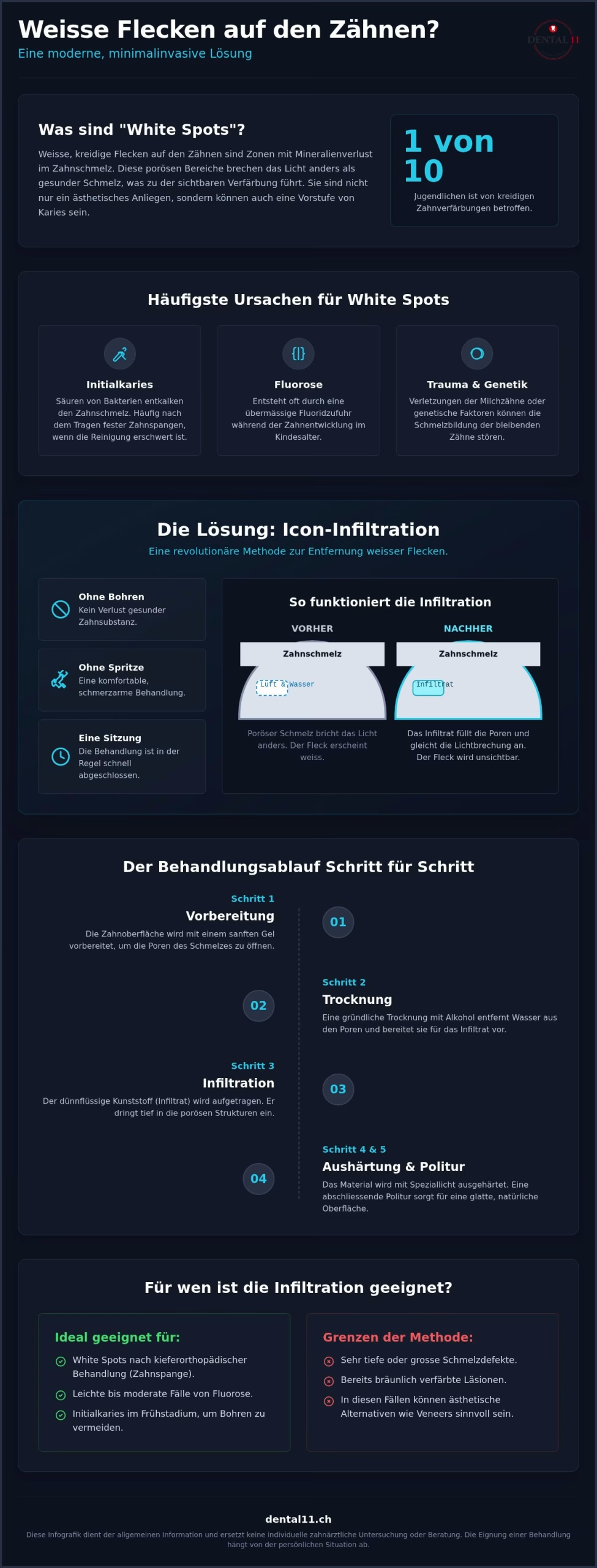
White spots are hypomineralised zones in the tooth enamel, caused by a local lack of important minerals such as calcium and phosphate. These areas look chalky because light is refracted differently in the porous structure than in healthy enamel. If you would like to have white spots removed, it helps to understand the structural background of this discolouration. The increased porosity not only makes the tooth visually noticeable, it also makes it more prone to absorbing colour pigments from food.
Early caries: when bacteria attack the enamel
In many cases, early caries is what causes the light patches. Bacteria in plaque produce acids that slowly demineralise the enamel. We see this particularly often after fixed braces, when cleaning around the brackets was difficult. At this stage we concentrate on the targeted regeneration of these weakened areas. Timely treatment can prevent superficial demineralisation from turning into a deeper cavity that would need conventional drilling.
Fluorosis and genetic causes
Another common cause is fluorosis, which usually results from too much fluoride while the teeth are forming in early childhood. Trauma to the milk teeth or genetic factors can also permanently disturb the enamel formation of the permanent teeth. With such systemic causes, treatment often calls for a different diagnostic approach than with caries-related spots. We distinguish carefully between superficial enamel disorders and deep structural defects so that we can draw up a suitable treatment plan for you at our practice in Zürich Enge.
Removing white spots in Zurich: Icon resin infiltration
For superficial white spots, Icon infiltration is often the first choice. It is a minimally invasive technique that works entirely without drilling. A special infiltrant is used to seal porous structures created by demineralisation of the enamel. This low-viscosity resin penetrates deep into the enamel and stops the demineralisation process at its source, making the tooth more resistant in the long term.
The key lies in how light is refracted. The white areas stand out because air and water in the pores reflect light differently from healthy enamel. The infiltrant has a refractive index similar to that of the natural tooth, so the visible marks blend in with the surrounding colour. You therefore benefit from a physical effect that also stabilises the tooth from within. It is a very conservative method that focuses on preserving the tooth and usually does not require an injection.
Step by step: the treatment process at Dental11
The treatment is carried out in one session. First, we prepare the surface with a gentle gel to open the pores. The tooth is then dried thoroughly with alcohol so that the material can be drawn deep into the capillaries. After applying the infiltrant, we harden it with a special light. A final polish makes sure the treated tooth feels smooth and natural.
Who is infiltration suitable for?
The method is well suited to white spots after orthodontic treatment or mild fluorosis. With very deep or already brownish discolouration, however, the technique reaches its limits. Whether Icon is right for your teeth is something we clarify during the check-up (CHF 99). You can easily book an appointment online to get clarity about your individual treatment options.
Cosmetic alternatives: when infiltration is not enough
Although resin infiltration is a good method in many cases, there are situations where it reaches its structural limits. This is often the case with very deep enamel defects or changes over large areas. A widespread misconception is that simple bleaching is the answer. In fact, whitening can often make white spots stand out more, because the contrast with the rest of the tooth increases. If you want to get rid of white spots for good, you therefore need carefully differentiated treatment planning.
In such cases, veneers offer an alternative. These very thin ceramic shells cover the defect completely and allow the colour to be matched to the neighbouring teeth. We often combine different approaches to achieve the right result for your individual situation. Preserving your healthy tooth structure always comes first. The choice of method depends largely on the depth and cause of the discolouration.
Veneers vs. Icon: a comparison
While Icon fills the pores from within, veneers are a cosmetic covering applied from the outside. They are used when the spots sit too deep in the enamel or when the shape of the tooth also needs to be corrected. You can find a detailed look at the options and visible changes in our guide to veneers in Zurich.
The role of professional teeth cleaning
Every cosmetic correction starts with a clean base. Thorough professional teeth cleaning (CHF 99) is essential to remove deposits and surface stains beforehand. Only on a clean tooth surface can the actual extent of the white spots be assessed accurately. Regular preventive care also helps to secure the long-term success of any treatment.
Your visit to Dental11: transparency and care in Zürich Enge
At Dental11 in Zürich Enge, we place great importance on empathetic, non-judgemental care in a relaxed atmosphere. Your path with us begins with a thorough assessment of your dental health. We use digital diagnostics to determine the exact depth and structure of the mineralisation disorders. This precision is the basis of our minimally invasive approach, which protects your healthy tooth structure. You will find us at Waffenplatzstrasse 11 in Zürich Enge, reachable by tram 5, 13 and 17 to the Waffenplatzstrasse stop, a few minutes from Sihlcity and Enge station.
Transparent costs and financing in Switzerland
Clear information about costs builds trust. Every treatment is billed according to the Dentotar, the Swiss dental tariff. Since the cost of treating white spots varies from person to person and depends mainly on the number of affected teeth and the chosen method, you receive a detailed breakdown after the initial examination. To make cosmetic dentistry accessible, we offer convenient instalment payments through the Zahnärztekasse. This allows you to decide on the long-term health of your teeth without financial pressure.
Booking and getting here
We want to make access to modern dentistry as simple as possible for you. Use our straightforward online booking to secure a time that suits you for an initial consultation. Consultation and treatment are available in German, English and Greek.
Your path to an even smile in Zürich Enge
Treating mineralisation disorders requires expertise and a careful touch. Methods such as Icon infiltration offer a good way to preserve natural tooth structure while calming the visual appearance. Accurate digital diagnostics always form the basis of successful treatment. Dental11 offers you calm care in Zürich Enge, a few minutes from Sihlcity and Enge station.
We bill according to the Dentotar tariff and accompany you through the entire process. Whether gentle infiltration or cosmetic additions such as veneers, we find the method that best suits your individual situation. Book your consultation at Dental11 in Zurich now and get advice in a relaxed atmosphere. We look forward to welcoming you to our practice.
Frequently asked questions about white spot treatment
Are the results of Icon treatment permanent?
The results of Icon infiltration are considered stable over the long term in modern dentistry, because the liquid resin penetrates deep into the pores of the enamel and is hardened there with light. This makes renewed demineralisation at the same spot considerably more difficult. However, how long the appearance lasts also depends on your own oral hygiene and eating habits. Regular professional teeth cleaning at our practice helps to maintain the treated appearance over many years.
Can white spots also be removed with bleaching?
Bleaching alone is usually not suitable for removing white spots. Because bleaching gels lighten the overall tooth colour, the white spots, which are already lighter, can often stand out even more after treatment. In many cases, however, it makes sense to bleach first and then match the infiltration precisely to the new shade. If you have sensitive teeth, our guide to bleaching sensitive teeth in Zurich gives you useful information on gentle whitening methods for sensitive patients. In this way we achieve a harmonious and natural overall result for your smile.
How much does it cost to remove white spots in Zurich?
The check-up with consultation costs CHF 99 at Dental11. The price of the infiltration depends on the number of affected teeth and is calculated according to the Dentotar tariff; after the examination you receive a written cost estimate. Basic health insurance does not cover purely cosmetic treatments.
Is white spot treatment unpleasant or painful?
Most patients find treating white spots with the Icon method very gentle, as it requires no drilling and usually no local anaesthetic. Because no healthy tooth structure is removed, the structure of the tooth is fully preserved. This minimally invasive approach is particularly suitable for people who are sensitive to conventional dental procedures. We place great importance on a calm atmosphere so that you feel comfortable throughout your appointment.
Can white spots come back after treatment?
Areas that have been successfully infiltrated generally do not return to their original chalky appearance, because the pores are permanently sealed. However, new white spots can develop elsewhere if oral care is inadequate or acid attacks demineralise the enamel again. Consistent preventive care and a tooth-friendly diet are therefore a sound basis for keeping your teeth even in appearance over the long term and for preventing new enamel defects.
This article is for general information only and does not replace an individual dental examination.