
Professionally reviewed by MDDr.(CZE) Polydefkis Papaioannou, dentist, Dental11 Zurich · As of 10/2026
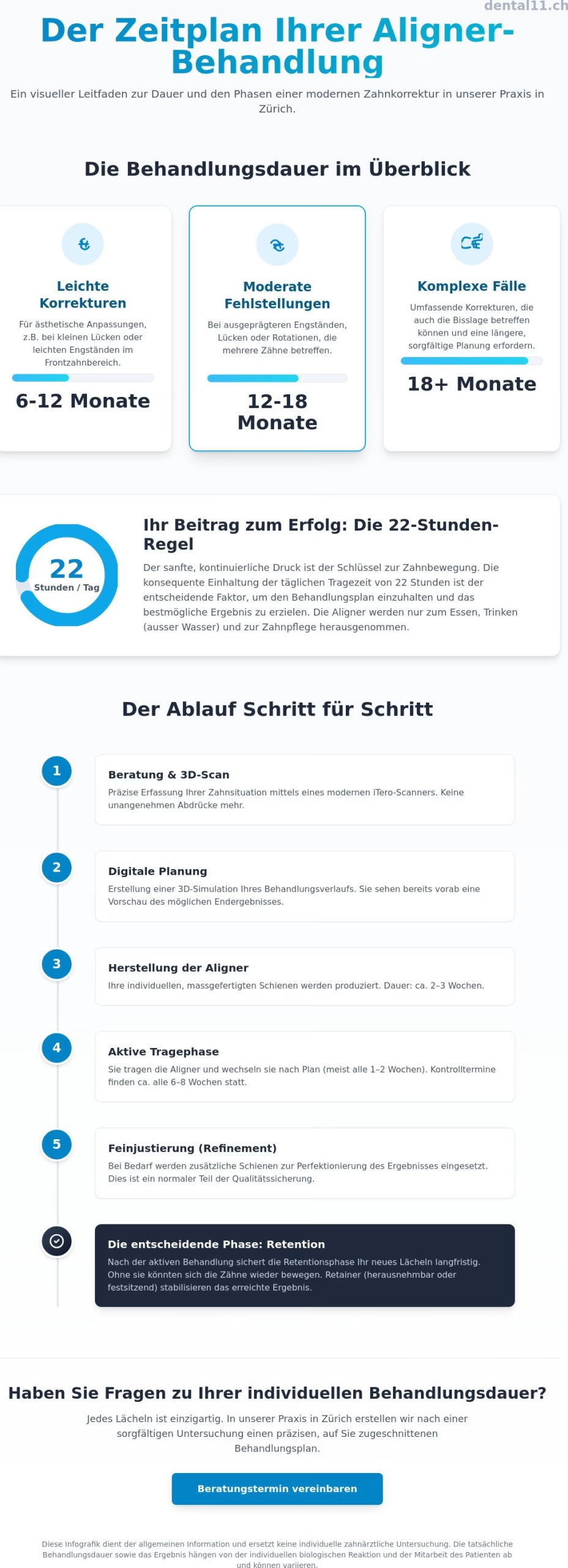
Aligner treatment takes 6 to 12 months for mild misalignment, 12 to 18 months for moderate cases and 18 to 30 months for complex bite problems. On top of this come two to three weeks of production time after the scan and, at the end, retention with a retainer, which is recommended for life. The duration depends on the extent of the correction, on bone remodelling (slower in adults) and above all on your wearing time: 22 hours a day, otherwise everything takes longer. At Dental11 in Zürich Enge we work with ClearCorrect (from CHF 3’499); you will see the expected timeline in the simulation after the digital scan.
This article explains the phases of treatment, the biological limits of tooth movement, what you can influence yourself and why retention is part of it.
Key points
- Tooth movement requires bone remodelling; this is why the aligners are usually changed only every 7 to 14 days.
- After the digital 3D scan, production of the aligners usually takes two to three weeks; check-ups take place roughly every six to eight weeks.
- Mild corrections 6 to 12 months, moderate ones 12 to 18 months, complex bite corrections 18 to 30 months. At Dental11: ClearCorrect from CHF 3’499.
- The aligners must be worn 22 hours a day; every longer break in wear extends the treatment.
- After the last aligner, a fixed lingual retainer and/or a night-time retainer secures the result; retention is recommended for life.
The basics: what determines how long aligner treatment takes?
Aligner therapy is a modern method for correcting misaligned teeth, based on the principle of gradual movement. Unlike conventional fixed braces, these clear plastic aligners use gentle but continuous forces to guide the teeth millimetre by millimetre into the planned position. The basis is a digital analysis that defines every single treatment step before the aligners are fitted for the first time.
How many months you will end up wearing your aligners cannot be answered in general terms. The individual duration of aligner treatment depends largely on the starting situation of your teeth. While simple aesthetic corrections are often completed after 6 to 12 months, moderate misalignments usually need between 12 and 18 months. In particularly complex cases, treatment can take longer than that. The important point is this: every jaw responds differently to the pressure applied, which is why your personal timeline always remains an individual plan.
Biological limits of tooth movement
Teeth are not rigid objects set in a fixed foundation. They are anchored elastically in the jawbone by the periodontal apparatus. For a tooth to move, a complex biological remodelling process has to take place. In the direction the tooth is moving, the body breaks down bone; on the opposite side it forms new bone tissue to stabilise the root again. This process cannot be speeded up at will.
If too much pressure is applied in too short a time, we risk permanent damage to the tooth structure or the roots, known as root resorption. Patience is therefore an essential part of good treatment. Regular aligner changes, usually every one to two weeks, keep the forces moderate and give the tissue enough time to regenerate. This is the only way to achieve a healthy and lasting realignment of your teeth.
Digital planning vs. biological reality
In our practice in Zurich we use modern software to calculate the duration of aligner treatment in advance. These simulations are precise and give you an idea of the possible end result beforehand. Even so, the human body is not a machine that rigidly follows a digital algorithm. There are phases in which teeth move exactly as planned, and moments in which the biological tissue needs a little more time.
If, at the end of the planned series of aligners, the teeth are not yet exactly in the intended position, so-called refinements are used. These are additional aligners used for fine adjustment. Such adjustments are a normal part of professional treatment and help achieve a good result for your individual situation. If you have questions about your personal timeline, you can book an appointment directly.
The timeline: from planning to the last aligner
The path to the tooth position you want is a journey that we plan carefully, step by step. In our practice in Zurich, this process begins with a detailed initial consultation. We use an intraoral scanner to create a precise three-dimensional image of your teeth. A conventional impression with sticky material is no longer needed. This digital basis allows us to simulate the entire tooth movement in advance and give you a first preview of the possible result.
Once we have finalised the virtual treatment plan, your individual aligners are produced. This step usually takes two to three weeks, as each set is custom-made. As soon as the aligners arrive at our practice, the active phase begins. You wear each aligner for a set period and come to our practice for a check-up roughly every six to eight weeks. These appointments are short and straightforward; they serve to make sure the teeth follow the digital plan exactly and that the duration of the aligner treatment stays within the expected range.
The preparation phase at the practice
Before the first aligner is fitted, we prepare comprehensive diagnostic records. In addition to the 3D scan, these include clinical photos and, if needed, digital X-rays. At a second appointment we discuss the simulation of your result in detail. This is where your treatment actually starts. When fitting the first aligners, we often place small, tooth-coloured composite dots known as attachments on the teeth. They act as precise pressure points so that the aligners can grip and guide the teeth effectively. Placing them is generally well tolerated, and the dots are barely visible in everyday life.
The rhythm of aligner changes
The standard rhythm for changing aligners is usually between 7 and 14 days. This rhythm is decisive for the overall duration of aligner treatment. Depending on how well your body responds to the gentle pressure and how complex the intended tooth movement is, we adjust this interval individually. A shorter interval does not necessarily mean faster treatment; the biological processes of bone remodelling set the healthy pace.
Regular check-ups are essential to monitor progress and make adjustments promptly when needed. Once the last aligner has done its work, the transition to retention follows. This is a passive phase in which we permanently stabilise the new position of your teeth. When you are ready to take the first step, you can simply book your consultation in Zurich here.
Complexity of the misalignment: a time comparison
The way your teeth sit in the jaw largely determines the time frame of your treatment. Not every correction involves the same effort; while some changes only affect the appearance of the front teeth, others require a comprehensive change in the bite. The individual duration of aligner treatment is therefore easier to understand by dividing cases into different levels of complexity.
- Mild corrections: These include closing small gaps between teeth (diastema) or correcting minor rotations in the visible area. Such adjustments usually take 6 to 12 months.
- Moderate cases: With moderate crowding, space often has to be created in the dental arch first. This can be done by minimally reducing the enamel at the contact points. Treatment time here is usually between 12 and 18 months.
- Complex misalignments: When functional problems such as a pronounced overbite, crossbite or deep bite are present, planning is more demanding. Such corrections can take 18 to 30 months and often require additional aids such as elastics to align the jaws with each other.
Cosmetic vs. functional corrections
It is a biological fact that single-rooted front teeth can be moved more easily, and therefore faster, than multi-rooted back teeth. A purely cosmetic correction of the "social six" (the six visible teeth in the upper jaw) often seems like a short process. However, as soon as the side teeth have to be included to ensure a stable bite, the time required increases. The interplay of aesthetics and function is essential for a result that stays healthy in the long term. A harmonious smile is only secure when the teeth also fit together properly when chewing.
Why "simple" does not always mean "quick"
Sometimes a misalignment looks minor, but the configuration of the roots in the bone turns out to be a challenge. In adult patients, the jawbone is also firmer and less elastic than in adolescents. This means that the duration of aligner treatment in adults often has to be calculated somewhat more generously in order to protect the tissue.
Your oral hygiene also plays an underestimated role in the timeline. Inflamed gums can slow down the remodelling processes in the bone or even force breaks in treatment. Consistent prophylaxis therefore helps the treatment run smoothly. If you are unsure which category your tooth position falls into, let us clarify this in a personal examination.
The human factor: how you actively influence the duration
While our technology in Zurich provides the mathematical basis for your tooth movement, in everyday life you are the decisive partner for success. Even precise planning is of little use if the aligners do not spend the necessary time in your mouth. This is what we call compliance. The duration of aligner treatment is to a large extent in your hands, because the biological remodelling of the jaw requires an almost uninterrupted application of force.
The golden rule is: wear your aligners 22 hours a day. That leaves you two hours for meals and daily tooth care. Every additional hour that the aligners spend in their storage case interrupts the gentle pressure on the tooth roots. During these breaks the tissue already begins to relax, which can slow down progress. If you stick to your wearing times consistently, you make sure that we can keep to the timeline as planned.
Consistency in everyday life
Fitting aligners into your working day or your travels takes a little organisation at first, but quickly becomes routine. At social events or long business meals, the temptation to leave the aligners out for longer is strong. Small strategies help here: use apps or trackers that remind you to put them back in. During wearing time, preferably drink water. If you are out and about and have no way of brushing your teeth, rinse your mouth thoroughly with water before putting the aligners back in. This not only protects your teeth but also prevents the material from discolouring. You can read how to care for the aligners themselves in our tips on cleaning aligners.
Should an aligner ever break or get lost, stay calm. In such a case it is important not to simply take a break. Contact us straight away. We usually advise wearing the previous set of aligners temporarily to hold the current position until a replacement is ready. This way we avoid a relapse into the old tooth position.
Risks of incorrect use
Some patients are tempted to change their aligners earlier on their own initiative in order to shorten the duration of aligner treatment. We strongly advise against this. The biological limits we discussed in the basics are fixed. Changing too quickly can overload the tooth roots and, in the worst case, lead to permanent damage. Trust the rhythm we have set for you. Open communication about pressure points or uncertainties is a safe route to a stable result. We accompany you patiently through every phase so that you feel confident at all times.
Retention: why treatment continues after the last aligner
When you wear the last aligner in your set, you have reached a major milestone. Biologically speaking, however, the process is not yet fully complete at this point. The active duration of aligner treatment only describes the phase in which we actively move your teeth. What follows is the passive phase of stabilisation, known as retention. Without this safeguard, teeth tend to drift back into their original misalignment, because the periodontal apparatus and the surrounding tissue need time to settle in the new position.
Teeth have a kind of biological memory. The elastic fibres that hold the tooth in the jaw behave much like rubber bands; after a correction they are under tension and try to pull the tooth back. The risk of relapse is particularly high in the first year after the active phase. Retainers are used to preserve the result in the long term. They allow the bone around the tooth roots to harden undisturbed while the teeth are held securely in their new place.
Types of retention
In our practice in Zurich we have various systems available to secure your tooth position. We often recommend a combination of two methods to ensure a high level of stability. A fixed lingual retainer is a very thin medical wire that we attach invisibly to the inside of the front teeth. Its advantage is that it works around the clock without you having to think about it.
In addition, there are removable retainers. These look similar to your aligners but are made of a more robust material. At first these retainers are usually worn every night; later the interval can often be reduced. While the lingual retainer mainly secures the front teeth, the night-time retainer stabilises the entire dental arch including the side teeth. Which solution suits you depends on the original misalignment and your individual needs.
Long-term care at Dental11
We see dental health as a lifelong process. Teeth move throughout life, even without previous treatment. This is why a regular check of the retainers as part of your annual prophylaxis appointment makes sense. We check that the wire is firmly in place or that your night-time retainer fits properly, so that we can respond early to even small changes.
If a retainer is ever damaged, prompt action is needed so as not to put the treatment result at risk. We support you with care and professional expertise beyond the active phase, so that you can enjoy your new tooth position for a long time. Secure your result and book your consultation in Zurich to find out more about the options for retention.
Your path to a harmonious smile in Zurich
The duration of aligner treatment is an interplay of modern technology, biological processes and your personal cooperation. As we have seen, the complexity of your tooth position and consistent adherence to wearing times largely determine the time frame. While simple aesthetic corrections often progress quickly, functional adjustments need the necessary time for a stable and healthy realignment.
At Dental11 at Waffenplatzstrasse 11 in Zürich Enge, a few minutes from Sihlcity and Enge station, we work with ClearCorrect aligners (from CHF 3’499). The intraoral scanner allows precise planning before the first aligner is fitted. You receive the cost estimate after the scan; payment in instalments is possible via the Zahnärztekasse. Appointments are available Monday to Friday, on Mondays and Tuesdays until 8 pm. This keeps the path to your well-being clear and safe at all times.
The first step is a personal consultation: Book your clear aligner consultation in Zurich now. We look forward to welcoming you to our practice and supporting you competently on your individual path.
Frequently asked questions about treatment duration
How long does aligner treatment take on average?
The average duration of aligner treatment is between 6 and 18 months. For mild corrections in the front teeth, visible progress can often be achieved after just 6 to 12 months. More complex cases that also involve the back teeth or the bite usually need a period of 18 months or longer. The exact timeline depends largely on your individual starting situation.
Can I shorten the treatment by changing the aligners more often?
No, shortening the change intervals on your own is not advisable and can put the health of your teeth at risk. The jawbone needs time for the biological remodelling processes. If the pressure is increased too quickly, we risk damage to the tooth roots. Trust the rhythm of usually 7 to 14 days that we have set on the basis of your biological conditions.
What happens if I only wear my aligners at night?
Wearing them only at night is not enough to move the teeth permanently. The necessary bone remodelling only takes place when constant pressure is applied for at least 22 hours a day. If you wear the aligners for too short a time, the tissue relaxes again during the day; treatment stalls or painful tension occurs when you put them back in.
Does treatment take longer for adults than for adolescents?
The duration of aligner treatment can tend to be somewhat longer in adults, as the jawbone is already firmer and less elastic. Even so, the method is also effective in adulthood. With good cooperation and consistent wearing time, the planned goals can usually be achieved precisely and within the estimated time frame.
How often do I need to come to the practice in Zurich for check-ups during treatment?
Check-ups at our practice in Zurich usually take place every 6 to 8 weeks. These appointments are important for comparing the progress of tooth movement with the digital plan and making small adjustments if necessary. At these visits you usually also receive your next sets of aligners for the following weeks.
Does the treatment take longer if I lose an aligner?
A loss can delay the timeline if you do not react immediately. It is important that you inform us straight away so that we can decide whether you temporarily wear the previous aligner or move directly to the next set. Any longer break without an aligner causes the teeth to drift back to their old position, which extends the overall duration.
Do I have to wear retainers forever after treatment?
To secure the new tooth position permanently, lifelong retention is strongly recommended. Teeth move throughout life, even after a successful correction. A fixed lingual retainer or a regularly worn night-time retainer prevents your teeth from shifting again. Once the active phase is complete, we discuss which system suits your long-term stability.
Is there a guarantee for the calculated treatment duration?
In medicine there are no guarantees for exact points in time, as every body responds individually to stimuli. The calculated duration is a very accurate estimate based on digital simulations. The actual time span can vary and depends on biological factors as well as your personal discipline in wearing the aligners.
This article is for general information only and does not replace an individual dental examination.