Clinically reviewed by MDDr. Polydefkis Papaioannou, dentist, Dental11 Zurich · Updated 10/2026
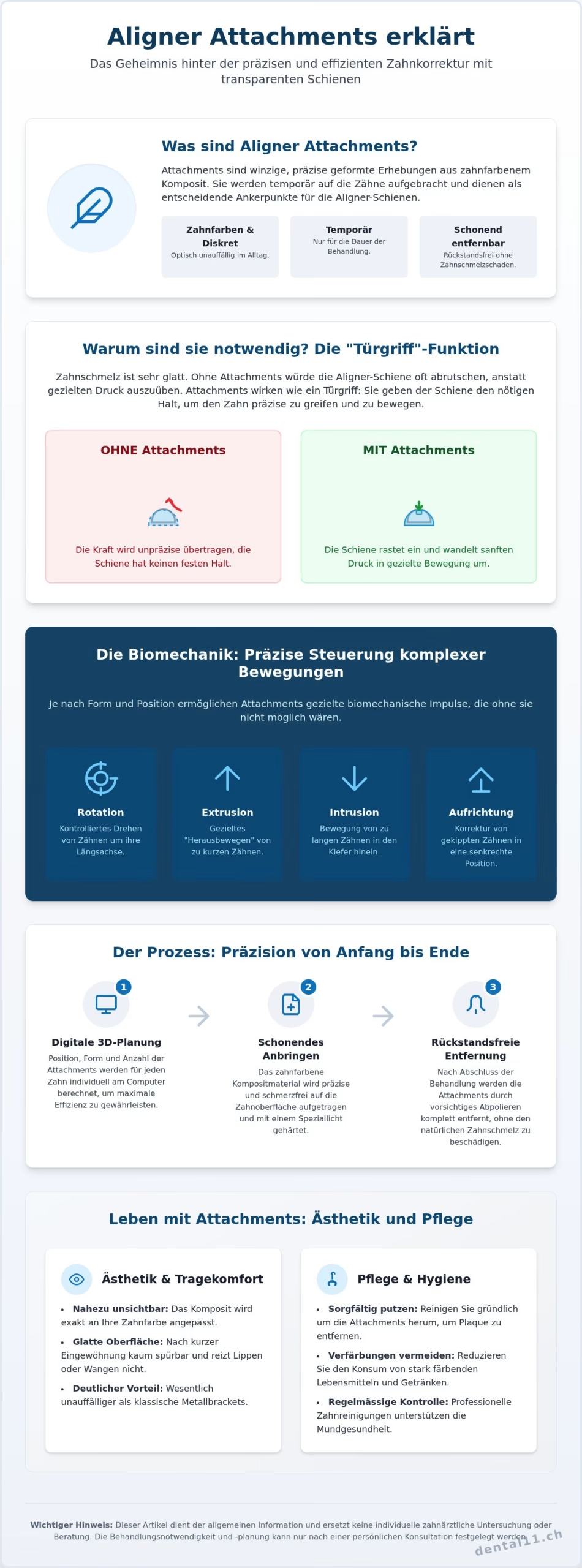
Aligner attachments are small, tooth-coloured composite bumps that are bonded to individual teeth for the duration of treatment. They give the smooth aligner something to hold on to: without them, an aligner could push a tooth, but not rotate, raise or lower it. How many attachments are needed is determined by the digital planning; simple corrections need only a few, complex ones considerably more. They are bonded on without drilling, stay on the teeth while you eat, can become slightly discoloured by coffee or turmeric, and are polished off at the end without leaving any residue. At Dental11 in Zürich Enge, they are included in ClearCorrect treatment (from CHF 3’499).
This article explains how attachments work biomechanically, what wearing them feels like, how to look after them and what to do if one comes off.
Key takeaways
- Attachments are discreet, tooth-coloured composite bumps that act as important anchor points for your clear aligners and hold them securely in place.
- Their main function is to turn the gentle pressure of the aligners into targeted biomechanical forces, so that more complex tooth movements such as rotations can also be carried out precisely.
- Despite their important mechanical role, they remain inconspicuous in everyday life and, after a short adjustment period, affect neither your appearance nor your usual wearing comfort.
- Careful dental hygiene and specific brushing techniques around the bumps are essential to prevent discolouration and to keep your mouth healthy throughout the treatment.
- At Dental11 in Zürich Enge, the position of each attachment is calculated in the digital ClearCorrect planning; placing and removing them involves no drilling.
What are aligner attachments? A definition for patients
Anyone who chooses a modern orthodontic correction will often come across the term attachments. These small aids are tiny, precisely shaped bumps made of a special dental composite that are applied directly to the tooth surface. They are a decisive factor in the success of complex tooth movements. They serve as temporary anchor points that allow the clear aligners to transfer the necessary force to the teeth effectively. Without these discreet buttons, the range of misalignments that could be treated would be considerably narrower.
The shape of these bumps is by no means random. Different geometries are used depending on the type of movement your tooth needs to make. Some are angular, others round or wedge-shaped. This variety makes it possible to direct the pressure of the aligner exactly where it is needed. After your treatment has been completed, the attachments are removed again at our practice in Zürich Enge. This is a gentle process carried out by careful polishing, which leaves your natural enamel completely intact.
Why aligners alone are often not enough
Tooth enamel is naturally extremely smooth. This makes it difficult for a thin plastic shell to get a firm grip, for example to rotate a tooth in a controlled way or to move it out of the jaw. The role of attachments can be compared to a door handle: a smooth door without a handle is hard to pull open; with the right lever, the movement becomes much easier.
Attachments give the aligner the grip it needs. They prevent the aligner from simply sliding over the tooth without achieving the intended effect. These anchor points are indispensable for complex tasks in particular, such as closing gaps or uprighting tilted teeth. They ensure that the biomechanical forces arrive exactly where they are needed for a precise correction.
Material and appearance: how the buttons look
Appearance during treatment is a major concern for many patients in Switzerland. This is where modern composite offers clear advantages. The material is matched precisely to the shade of your natural teeth, so that the attachments blend in with the tooth almost completely. Compared with the metal brackets of conventional fixed braces, they are very discreet.
- Tooth-coloured composite: the material is the same as that used for high-quality fillings.
- Individual planning: the position and number of buttons are calculated individually for each patient.
- Smooth surface: despite their function, they are shaped so that they hardly irritate the lips or the insides of the cheeks.
Although you can feel the small bumps with your tongue when the aligners are out, they usually remain invisible to the people around you in everyday life. This combination of technical precision and attention to appearance makes them an essential part of modern aligner therapy at Dental11.
The biomechanics: how attachments control tooth movement
Aligner therapy is based on clear physical principles. While the aligner itself exerts gentle pressure on the crown of the tooth, the attachments act as a biomechanical lever. You can think of it like climbing: without holds on the wall, you cannot get a grip. The attachments are those holds. They allow the aligner not just to push the tooth, but to grip and guide it in a targeted way. Without them, the transfer of force to the smooth tooth surface would often be too imprecise to correct complex misalignments.
Today these points are planned digitally and with great precision. At Dental11 in Zurich, we use computer-aided 3D simulations to determine the right position for each attachment. Every movement is calculated in advance. Whether a tooth needs to be rotated, raised or lowered determines the geometry of the attachment. This technical accuracy ensures that the forces act exactly where they are needed, without putting unnecessary strain on the tissues that support the teeth. Each attachment has a tailored task within the overall treatment plan.
Rotation and root movement
Rotated teeth are a common problem. Because teeth are often rounded in shape, an aligner simply slips off without help. This is where the attachment comes in. It creates a defined contact surface through which torque can be built up. This makes it possible to correct the position of the crown and, at the same time, the alignment of the root. Stable root movement is essential for a lasting result that holds for years after treatment. Certain teeth, such as the canines, often need more support than the smaller incisors because of their long roots.
Extrusion and intrusion: raising or lowering teeth
Vertical corrections are particularly demanding. When a tooth looks too short (extrusion) or protrudes too far from the jaw (intrusion), the surface pressure of the aligner alone is not enough. To move a tooth out of the jawbone in a controlled way, the aligner needs a firm point of resistance. Here the attachment acts as an anchor that the aligner hooks onto in order to generate the necessary pull.
The interaction between the geometry of the attachment and the design of the aligner is decisive. Only when both components fit together precisely are the vertical forces created that are needed for a harmonious smile. If you are unsure whether your individual case requires attachments, you can discuss your options in Zürich Enge in a personal consultation.
Comfort and appearance: living with attachments
Many patients choose clear aligners because they are looking for a discreet solution. The idea of suddenly having small bumps on their teeth therefore often causes some scepticism. However, the worry about conspicuous dots is usually unfounded. Because the material is matched precisely to the shade of your natural enamel, the attachments blend in with the tooth surface almost completely. Even when you laugh heartily or talk animatedly, other people generally do not notice them. They are designed to have very little effect on the appearance of your treatment.
The tongue is a highly sensitive organ. In the first few days after placement, the tooth surface feels unusually rough or bumpy without the aligners. This is completely normal. Your brain needs a short time to process these new sensations. In most cases, this foreign-body feeling disappears after two to three days. Your speech is not affected either. As the bumps are very flat, they interfere neither with lip movement nor with pronunciation. Your general sense of comfort soon returns to its usual level.
Eating and drinking with attachments
One major advantage of aligner therapy is that you simply take the aligners out to eat. The attachments, however, remain firmly on the teeth. In principle there are no strict rules about what you can eat. Nevertheless, some care is advisable with very hard foods such as seeds, very hard bread crusts or sticky sweets. This prevents an attachment from coming loose prematurely.
An important aspect of attachments in everyday life is how they look over time. The composite used can become slightly discoloured by strongly pigmented foods such as turmeric, red wine, coffee or black tea. Thorough oral hygiene after every meal is therefore the key to preventing this. Rinse your mouth briefly or, ideally, brush your teeth before putting the aligners back in. This keeps the material light and inconspicuous over the long term, in line with the aesthetic standards of treatment in Switzerland.
Protecting the oral mucosa
At Dental11 in Zurich, we attach great importance to a smooth finish. After bonding, the edges of the attachments are finely polished. This considerably reduces the risk of irritation to the insides of the cheeks or the lips. If you nevertheless notice slight sensitivity in the early phase, mild rinses with chamomile can be soothing.
Should an area unexpectedly feel uncomfortable, this can often be remedied with a minimal touch-up polish at our practice. These small adjustments are part of our service, to make your path to the result you want as comfortable as possible. Understanding the function of attachments helps you accept these temporary companions as necessary tools for your dental health.
Care and handling: practical tips for everyday life with aligners
Your daily routine changes only slightly with the small bumps on your teeth, but in an important way. As the function of the attachments depends largely on the stability and clean fit of the aligner, care is a key factor in success. Unfortunately, the small edges of the attachments also create new niches where bacterial plaque tends to build up. Conscientious cleaning not only prevents tooth decay, it also keeps the attachments tooth-coloured and therefore inconspicuous.
A quick check in the mirror should become a regular part of your morning. Check whether the surfaces of the attachments are still smooth and whether any stubborn food debris has lodged around the edges. A quick feel with your tongue often helps you notice changes in texture early. The cleaner the transitions between tooth and attachment, the more precisely the aligner can grip.
Good oral hygiene during treatment
An electric or sonic toothbrush is often a very effective tool for cleaning the edges of the attachments thoroughly. Guide the bristles gently around the bumps in circular movements. For the narrow spaces between the teeth and the transitions to the gums, interdental brushes or a special single-tuft brush are useful additions.
As plaque tends to build up on the small steps, regular dental hygiene in Zurich at our practice is particularly important. During these appointments, we professionally remove deposits from areas that are hard to reach, which reduces your risk of decay during treatment. This helps keep your enamel healthy underneath and around the attachments.
First aid if an attachment comes off
In rare cases, an attachment may loosen or fall off completely, for example when eating very firm foods. If this happens, there is no need to worry. Losing a single attachment usually does not immediately affect the overall function of the attachments. It is nevertheless important that you let us know promptly, so that we can bond the attachment back on properly in Zürich Enge.
Make sure you keep wearing your aligners consistently, even if an attachment is missing. The aligner keeps its basic tension and continues the planned movements on the other teeth. Interrupting the wearing time would delay treatment progress far more than a missing button for a few days. We schedule the reattachment so that your timetable stays on track.
If you are unsure about the correct cleaning technique or have noticed a loose attachment, you can easily book an appointment at our practice in Zürich Enge online. We will guide you carefully through every step of your treatment.
Precise aligner planning at Dental11 in Zürich Enge
Every successful change begins with a precise plan. At Dental11 in Zürich Enge, we use a fully digital workflow to make this process as comfortable as possible for you. Instead of uncomfortable impression trays, we use a digital 3D scan. These high-resolution images form the basis of your entire treatment. The function of the attachments is already taken into account in the virtual simulation. We calculate on the computer exactly where a lever is needed to guide your teeth gently into the desired position. This precise process ensures that no attachment is placed unnecessarily.
Our experience in aesthetic dentistry allows us to keep in mind not only function but also the harmony of your smile. We know that patients value discretion. That is why, during the planning phase, we explain openly how many attachments your individual case requires and where they will be placed. The number needed depends largely on the complexity of the misalignment. Our practice at Waffenplatzstrasse 11 in Zürich Enge, a few minutes from Sihlcity and Enge railway station, is easy to reach for the check-ups every six to eight weeks; on Mondays and Tuesdays we are open until 8 pm.
Your path to straight teeth in Zurich
In a personal consultation, we discuss your wishes. We work with ClearCorrect aligners (from CHF 3’499); you can read how the treatment works in our article on aligner therapy for adults. We accompany you through every step. Placing the attachments involves no drilling and is generally well tolerated. Removal at the end of treatment is just as gentle. We polish the surfaces carefully until your enamel is smooth and shiny again. Throughout the entire process of changing your smile, we are on hand with advice and support, so that you feel confident at every stage.
Book a consultation
The first step is a thorough assessment. We take the time to examine the position of your teeth carefully and draw up a detailed treatment plan for you, including a transparent cost estimate. As every situation is different, the duration and cost of treatment can vary. Simply book your appointment at Dental11 online and let our team advise you. We look forward to welcoming you to our practice in Zürich Enge.
Your path to a harmonious smile in Zurich
Attachments are much more than small dots on your teeth; they are the mechanical core of your treatment. They are essential for translating the gentle forces of the aligners precisely into the desired tooth movements. Thanks to modern materials and digital planning, they remain discreet in everyday life and are easy to look after with the right routine. They make results possible that often could not be achieved with aligners alone.
The first step is a personal consultation: Book an aligner consultation in Zurich now. We look forward to meeting you and working with you to find the right approach for your dental health.
Frequently asked questions about aligner attachments
Do aligner attachments hurt when they are placed?
Placing attachments is a gentle procedure in which the tooth surface is simply prepared with a special gel. There is no drilling, as the composite is only bonded to the surface. Patients report at most a slight feeling of pressure or the unfamiliar taste of the bonding agent during the procedure. After a few minutes the application is complete, and you can put your aligners in as usual straight away. The treatment involves no invasive work on the tooth structure.
Does every patient need attachments?
Whether attachments are needed depends on how complex your tooth misalignment is. While simple corrections can sometimes do without them, rotations or vertical movements usually require additional anchor points. At Dental11, the role of the attachments is analysed in detail as part of our digital 3D planning. This way we make sure that attachments are only placed where they are needed to control the forces precisely. The aim is always an efficient treatment.
Can the attachments become discoloured?
As the attachments are made of dental composite, strongly pigmented foods such as turmeric, coffee or red wine can discolour them over time. However, thorough oral hygiene after every meal reduces this risk considerably. We recommend rinsing your mouth briefly with water or brushing your teeth after eating or drinking such foods. If slight shadows still appear, they can often be removed during a professional dental cleaning at our practice in Zurich.
What happens if I swallow an attachment?
If you accidentally swallow an attachment that has come loose, there is no reason to worry. The material is medically safe and will pass naturally. What matters more is that you contact us promptly so that we can replace the missing attachment at our practice. A short-term loss usually does not put your treatment progress at risk, as long as you keep wearing your aligners consistently and attend the appointment to reattach it soon. We will arrange a replacement quickly.
How are the attachments removed after treatment?
Once your correction is complete, the attachments are removed gently from the tooth surface without leaving any residue. We use special polishing instruments that carefully take off the composite without damaging your natural enamel. The procedure is straightforward and takes only a few minutes per tooth. Afterwards your teeth feel completely smooth again. This step marks the transition to the retention phase, in which the result is stabilised long term with a retainer to prevent the teeth from shifting.
Can I still have a professional dental cleaning with attachments?
A professional dental cleaning is not only possible throughout the treatment, it is strongly recommended. During the dental hygiene appointment, we remove deposits around the attachments with particular care. The small bumps are no obstacle for modern cleaning instruments. Regular preventive care helps keep your enamel healthy and ensures that tartar or plaque does not interfere with the attachments. It is an important part of prevention.
How many attachments are needed per jaw?
The number of attachments varies widely and cannot be stated in general terms. In some cases two to four are enough, while more complex movements may require considerably more. At our practice in Zürich Enge, we create an individual simulation for you that shows exactly where and how many attachments will be placed. We always aim for a balance between the mechanics that are needed and a discreet appearance, so that the treatment remains inconspicuous.
Do attachments affect how long aligner treatment takes?
As a rule, attachments do not lengthen the treatment time; often they are what makes it efficient and predictable in the first place. They allow the planned tooth movements to be carried out more precisely, which reduces the risk of delays. Without them, certain corrections could take considerably longer or might not be possible at all. The exact treatment time, however, always depends on your individual starting situation and on wearing the aligners consistently. You can read which time frames are realistic in our article on the duration of aligner treatment.
This article is for general information only and does not replace an individual dental examination.