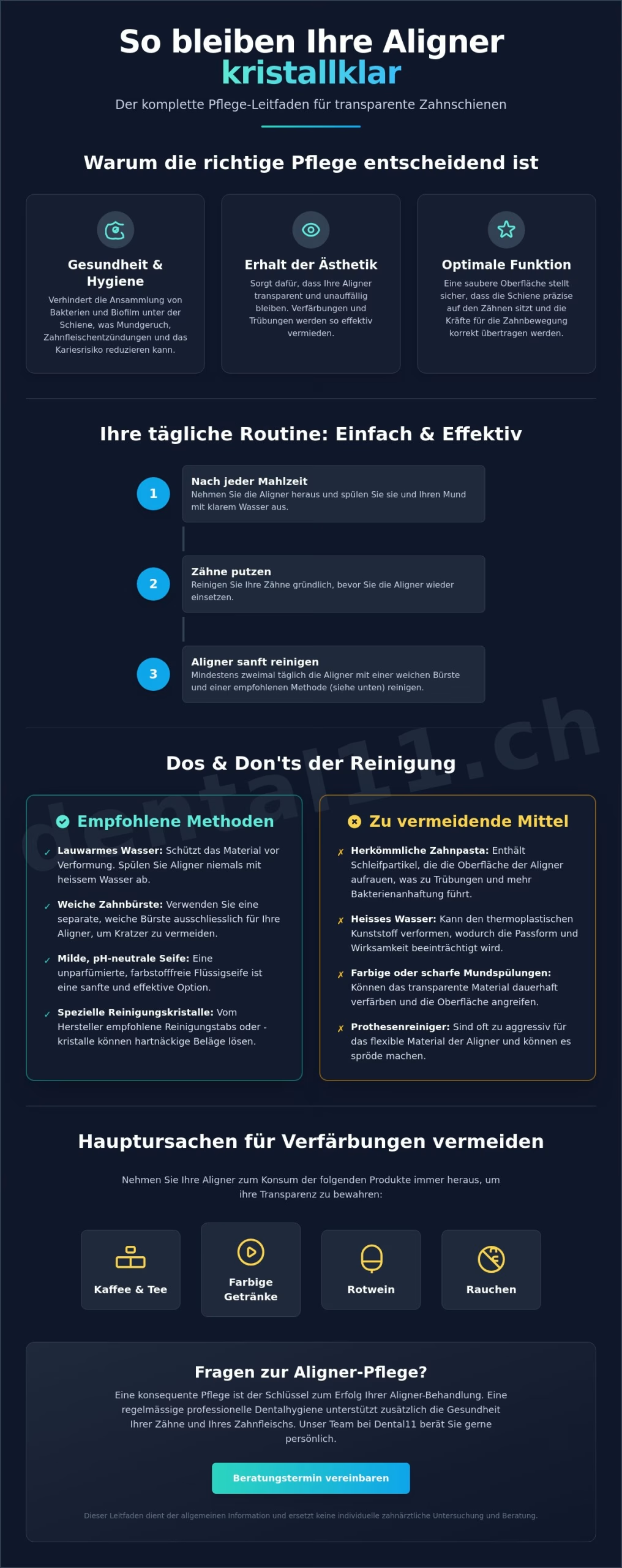
Clean your aligners twice a day with a soft toothbrush, lukewarm water and a drop of mild, colourless liquid soap; after every meal, rinse the aligner briefly before you put it back in. No toothpaste (it scratches and clouds the plastic), no hot water (it warps the aligner), no vinegar, baking soda or coloured mouthwash. Once or twice a week, a cleaning tablet for aligners or an ultrasonic bath loosens the deposits in the pores. Only drink coffee, tea or red wine, or smoke, with the aligners out, otherwise they will discolour. Because no saliva rinses the teeth under the aligner, a dental hygiene appointment every six months (CHF 99 at Dental11) is part of the treatment.
This guide explains why care matters so much, what the daily routine looks like, which home remedies do harm and what to do about discolouration.
Key points
- No saliva rinses the teeth under the aligner; without daily cleaning a biofilm forms that puts strain on tooth enamel and gums.
- Routine: twice a day with a soft brush, lukewarm water and mild soap; rinse after every meal; a cleaning tablet once or twice a week.
- Mild, colourless liquid soap is safe; toothpaste, baking soda and vinegar roughen the plastic and make the aligner cloudy.
- Coffee, tea, red wine, turmeric and smoking stain the aligners; always take the aligners out for these.
- Dental hygiene (CHF 99) every six months at Dental11 in Zürich Enge removes deposits around the attachments that the brush cannot reach.
Why regular aligner care matters for your dental health
A major advantage of aligner treatment is that it remains almost invisible in everyday life. This cosmetic comfort, however, brings a particular responsibility for your daily oral hygiene. Because the aligners usually sit directly on the teeth for 22 hours a day, an enclosed space forms between the plastic and your tooth enamel. In dentistry we look at this area critically, as the mouth's natural cleaning mechanism only works to a limited extent here.
Normally your saliva continuously washes away food particles, sugar and acids and neutralises the environment in your mouth. Under the aligner this flow of saliva is blocked. You can almost picture it as a small incubator: it is warm and moist and gives bacteria ideal conditions to grow. Without thorough cleaning, you risk harmful microorganisms multiplying unchecked. This can lead not only to bad breath but also to a higher risk of inflammation.
Aligners apply targeted pressure, but to do so they need a completely clean contact surface with the tooth. This is especially important with attachments. These are small, tooth-coloured composite bumps that act as anchors for tooth movement. Unfortunately, they also create niches where plaque tends to build up. Poor care therefore puts not only the appearance at risk but, in the worst case, also the health of your gums.
Understanding bacteria and biofilm
Bacteria stick surprisingly well to plastic surfaces. Within a short time a biofilm forms on the inside of the aligner. This sticky layer is often the main cause of unpleasant odours. If the film stays in place, the bacteria produce acids that can attack tooth enamel directly. Because protective saliva cannot reach the tooth, natural remineralisation is missing. Consistently removing these deposits is an effective way to protect your teeth against demineralisation.
Preserving the properties of the material
The precision of your aligners is the key to success. Even tiny mineral deposits from saliva can slightly affect the fit. If the aligner no longer sits exactly, the transfer of force becomes less accurate. Discoloured aligners also lose their most important property: discretion. In a professional setting, for example at meetings in Zurich, you want to be able to rely on your aligners staying clear. Careful care keeps them transparent for the whole time each aligner is worn.
Step by step: how to clean your aligners in everyday life
A reliable routine gives you confidence that your treatment stays discreet and hygienic. It is not enough to wipe the aligners only now and then; a systematic approach protects both the material and your teeth. The following guide shows you how to keep your aligners clear in everyday life. It is important to start straight after you get up, as bacteria and saliva residue can collect on the inside overnight.
During the day, rinsing after every meal is essential. Before you put the aligners back in, you should not only brush your teeth but also clean the aligners briefly under running water. This prevents food particles or sugar from being trapped between tooth and plastic. If you are out and do not have a brush to hand, at least rinse thoroughly with clean water. These simple steps go a long way towards preventing yellowish discolouration.
Mechanical cleaning with a brush
For daily cleaning, mechanically removing the biofilm is crucial. Use a separate, soft toothbrush for this. Hard bristles can cause micro-scratches in the thermoplastic material, where bacteria settle more easily and which make the aligner look cloudy over time. Also avoid coloured or highly abrasive toothpastes. The abrasives they contain are designed for natural tooth enamel but are often too harsh for the plastic. Instead, clean the aligners with gentle, circular movements on the inside and outside.
Rinsing and soaking: the right temperature
A common mistake is using water that is too hot. Because aligners are made of a special thermoplastic material, they are sensitive to high temperatures. Boiling water can distort the precise fit, which can put the success of the treatment at risk. Always use lukewarm water instead. It is quite enough to soften deposits without damaging the material. In the evening, a more thorough clean is advisable before the longest wearing period begins while you sleep.
Pay attention to storage as well: when you are not wearing the aligners, let them dry completely after cleaning before you put them in the case. A moist, closed environment in the case encourages bacterial growth. If you have doubts about the fit or notice stubborn deposits during your treatment, you can book a consultation in Zurich at any time.
Home remedies or special products: what is really good for your aligners
Choosing the right cleaning method determines whether your aligners stay clear for the whole wearing period or turn cloudy early. While mechanical cleaning with a brush is the basis, many patients look for additional ways to neutralise discolouration and odours. This often raises the question of whether familiar home remedies are enough or whether special products are a better investment. It is not only about cleanliness but above all about protecting the sensitive thermoplastic material.
Aggressive chemicals or unsuitable substances can attack the surface of the plastic. This makes the material brittle and more prone to cracks. Once the surface has been roughened, bacteria and colour pigments find it even easier to cling on. It is therefore important to choose your cleaning aids with care. There are many tips in circulation in this area, but they are not always scientifically sound and, in the worst case, can compromise the fit of your aligner.
Take care with aggressive home remedies
Vinegar is often recommended as a natural descaler. In concentrated form, however, vinegar essence can attack the structure of the plastic and lead to permanent clouding. Baking soda is similar. The fine particles it contains act like an abrasive. They leave microscopic scratches that make the aligner look dull. If you need a quick solution in between, a mild, unscented and colourless liquid soap is a much safer alternative. It dissolves grease and deposits effectively without chemically altering the material. Afterwards, simply rinse the aligners thoroughly with lukewarm water.
Special cleaners and ultrasonic baths
Specialised cleaning crystals or tablets are chemically matched to the needs of aligners. Most of them work with active oxygen, which kills bacteria and gently loosens deposits. Using them once or twice a week can help remove stubborn residue that is hard to reach with a brush alone. For a particularly deep clean in the microscopic pores of the plastic, ultrasonic cleaners can be a useful addition. These devices create vibrations that loosen even the smallest particles without putting mechanical strain on the material. They are increasingly used in Swiss households, as they reduce the effort of care and give a very hygienic feel when you wear the aligners.
Common mistakes and how to avoid discolouration
The main advantage of your aligner treatment is how inconspicuous it is. But exactly this appearance is at stake when the aligners become discoloured. It is often small lapses in everyday life that cloud the material. If you understand which factors affect clarity, you can take targeted action. This is not only about appearance but also about the hygienic condition of your aligners for the whole time you wear them.
Coffee, black tea and red wine are the classic pitfalls. The colourings they contain penetrate the fine pores of the plastic. If you do not take the aligners out when drinking these beverages, dark edges quickly appear. Smoking also leaves clear traces. Nicotine and tar not only create a yellowish film but also bind unpleasant odours to the material. These deposits are difficult to remove later. If these particles are not removed consistently, the fresh feel of wearing the aligners suffers considerably.
Another common mistake is eating with the aligners in. Even “just a little something” such as a biscuit or a piece of fruit can be a problem. The force of chewing pushes food particles under the aligner, where they stay for hours. Even more critical is poor oral hygiene before putting the aligners back in. If you trap plaque and sugar under the aligner, you create an environment that favours tooth decay. Avoiding these mistakes is one of the most important rules for treatment to run smoothly.
Recognising colourings in food
Certain foods act like ink on the plastic. Turmeric, curry and dark berries are particularly strong. Many of these healthy but strongly coloured ingredients are found in Zurich restaurants. When you eat out, always take the aligners out and rinse your mouth thoroughly with water afterwards if brushing your teeth is not possible at that moment. Sugar is another major risk: bacteria under the aligner convert it into acid, which attacks tooth enamel directly, as the protective flow of saliva is blocked.
Dealing with aligners that are already discoloured
What can you do if it has already happened? An honest professional assessment is that heavy discolouration usually cannot be fully reversed. Intensive cleaning attempts with hard brushes can even make the problem worse by roughening the surface. If the aligner has become very unsightly or smells unpleasant, switching to the next set early can be considered. However, this should always be agreed with your dentist so as not to put the tooth movements at risk. Use the experience for your next set of aligners and focus on prevention.
If you are unsure whether your aligners still fit properly or would like a professional assessment, you can book a consultation at our practice in Zurich here.
The role of professional dental hygiene at Dental11
Although a conscientious routine at home is the basis, self-care during aligner treatment reaches natural limits. Even if you follow all the cleaning tips consistently, some areas of the mouth remain hard for the toothbrush to reach. At our practice in Zurich, we place great importance on supporting you professionally during this phase. Regular check-ups make sure that your teeth and gums stay healthy despite the long daily wearing times of the aligners. The reduced flow of saliva under the plastic calls for more attention than usual.
At Dental11 in Zürich Enge, we regard professional cleaning as an integral part of successful treatment. We check not only how clean the aligners are but also the condition of your tooth enamel and how your gums respond to the mechanical load. Because the length of treatment varies from person to person, we adapt the intervals between preventive appointments to your needs. This allows us to step in early, before stubborn tartar or inflammation develops.
Dental hygiene during aligner treatment
The attachments, the small anchor points on your teeth, give bacteria additional niches. Plaque can build up here unnoticed, increasing the risk of discolouration or tooth decay. During dental hygiene in Zurich, we remove these deposits gently and thoroughly with fine instruments. We clean not only the tooth surfaces but pay particular attention to the transitions between tooth and composite attachment. This is an essential step in protecting the health of the tissues that support your teeth over the long term and in avoiding unsightly marks.
Your appointment at Dental11 in Zürich Enge
At our practice at Waffenplatzstrasse 11 in Zürich Enge, we take time for your individual concerns. Every course of treatment is different, which is why you receive advice tailored to your ClearCorrect treatment. You can read how the treatment works in the article Aligner treatment for adults. Together we discuss how you can improve your care at home and what you should look out for in your particular situation. Transparency is important to us, which is why we explain preventive measures and possible risks to you in full. At Dental11, dental hygiene costs CHF 99 and a check-up costs CHF 99; appointments are available Monday to Friday, until 8 pm on Mondays and Tuesdays.
Your path to hygienic and successful aligner treatment
Careful care of your aligners is far more than a cosmetic matter. It actively protects your oral health and makes sure that your treatment stays discreet for its whole duration. The tips covered in this article help you build a simple and effective routine into your everyday life. Remember that combining thorough mechanical cleaning with avoiding aggressive home remedies is gentle on the material and protects your teeth from bacterial deposits.
Our team will be glad to support you at every step. At our practice in Zürich Enge, a few minutes from Sihlcity, we value transparent pricing and personal care that is tailored to your individual situation. We help you pursue your treatment goals safely and keep your oral hygiene at a high level. Book your clear aligner consultation at Dental11 in Zurich now and let us look after your health together. We look forward to welcoming you in a relaxed atmosphere.
Frequently asked questions about aligner care
Can I clean my aligners with normal toothpaste?
No, you should not clean your aligners with ordinary toothpaste. The abrasive particles it contains are designed for hard tooth enamel but can roughen the softer plastic of the aligners. Bacteria and colour pigments settle more easily in these micro-scratches, which makes the aligner permanently cloudy. Instead, use a mild, colourless liquid soap and lukewarm water for gentle care of your aligners.
How often a day should I clean my aligners?
Clean your aligners thoroughly at least twice a day, ideally in the morning after you get up and in the evening before you go to bed. It is also important to rinse the aligners briefly under running water after every meal. This regular cleaning stops saliva residue from drying on and causing unpleasant odours or visible deposits that could affect your oral health.
What should I do if my aligners still smell after cleaning?
If your aligners smell despite cleaning, this points to a remaining bacterial film. In this case a more intensive soak in special cleaning crystals or the use of an ultrasonic device often helps to loosen deposits in the pores. Also make sure that your teeth are completely clean before you put the aligners back in. Sometimes the odour can also come from hidden tartar around the attachments.
Can I soak my aligners in mouthwash?
We advise against soaking aligners in mouthwash for long periods. Many mouthwashes contain colourings that can permanently stain the clear plastic. The alcohol they contain can also make the material brittle over time and affect the fit. A brief rinse with a clear, alcohol-free mouthwash is harmless, but it is no substitute for the necessary mechanical cleaning with a soft brush.
Are denture cleaning tablets suitable for aligners?
Denture cleaning tablets are only suitable to a limited extent, as they are often developed for sturdier denture materials. Some of these products are chemically too aggressive for the thin thermoplastic material of aligners. It is safer to use products that are explicitly approved for aligner systems. These crystals clean effectively without attacking the material structure or the important clarity of your aligners, or making the material brittle.
What can I do if I have no way of cleaning them while out and about?
When you are out, at least rinse the aligners and your mouth thoroughly with clean water. This removes larger food particles and dilutes acids until you have access to your toothbrush again. Never wrap the aligners in a napkin without cleaning them, as they are easily forgotten or damaged there. Always use your rigid storage case to keep them hygienic when you are out.
Can aligners be damaged by water that is too hot?
Yes, water that is too hot can permanently deform your aligners and make them unusable. The aligners are made of a special plastic that can change at high temperatures. Only use lukewarm water for cleaning, at a temperature that feels comfortable on your skin. Avoid boiling water or cleaning them in the dishwasher, as even slight deformation puts the precise fit, and with it the success of the whole treatment, at risk.
Why do my aligners turn yellowish despite cleaning?
Yellowish discolouration is usually caused by colour pigments from food or by tobacco use. Even if you take the aligners out to eat, colourings can remain in your saliva if you have not rinsed your mouth thoroughly. Tiny scratches from a brush that is too hard also make the plastic discolour more quickly. Consistent cleaning and professional dental hygiene help to keep such cosmetic issues to a minimum during treatment.
This article is for general information only and does not replace an individual dental examination.