Healing after a dental implant takes place in two phases. The gum closes within 10 to 14 days, while the bone needs 2 to 3 months in the lower jaw and 4 to 6 months in the upper jaw before the implant is firmly fused (osseointegration). For the first three days: apply cold, eat soft food, do not smoke and avoid sport. Warning signs are pain or swelling that increases again after the fourth day, fever and a loose temporary restoration. At Dental11 in Zurich Enge, an implant with crown costs from CHF 4’600, and the check-ups during healing are part of the treatment.
In this guide you will learn how the implant heals into the jawbone step by step. We explain which phases of recovery matter most and how you can support your body during this time. As the length of healing varies from person to person, you will get a clear overview of the usual timelines along with practical tips for everyday life. Our aim is to give you well-founded information so that you can go through this period with confidence and feel at ease again soon.
Key points
- The gum heals in 10 to 14 days (removal of stitches), the bone in 2 to 3 months (lower jaw) or 4 to 6 months (upper jaw); with bone grafting, 2 to 4 months longer.
- First 48 hours: apply cold (15 minutes on, 15 off), keep your head raised, eat soft food, no straw, no nicotine, no alcohol.
- Sport: light activity after one week, intensive training after two weeks; avoid sauna and sun in the first few days.
- Warning signs: pain or swelling increasing again after day 4, fever, a bad taste, a loose temporary restoration. In that case, call us.
- Dental11 Zurich Enge: implant with crown from CHF 4’600, dental hygiene to help prevent peri-implantitis CHF 99.
The phases of healing: what happens after the implant is placed?
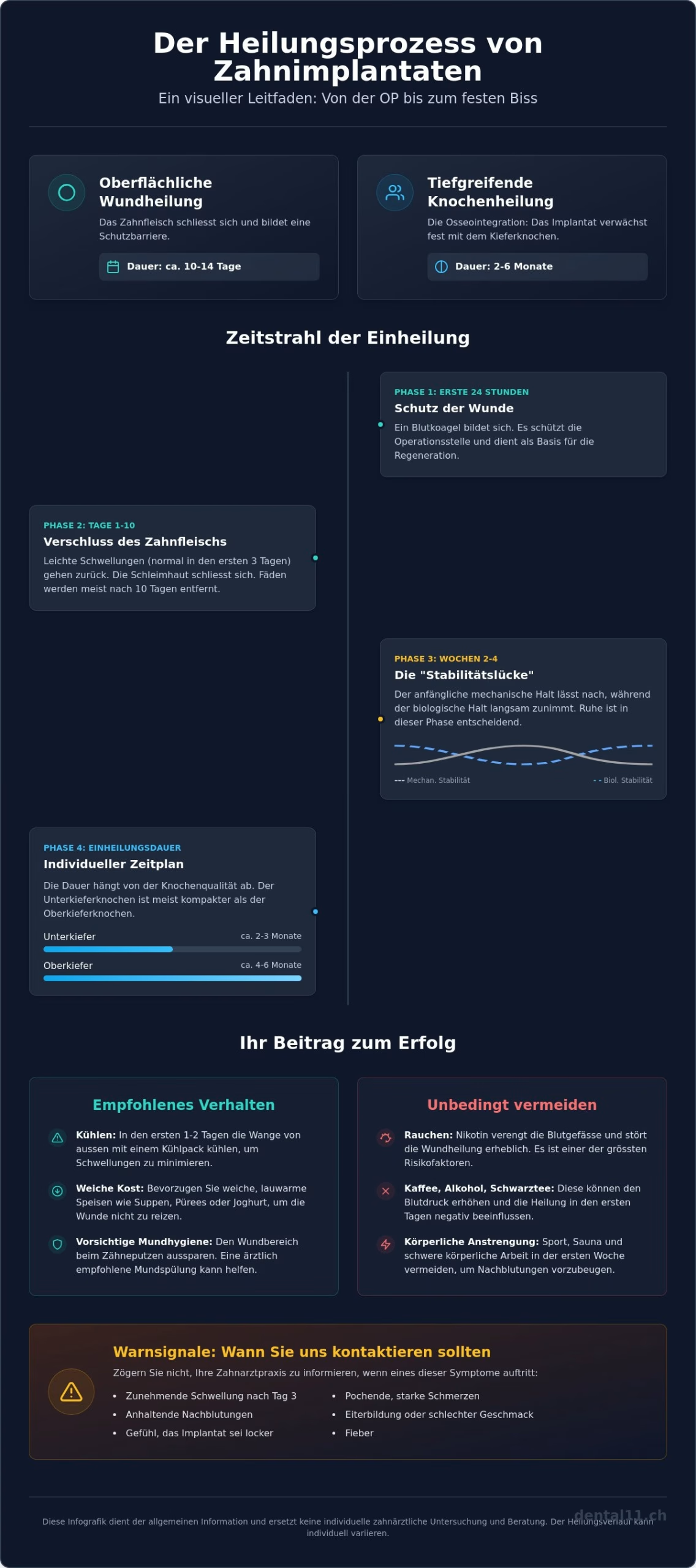
Once the implant has been placed precisely in the jawbone, a biological process begins. Your body does not treat the new root as a foreign object but starts integrating it straight away. Medically, we distinguish between two different processes: the superficial wound healing of the soft tissue and the deeper healing in the bone. In the first 24 hours, a blood clot forms around the implant shoulder. This natural plug protects the wound and serves as a framework for new cells.
Over the following 1 to 14 days, the body concentrates on closing the mucosa. The stitches are usually removed after about ten days, once the wound edges have grown together securely. An important factor for successful healing is the biocompatibility of the materials used. Both titanium and modern ceramic (zirconium dioxide) allow bone cells to grow directly onto their surface without triggering a defensive reaction.
Healing of the gum
The first ten days are particularly important for the gum to close tightly. During this time a barrier forms against bacteria from the mouth. Mild swelling in the first three days is a normal reaction of the tissue to the procedure. If swelling increases after the fourth day, however, or comes with throbbing pain, a short consultation with our practice, Dental11 in Zurich, is advisable. During this phase, be sure to avoid mechanical irritation from hard toothbrushes or firm chewing at the suture line so as not to disturb the delicate healing.
Osseointegration: when the implant becomes part of the body
While the gum heals quickly, the bone needs considerably more time. This process is called osseointegration. Bone cells grow into the microscopically fine structure of the implant surface. Here we distinguish between two kinds of stability:
- Primary stability: the purely mechanical hold the implant has in the bone directly after it is screwed in.
- Secondary stability: the biological hold created as the bone actually grows onto the implant.
Between the second and fourth week after surgery, mechanical stability often drops slightly while biological stability only builds up slowly. This “stability gap” is why the resting phase matters so much. Only if the implant is not exposed to excessive loads during this time can a lasting, stable bond form. The ability to regenerate varies between individuals and depends heavily on general health. If you have questions about your own situation, you can book an appointment to have your healing assessed professionally.
How long does the healing phase take? A timeline for a firm bite
Patience pays off, especially when it comes to your dental health. “How long do I have to wait?” is probably the question we hear most often in our practice in Zurich. The answer is as individual as your fingerprint. Healing cannot be artificially accelerated, as it depends on the body’s own capacity to regenerate. While some patients already show high stability after a few weeks, others need a little more time to build a secure base for the final restoration. We accompany you during this phase with regular check-ups to monitor progress closely.
Comparison: upper jaw vs. lower jaw
The jawbone is not built the same everywhere. In the lower jaw we usually find a very compact, firm bone structure, where the implant quickly gains mechanical hold. In the upper jaw, by contrast, the bone tends to be softer and more porous, similar to a natural sponge. It also often borders directly on the maxillary sinus. The quality of this bone bed largely determines how much time the body needs for osseointegration.
| Jaw area | Average healing time |
|---|---|
| Lower jaw | 2 to 3 months |
| Upper jaw | 4 to 6 months |
| With bone grafting (e.g. sinus lift) | An additional 2 to 4 months |
In rare exceptional cases, immediate loading is possible. However, this requires very good bone quality and very high primary stability. For most patients, the conventional approach with a protected healing phase is the safer choice for aiming at long-term stability. The prospects of healing can vary depending on the starting situation. We explain in a separate article when an immediate implant with fixed teeth in one day may be an option.
Factors that can delay healing
Certain health factors can affect the timeline. Pre-existing conditions such as poorly controlled diabetes mellitus or advanced osteoporosis often slow down the formation of new bone. Smoking is a particularly critical factor. Nicotine narrows the fine blood vessels in the gum and bone, which greatly reduces the supply of oxygen and nutrients to the implant site. Smoking during the healing phase significantly increases the risk of complications.
Oral hygiene also plays an important role from the first day. Bacterial plaque on the neighbouring teeth can spread to the fresh wound and cause inflammation. A clean mouth is an essential condition for undisturbed healing. We assess your personal suitability for an implant with modern diagnostics in order to plan your path to a firm bite precisely. Simply arrange a consultation at our practice.
What to do after surgery: your contribution to success
The surgical part is complete, but now a phase begins in which your cooperation is decisive. Smooth healing depends largely on how consistently you follow the recommendations in the first days after the procedure. We see treatment as a partnership: while we take care of precise placement, your behaviour creates good conditions for recovery. Rest and patience are your most important companions during this time.
In the first 24 to 48 hours, managing swelling is the priority. Keep cooling the affected cheek area from the outside. Use cold packs or cold, damp compresses, always wrapped in a thin cloth to avoid cold burns to the skin. A rhythm of 15 minutes of cooling and 15 minutes of rest has proven effective. You should also keep your head raised when sleeping and resting. This lowers blood pressure in the surgical area and helps reduce throbbing sensations or more pronounced swelling.
Diet, alcohol, caffeine and nicotine
While the local anaesthetic is still working, avoid eating and hot drinks to prevent biting yourself or burns. In the first three to five days, soft food is ideal. Soups, smoothies or well-cooked pasta do not put mechanical strain on the wound. When drinking smoothies, however, do not use a straw, as the suction could dislodge the important blood clot in the wound.
Particular care is needed with stimulants. Caffeine and alcohol stimulate the circulation and can encourage further bleeding. Nicotine is especially harmful to healing because it greatly reduces blood flow to the gum. You should also avoid spicy seasoning or very hot food to prevent irritation. Some patients also avoid dairy products in the first few days, as the lactic acid bacteria they contain could in theory interfere with wound healing; this is purely a precaution.
Physical activity and sport
Allow yourself at least three days of complete physical rest. Avoid heavy lifting, bending over or work that requires you to keep your head down. Such movements increase pressure in the head area and can disturb healing. Gentle walks in the fresh air are usually fine after a few days and help you feel well.
Depending on the extent of the procedure, you should take a break from intensive sport for about one to two weeks. Contact sports or high-intensity training carry a risk of jolts or injury at the implant site. Sauna sessions, sunbeds or long sunbathing are also counterproductive in the first phase, as heat dilates the blood vessels and can promote inflammation. If you are unsure whether you can resume training, we will be glad to clarify this at a short check-up.
Risks and complications: what to look out for
Although modern dental implants can last for decades with good care, biology does not always go according to plan. Smooth healing is the goal of every treatment, but as with any medical procedure, individual factors can lead to deviations. It is important to us that you are fully informed not only about the benefits but also about possible warning signs and risks. Transparency builds trust and allows you to react quickly and correctly if something goes wrong.
Mild discomfort or a feeling of pressure in the first few days is a normal reaction and can usually be well controlled with the prescribed medication. The intensity of these sensations varies and depends heavily on the complexity of the procedure and your personal situation. If the pain does not subside as expected, however, and suddenly increases again after the fourth day, this is a sign we must take seriously. In such cases, a professional assessment at our practice in Zurich Enge is the recommended step to protect the success of healing. You can read in our separate article which kinds of pain after a dental implant are normal and when you should see your dentist.
Preventing peri-implantitis
The main risk to the long-term survival of your implant is peri-implantitis. This is an inflammation of the tissue around the artificial root which, in the worst case, can lead to bone loss. It is usually caused by bacterial plaque that collects at the junction between implant and gum. Consistent dental hygiene in Zurich provides good conditions for keeping these sensitive areas free of bacteria. Once healing is complete, we support you with special cleaning aids such as interdental brushes or special dental floss to keep your gums healthy.
Recognising warning signs
Your body sends clear signals when recovery is disturbed. During the healing phase, pay particular attention to the following symptoms:
- Persistent pain: pulsating or throbbing discomfort that becomes stronger after the fourth day.
- Increasing swelling: when the cheek suddenly swells noticeably again after initially improving.
- Fever or feeling unwell: a general sense of illness may indicate an infection.
- Unpleasant taste: a bad smell or taste in the mouth can be a sign of inflammation at the wound site.
- A feeling of instability: an implant or the temporary restoration attached to it should never feel loose.
If you notice any of these signs, there is no need to panic, but it is a reason for a prompt check-up. Early intervention means most complications can be treated successfully before they put healing at risk. If you are unsure or notice a change, please contact us promptly so that we can look at the situation together.
Individual support during healing at Dental11 in Zurich Enge
The path to a stable foundation does not end with the surgical procedure. At Dental11 in Zurich Enge, we see the healing phase as a time in which we accompany you closely, using modern diagnostics. Our approach combines technological progress with personal, attentive care. We know that every patient has different needs and perhaps concerns as well. That is why we take the time needed for calm and safe recovery.
To make healing as efficient as possible, we rely on precise digital planning. Three-dimensional imaging allows us to prepare the procedure in a minimally invasive way. This often means less tissue trauma and a potentially quicker return to your usual routine. For you, this means more comfort and greater predictability throughout the process. It matters to us that you feel well looked after at every stage.
Clear and understandable costs are an essential part of how we see our service. Before treatment begins, we draw up a detailed plan that sets out both the medical steps and the costs transparently: implant with crown from CHF 4’600, extraction from CHF 180, bone grafting shown separately if needed, billing according to the Dentotar tariff. Our location in Zurich Enge, a few minutes from Sihlcity and Enge railway station, also makes it easy to fit check-up appointments into your daily life, with appointments until 8 pm on Mondays and Tuesdays.
Quality and precision
Quality in implantology is no coincidence. Dental11 is a member of the Swiss Dental Association SSO and the Zurich Dental Association, and uses clinically proven implant systems. Our team also takes the time needed for complex cases or anxious patients. Stable healing is based on this combination of high-quality materials, precise diagnostics and professional expertise.
Your next step towards fixed teeth
Every jaw and every starting situation is different. That is why we warmly invite you to a personal consultation at our modern practice. Together we will discuss your wishes and answer all your questions about the biological processes and the possible types of restoration. We will draw up an individual healing and cost plan tailored precisely to your situation.
Your path to a better quality of life and fixed teeth
Successful healing is the result of precise dental work and your careful aftercare at home. Biological healing takes time and depends on individual factors such as bone quality. With the right diet, consistent hygiene and physical rest in the first days, you lay the foundation for a stable bond between implant and jaw.
At Dental11 we use digital diagnostics to make the procedure as gentle as possible for you. We accompany you with a transparent cost structure without hidden fees and with personal care through every phase of recovery. Thanks to our location in Zurich Enge, we are easy to reach for your check-up appointments.
We are happy to take time for your questions and to draw up a plan that fits your individual situation. Book a consultation in Zurich Enge now. We look forward to welcoming you to our practice soon.
Frequently asked questions about the healing process
How long does it take for a dental implant to heal completely?
Complete healing usually takes between three and six months. While the lower jaw, with its firmer bone structure, can often bear load after two to three months, the upper jaw usually needs four to six months. The exact time also depends heavily on your personal capacity to regenerate and on bone quality. We accompany you with regular check-ups to determine the right time for the final crown.
Will I have a gap in my teeth during the healing phase?
No, you do not have to live with a visible gap during the healing phase. We offer various options for a temporary restoration that maintains both appearance and chewing function while you wait. The temporary restoration is designed so that it does not put load on the healing implant. In a consultation, we will find the solution that best suits your lifestyle and needs together.
When are the stitches removed after implant placement?
The stitches are usually removed seven to fourteen days after the procedure. This appointment is generally short and causes little discomfort; it also allows us to assess the initial healing of the gum. In some cases we use self-dissolving stitches that do not need to be removed. We will tell you directly after surgery which method was used in your case and what the next steps are.
When can I do sport again after the implant has been placed?
You can usually start light training again after about one week. You should avoid intensive sports, heavy strength training or high-impact sports for at least two weeks. Physical exertion raises blood pressure, which can encourage further bleeding or swelling at the wound site. Listen to your body and increase intensity only gradually so as not to put healing at risk.
Can I smoke during the healing period?
We strongly advise you to stop smoking for the entire healing period, or at least to cut down considerably. Nicotine greatly impairs blood flow to the bone and gum, which increases the risk of disturbed healing or implant loss. A smoke-free healing phase provides good conditions for long-term stable anchorage. We are happy to give you tips on preparing for this important phase of recovery.
What can I do if the swelling does not go down after surgery?
Mild swelling up to the third day after surgery is completely normal and a natural reaction of the tissue. If the swelling increases again after the fourth day, however, or is accompanied by throbbing pain and fever, please contact us immediately. Consistent cooling and keeping your head raised while sleeping are the key measures in the first 48 hours. If you are unsure, a short check-up at our practice is always the safe course.
How should I clean my teeth during the healing phase?
In the first few days, carefully avoid the wound site itself when brushing. Clean the rest of your teeth as usual, but with a soft toothbrush to avoid irritation. We often prescribe an antibacterial mouth rinse that reduces the number of germs in the mouth without applying mechanical pressure. After the stitches have been removed, we will be glad to show you special techniques for gently caring for the implant area with interdental brushes or special dental floss.
Does insurance cover the cost of aftercare?
In Switzerland, the costs of dental implants and aftercare are generally not covered by compulsory basic health insurance (KVG). Exceptions exist only for severe, unavoidable illnesses or accidents. However, many patients have private supplementary dental insurance (VVG) that covers part of the costs. We will be glad to prepare a detailed cost estimate that you can submit to your insurer in advance so that they can review it and clarify cost coverage.
This article is for general information only and does not replace an individual dental examination.