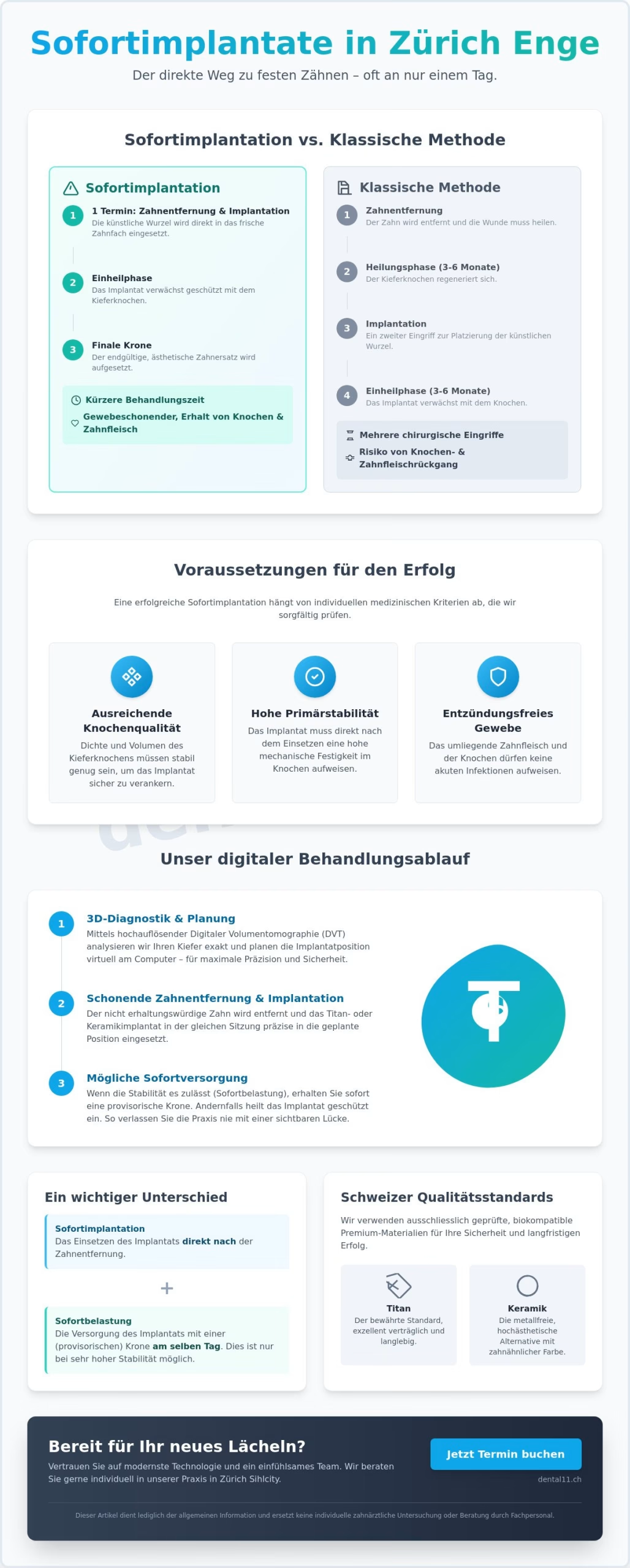
With an immediate implant, the artificial tooth root is placed in the same appointment as the tooth extraction, instead of after three to six months of bone healing. You often receive a temporary crown on the same day, so you leave the practice without a visible gap. The requirements are enough stable bone and an area free of inflammation; the final crown follows once the implant has healed in. At Dental11 in Zürich Enge, an implant with crown costs from CHF 4’600.
In this article you will learn what the process with 3D diagnostics looks like, who is suitable for an immediate implant, what the risks are and what it costs, so that you can make an informed decision about your long-term dental health.
Key points
- Immediate implantation means the implant is placed in the same appointment as the tooth extraction; immediate loading means a temporary crown on the same day, only with good primary stability.
- Requirements: enough stable bone, no acute inflammation, good oral hygiene; smoking and uncontrolled diabetes increase the risk.
- Advantages: fewer procedures, shorter overall treatment time, preservation of bone and the gum line, no visible gap.
- Healing time until the final crown: usually three to six months.
- Costs at Dental11: implant with crown from CHF 4’600, extraction from CHF 180; written cost estimate based on the Dentotar tariff.
What is an immediate implant? Modern tooth replacement in Zürich Enge
An immediate implant is a contemporary way to close a gap discreetly and functionally without long waiting times. With this method, we place the artificial tooth root directly into the fresh extraction socket, immediately after a tooth that cannot be saved has been removed. An implant is a screw made of titanium or ceramic that fuses firmly with the jawbone through the biological process of osseointegration, forming a stable foundation for the replacement tooth.
The main advantage over conventional delayed implantation is the time saved. With conventional procedures, a healing phase of three to six months often has to pass before the implant can be placed; here, this waiting time is eliminated completely. For our patients, an immediate implant means fewer surgical procedures and noticeably fewer appointments at the practice. This is gentler on the tissue and also helps to preserve the natural bone structure and the gum line.
The location of Dental11 in Zürich Enge, a few minutes from Sihlcity and Enge railway station, makes aftercare easy to fit into everyday life. Check-ups can be integrated into your day without difficulty, and on Mondays and Tuesdays appointments are available until 8 pm.
Immediate implantation vs. immediate loading: an important difference
In dentistry, we distinguish clearly between the time of implantation and the time of loading. Immediate implantation simply describes the surgical step of placing the implant directly after the extraction. Immediate loading is something different: here the implant receives a temporary or final crown on the same day. Whether an immediate implant can be loaded straight away depends on several factors:
- Primary stability: the implant must achieve sufficient firmness in the bone when it is placed.
- Bone quality: the density of the jaw has a major influence on whether immediate restoration succeeds.
- Absence of inflammation: the surrounding tissue must not show any acute infection.
Not every implant is suitable for immediate loading. In some cases a protected healing phase under the gum is safer in order to ensure long-term stability.
Materials and quality
At Dental11 we use implants made of biocompatible titanium or metal-free ceramic, which are known for their durability and tolerability. Our clinical experience in implant dentistry allows us to make precise diagnoses and to tailor the treatment to your needs.
Dental11 is a member of the Swiss Dental Association SSO and the Zurich Dental Society. We value transparency and honest communication about the possibilities and limits of modern implant dentistry, so that you feel confident at every step.
The treatment process: from diagnosis to a firm tooth root
At Dental11 in Zürich Enge, the path to your new smile begins with a thorough assessment. We take plenty of time to understand your individual situation. First, we take high-resolution 3D images using cone beam computed tomography (CBCT). This technique allows us to analyse your jawbone and the surrounding nerve structures to the millimetre. An immediate implant requires this careful preparation so that stability is ensured directly after placement. Every plan is individual and tailored precisely to your anatomy.
Digital planning for greater safety
In the past, uncomfortable impressions with thick impression material were standard. Today we use modern digital scanners. This is considerably more comfortable for you and provides more precise data. On the computer, we simulate the future position of the tooth root virtually. We can see in advance exactly where the implant will find the best support. This detailed preliminary analysis considerably reduces surgical risks. We plan the procedure so accurately that there are no uncertainties on the day of treatment. This gives you and us the confidence needed for a predictable result. The digital simulation also helps to position the future replacement tooth correctly before the first incision.
Gentle surgical procedures
On the day of treatment itself, the tooth that cannot be saved is extracted and the implant is usually placed in a single appointment. We consistently use minimally invasive techniques. This protects the surrounding soft tissue and supports quick healing. Careful local anaesthesia ensures that you can stay relaxed during the procedure. Our team guides you attentively through every single step. You receive clear written recommendations for the first days after the appointment, so that recovery goes as smoothly as possible.
After implantation, the artificial root often receives a temporary crown straight away. This means you do not leave our practice with a visible gap. The actual healing phase, during which the material fuses firmly with the jawbone, usually takes three to six months. Once this process is complete, we make your final, permanent crown. Its shape and shade are matched individually to your natural teeth. An immediate implant gives you a timely restoration that works well and blends in harmoniously with your other teeth. Whether this method can be used in your case depends on factors such as bone density and your general oral health.
Requirements and limits: who is suitable for an immediate implant?
An immediate implant in Zürich Enge offers many advantages, but its medical success depends largely on your individual circumstances. Not every jaw is ready for this method straight away. For us at Dental11, the most important criterion is what is known as primary stability. This means the firm, mechanical hold that the implant finds in the bone directly after placement. This initial firmness determines whether the implant can heal in safely.
There are clear factors that can speak against immediate treatment. These include:
- Acute inflammation: if there is a purulent infection at the tooth root or in the surrounding tissue, it must heal completely first.
- Heavy smoking: nicotine reduces blood flow to the gums and considerably delays wound healing.
- Systemic conditions: poorly controlled diabetes mellitus or advanced osteoporosis can increase the risk of implant loss.
- Inadequate oral hygiene: without consistent care at home, long-term success is at risk, as bacteria can cause inflammation around the implant (peri-implantitis).
At our practice in Zürich Enge, we take plenty of time for honest and transparent advice. We check carefully whether an immediate implant is the safest solution for your specific situation, or whether a conventional approach with a longer healing phase is preferable.
Bone quality and anatomy
The amount of bone available at the extraction site is decisive. In the lower jaw the bone is usually more compact and firm, which often favours immediate restoration. The upper jaw frequently has a softer structure, which requires more precise planning. If there is not enough bone, bone grafting may be needed beforehand or at the same time. In such cases we often decide against immediate loading so as not to put stability at risk. We use modern digital diagnostics to assess your bone volume in three dimensions.
Risks and managing complications
Although the success rates of modern implant systems are high, there are residual risks such as delayed healing or loss of the implant in the early phase. We inform you openly about these possibilities. A close schedule of post-operative check-ups is standard at Dental11. If you have pre-existing conditions such as diabetes, we coordinate with your family doctor where necessary. Our aim is a restoration that is not only quick but, above all, lasting. If you are unsure whether your bone structure is sufficient, you can book an appointment here for an initial assessment.
Advantages and considerations: immediate implantation vs. the conventional method
If you are interested in an immediate implant, you are usually choosing between an established traditional approach and a more efficient modern one. The conventional method requires patience. After the tooth is removed, the jawbone usually has to heal for three to six months before the implant is even placed. This is followed by a further healing phase. In total, patients often wait nine months for their fixed replacement tooth. An immediate implant shortens this path considerably. Here, implantation takes place immediately after the extraction in the same appointment. This reduces the treatment time to a few weeks or months, depending on individual healing.
A key factor is the preservation of bone. As soon as a tooth is missing, the body begins to break down the bone that is no longer under load. This process starts after just a few weeks. Placing an implant directly means the bone continues to be stimulated. This helps to prevent bone loss and preserves the natural contours of the face. Psychologically, there is also no burden from visible gaps or loose temporary dentures, which supports self-confidence in everyday life.
A focus on aesthetic results
Aesthetics depend largely on the gum line. With immediate implantation, the implant together with a temporary crown acts as a support for the soft tissue. It prevents the papillae, the small triangles of gum between the teeth, from collapsing. Restoring these structures later is often surgically complex. Acting quickly preserves the natural frame of your smile. The final crown then blends in so seamlessly that it is hard to tell apart from natural teeth. This effect is particularly valuable for front teeth.
Cost and time management
For many people in the busy business city of Zurich, time is valuable. The conventional method requires two separate surgical procedures and numerous check-ups. With an immediate implant, we noticeably reduce the number of visits needed. This means less time off work and less psychological strain from repeated procedures. From a financial point of view, the costs of extensive bone grafting, which might have become necessary after a longer wait, are often avoided. At Dental11 we place great importance on transparency: an implant with crown costs from CHF 4’600, extraction from CHF 180; all items are listed in advance in the cost estimate.
Whether this method is suitable for you depends on factors such as bone density and whether the area is free of inflammation. At our practice we use precise digital diagnostics to assess the stability of the implant objectively during the procedure. We advise you with care and show you the safest solution for you.
Your appointment for immediate implants at Dental11 in Zürich Enge
Fixed replacement teeth mean quality of life. At Dental11 in Zürich Enge, we understand that the path to new teeth requires trust. Our practice philosophy combines modern digital technology with genuine empathy for your individual needs. We create an environment in which you feel like a valued guest rather than a number. In our bright rooms at Waffenplatzstrasse 11, we rely on calm, respectful communication so that you feel confident at every step.
The decision to have an immediate implant often comes with many questions. Our team takes the time needed to analyse your situation carefully. We use high-resolution diagnostics to plan the treatment precisely. Your comfort is always our focus. We listen to you and work with you to develop a solution that suits you both functionally and aesthetically.
Fair prices and payment in instalments
Financial clarity is an essential principle of our practice. We know that high-quality dentistry is an investment. That is why we communicate all costs openly and honestly from the start. We charge strictly according to the Swiss dental tariff (Dentotar). Before your treatment begins, you receive a detailed cost estimate; an implant with crown costs from CHF 4’600. There are no hidden fees or unexpected surcharges.
- Detailed cost breakdowns according to the Dentotar system.
- Implant with crown from CHF 4’600, extraction from CHF 180, bone grafting listed separately if needed.
- Payment in instalments through the Zahnärztekasse, so that the financial outlay can be planned.
Every situation is unique. The actual costs depend greatly on your individual bone condition and the material chosen. In a personal consultation, we show you various options that fit your budget.
Care for anxious patients
Many people feel uneasy at the thought of visiting the dentist. At Dental11 we deliberately take time to reduce exactly this stress. We offer attentive care in a relaxed atmosphere. Our aim is to give you back a sense of control over the situation. We explain every step and use particularly gentle methods to make the procedure as comfortable as possible. As an experienced dentist in Zurich, we know that patience and understanding are often just as important as technical skill.
Our practice is located at Waffenplatzstrasse 11 in Zürich Enge. Trams 5, 13 and 17 stop at Waffenplatzstrasse, S-Bahn trains stop at Enge station, and parking is available in the Sihlcity car park. We warmly invite you to visit us for a no-obligation initial consultation. Discover how modern dentistry can make a positive difference to your everyday life.
Your path to a better quality of life with fixed replacement teeth
Provided the medical requirements are met, an immediate implant allows you to leave the practice on the day of implantation with a fixed restoration. At Dental11 we attach great importance to careful planning. For this we use modern 3D diagnostics to achieve precise results and to weigh up risks individually. As every situation is unique, we take plenty of time for your personal concerns. We advise you with care and explain all options and treatment alternatives. A stable bite and natural-looking aesthetics make a major contribution to your daily well-being.
Our practice is located at Waffenplatzstrasse 11 in Zürich Enge and is easy to reach. Trust comes from clarity; that is why we charge for our services transparently according to the Dentotar tariff, implant with crown from CHF 4’600. This way you know exactly what investment in your dental health to expect. We rely on honest communication without false promises, so that you always feel confident with us.
Book your consultation for immediate implants in Zürich Enge now
We look forward to welcoming you in our relaxed atmosphere and finding the right solution for your long-term oral health together.
Frequently asked questions about immediate implants
How much does an immediate implant cost in Zurich?
At Dental11, a single-tooth implant including crown costs from CHF 4’600, and extraction of the tooth from CHF 180. The final price depends on the crown material and on whether bone grafting is needed. After the 3D diagnostics, you receive a detailed cost estimate based on the Dentotar tariff.
Is having an immediate implant placed painful?
The procedure is carried out under local anaesthesia, so you will not feel any pain during treatment. Once the anaesthetic wears off, you may notice a slight feeling of pressure or some swelling, which is completely normal. These symptoms can usually be managed well with common painkillers and subside on their own within a few days.
How long does healing take with an immediate implant?
The biological healing phase, during which the implant fuses firmly with the jawbone, usually takes between three and six months. Although you often leave the practice on the same day with a fixed temporary restoration, your body needs this time for complete osseointegration. During these months you should not put excessive load on the implant, so as to support the healing process.
Can every tooth be replaced with an immediate implant?
An immediate implant is only an option if the available bone is stable enough and there is no acute inflammation at the tooth root. This is often the case with front teeth and less often with back teeth. We check your suitability using high-resolution digital diagnostics to make sure that the implant achieves the primary stability needed for immediate restoration.
What are the risks of immediate implantation?
Possible risks include wound healing problems, infection in the surgical area or insufficient firmness of the implant in the bone. In rare cases the implant may not heal in as intended and has to be removed. Careful planning and modern technology help us to minimise these risks, but a residual surgical risk remains, which we explain to you fully beforehand.
Does health insurance in Switzerland cover the cost of implants?
Compulsory basic health insurance only covers the cost of an implant in cases of severe systemic illness or after accidents. In most cases it is a private service paid for by the patient. If you have supplementary dental insurance, part of the treatment costs is often reimbursed, depending on your policy and insurance model.
How long do immediate implants last compared with conventional implants?
When correctly indicated, immediate implants have a similarly good long-term prognosis to conventional implants and can last for decades with good oral hygiene and regular professional cleaning. Thorough oral care is essential to prevent inflammation such as peri-implantitis and to keep the artificial tooth root in place for the long term.
This article is for general information only and does not replace an individual dental examination.