
Clinically reviewed by MDDr.(CZE) Polydefkis Papaioannou, dentist, Dental11 Zurich · Updated 10/2026
Pain after a dental implant is normal for the first three to five days; swelling and a feeling of pressure peak after 48 to 72 hours and then ease day by day. Ibuprofen or paracetamol taken according to the practice's schedule, cooling at intervals and soft food are usually enough. It is not normal if the pain increases after the third day, if the swelling grows again, or if you have a fever, pus, an unpleasant taste or numbness in the lip or chin. In these cases, call Dental11 in Zürich Enge; at weekends, the emergency dental service of the Canton of Zurich can help on 0800 33 66 55. Pain at an implant that has been in place for years points to peri-implantitis or a loose screw and should also be checked.
In this article, you will learn which symptoms are entirely normal in the first phase and which simple measures can gently support your recovery. We explain how healing usually progresses and which specific signs mean you should contact us in Zurich for a short check-up. This gives you a clear picture of your recovery period, so you can soon look forward to chewing with confidence again.
Key points
- Mild discomfort and swelling in the first few days are the body's natural response as the tissue heals.
- From the fourth day, the discomfort should ease noticeably; increasing, pulsating pain, fever or pus are warning signs of an infection.
- Cooling at set intervals and following the medication schedule consistently help you manage the first phase of recovery well.
- Digital 3D planning at our practice helps to keep tissue trauma to a minimum and supports healing.
- Aftercare at Dental11 in Zürich Enge: check-up after one to two weeks (stitch removal), an X-ray check once the implant has healed, then dental hygiene (CHF 99) twice a year. Implant with crown from CHF 4’600.
Pain after a dental implant: what to expect immediately after the procedure
Placing an artificial tooth root is a precise surgical procedure that starts a targeted healing process in the tissue. The implant is anchored in the jawbone and fuses with it over the following months (osseointegration). As soon as the local anaesthetic wears off, your body actively begins to regenerate. This transition is the moment when you first become aware of the surgical area. Many patients at our practice in Zurich wonder during this phase which kind of pain after a dental implant counts as normal.
It is important to distinguish between superficial wound pain and a deeper feeling of pressure in the jaw. While the wound in the gum may burn or pull in the first few hours, the feeling of pressure usually results from the stretching of the tissue and the insertion of the implant body. Mild swelling is no cause for concern. It is a natural protective response: the body increases blood flow to the affected area to bring important healing cells to where they are needed.
The first 24 to 72 hours
Within the first three days after the implant is placed, discomfort and swelling usually reach their peak. During this initial phase, there may be slight bleeding or a small bruise may appear on the cheek. These side effects have a clear biological explanation and usually fade quickly. Rest is now the top priority. We advise our patients to avoid sport and heavy physical work so that blood pressure stays stable and the fresh wound can heal undisturbed. A calm daily rhythm makes a real difference to the body's own regeneration.
Normal sensations vs. acute pain
What a patient perceives as “normal” depends greatly on their individual pain threshold. While some people feel only a slight throbbing, others experience the pain after a dental implant more intensely. Perception is also influenced by the complexity of the procedure, for example if bone grafting was carried out at the same time. The prescribed medication plays a central role here. Painkillers should be taken according to the schedule we have prepared for you. Moderate discomfort that responds well to the prescribed medication is part of normal healing. If the pain becomes unbearable despite medication, however, it makes sense to get in touch with us.
The healing process: a timeline for your recovery
Healing after an implant procedure is not a single event but a sequence of biologically coordinated phases. While the first few days are often marked by visible reactions, the body's real work takes place out of sight. Many patients find it helpful to picture this process as a timeline. This makes it easier to put pain after a dental implant into context and avoid unnecessary worry. As a rule, the seventh day marks a turning point, when most visible symptoms subside noticeably.
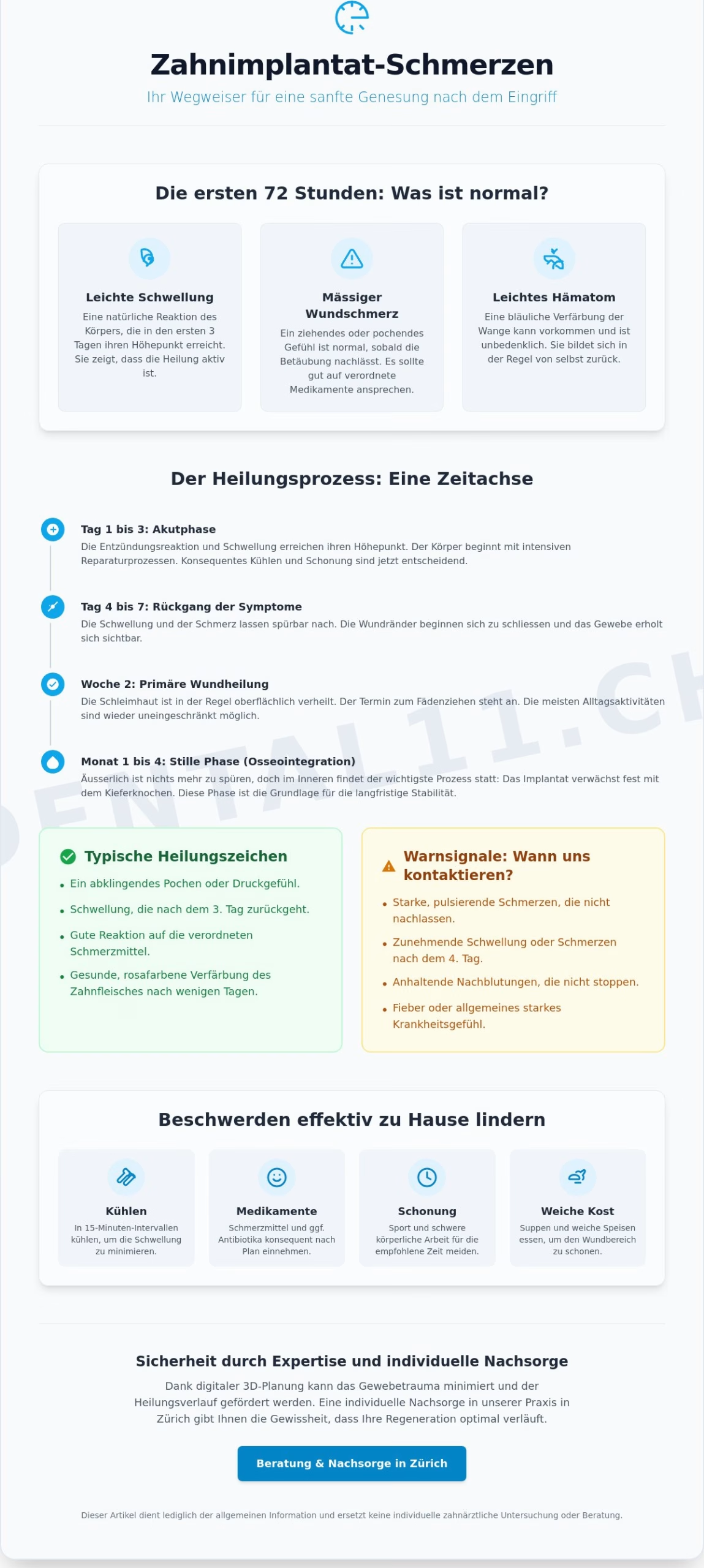
- Days 1 to 3: The inflammatory response peaks during this time. Swelling is at its most pronounced. This is a sign of high metabolic activity in your jaw.
- Days 4 to 7: The edges of the wound begin to firm up. The swelling goes down and the tissue changes from a strong red to a healthy pink.
- Week 2: The appointment for stitch removal is due. Primary healing of the gum tissue is usually complete.
- Months 1 to 4: This is the “quiet phase”. The implant fuses firmly with the bone, a process we call osseointegration.
Biological milestones of healing
Immediately after placement, a blood clot forms around the implant and acts as a framework for new bone cells. Over the following weeks, specialised cells transform this framework into load-bearing bone tissue. During this time, the implant is firmly anchored but still biologically sensitive to excessive load. Factors such as your general health and bone quality play an important role here. In the long term, too, watch for warning signs such as bleeding gums or pus at the implant so as not to put the result at risk. Thorough but gentle care is the basis for lasting stability. We describe all phases of the healing process after a dental implant in a separate article.
What to do in each phase
Your cooperation is key to a smooth recovery. In the first few days after the procedure, choose soft foods that need hardly any chewing. Soup, smoothies or purées are ideal. Once the stitches have been removed, you can gradually return to your usual diet. When cleaning your teeth, avoid touching the wound directly with the toothbrush in the first week; special rinses help keep the area clean instead. Sport can usually be resumed after about a week, provided it is not a contact sport. If you are unsure whether your recovery is on schedule, you can book an appointment at any time to have your progress checked at our practice in Zurich.
Warning signs: when is pain at the implant no longer normal?
Having looked at the usual recovery timeline, it is important to know where natural healing ends and complications that need treatment begin. With pain at an implant, how it develops over time is the most important indicator. Normal healing is marked by steady improvement. If your discomfort does not subside after the third day but becomes more intense, this is a clear signal from your body that needs to be assessed by a professional.
A pulsating or throbbing feeling in the jaw, often accompanied by an unpleasant taste in the mouth, frequently indicates early inflammation or an abscess. Persistent numbness or tingling in the lip, tongue or chin should be taken just as seriously. Such sensory changes can point to irritation of the nerves and should be examined promptly. If you also have a fever, chills or feel generally unwell, your body may be reacting to a local infection. In these cases, waiting is not advisable.
Peri-implantitis: recognising the inflammation
One of the biggest challenges for long-term success is peri-implantitis. This is not a superficial irritation of the gum but a deeper inflammation that can attack the jawbone around the implant. Warning signs are dark red, shiny gums that bleed under light pressure or even release pus. Prompt treatment by our team can, in many cases, stop the bone loss and save the implant for the long term. Early diagnosis often decides whether the restoration can be kept.
Late complications: pain after months or years
Problems can also arise when the implant has been anchored in the jaw without any trouble for years. The causes often lie in mechanical overload, for example from grinding your teeth at night, or in changes in your general oral health. Loose connecting screws between the implant and the crown can also cause irritation that feels like a dull ache. Regular check-ups at Dental11 in Zurich are therefore essential to identify such mechanical problems early, before they become a biological problem. If you are unsure, please make an appointment for a check-up.
Practical help: relieving discomfort effectively at home
The good news is that you can influence your healing after treatment to a large extent yourself. Having covered the biological phases and warning signs in the previous sections, we now focus on concrete measures for your everyday life. The aim is to keep the typical pain after a dental implant as low as possible and give your body the rest it needs for osseointegration.
Cooling correctly is a central part of this. Many patients make the mistake of cooling the cheek continuously. Instead, we recommend an interval approach: cool the affected area for about 10 to 15 minutes, then take a break of the same length. Always wrap the cold pack in a thin cloth to avoid frostbite on the skin. This method reduces swelling effectively without disrupting blood flow in the long term.
Also pay attention to your sleeping position. Keeping your upper body slightly raised for the first few nights lowers the blood pressure in your head. This helps prevent throbbing at night and allows swelling to go down more quickly. At the same time, it is essential to follow the dosage schedule for painkillers. Do not wait until the pain becomes unbearable before taking the medication; follow the plan we gave you in Zurich.
Home remedies and gentle support
Alongside the usual medication, gentle home remedies can support your recovery. From the second day, you can carefully rinse with lukewarm salt water or an alcohol-free antiseptic solution. This keeps the number of germs in your mouth low. Avoid any form of heat, however. Saunas, sunbeds or direct sunlight dilate the blood vessels and can encourage bleeding and swelling. Remember: cooling from outside helps, while heat from inside or outside is counterproductive.
What you should definitely avoid
- No experiments: Do not touch the wound with your fingers or tongue. This introduces bacteria and disturbs the fresh stitches.
- Take care when eating: In the early days, always chew on the opposite side so as not to put mechanical pressure on the new implant.
- Avoid nicotine and caffeine: Nicotine and caffeine narrow the blood vessels or raise blood pressure unnecessarily. Both can delay wound healing.
Avoid physical exertion for at least three to seven days. High blood pressure can strain the fresh wound and lead to unnecessary discomfort. If you have questions about your individual recovery or would like a personal consultation, you can make an appointment at any time.
Careful planning: pain management at Dental11 in Zurich
A successful implant procedure begins long before the surgery itself. At our practice in Zurich, we combine a caring approach with precise technology to keep you comfortable during and after treatment. One important factor that affects how much pain you have after a dental implant is the way the surgery is carried out. The more precisely we plan, the less strain is placed on the surrounding tissue. The result is usually a calmer and more predictable recovery for our patients.
We use digital 3D imaging (CBCT) to capture the anatomy of your jaw to the millimetre. This technology allows us to visualise the course of the nerves and the bone structure precisely in advance. With this computer-assisted planning, we can often perform the procedure in a minimally invasive way. For you, this means smaller incisions, less tissue trauma and less tendency to swell. Digital precision is therefore the foundation of modern pain management that is gentle on the body and supports natural regeneration.
Modern technology for gentle treatment
At our practice, minimally invasive surgery is part of everyday work. We use materials with good biocompatibility that support integration into the jawbone. Thorough diagnostics in advance help us reduce risks before the first treatment step. If acute problems or uncertainties arise despite all precautions, we are there for you. Call us Monday to Friday; if you have complications after an implant procedure, we will see you as soon as possible. At weekends and at night, the emergency dental service of the Canton of Zurich can help on 0800 33 66 55. You can book routine check-ups in Zürich Enge online.
Your appointment at Dental11
We warmly invite you to a no-obligation consultation in the relaxed atmosphere of our practice. We know that cost plays an important role when it comes to replacing teeth. An implant with a crown at Dental11 costs from CHF 4’600; you will receive a cost estimate based on the Dentotar tariff before treatment, and payment in instalments is possible through the Zahnärztekasse. We take the time to discuss your individual concerns and draw up a treatment plan tailored to you. Your oral health and wellbeing are our shared goal. You can rely on care that combines professional knowledge with a personal touch.
Your path to chewing with confidence in Zurich
A dental implant is a valuable investment in your quality of life and deserves knowledgeable, caring support. We have seen that temporary sensitivity immediately after the procedure is biologically normal and can be managed well with targeted measures. The basis for successful healing is precise diagnostics and your understanding of your body's natural regeneration phases. If you are still unsure about pain after your dental implant, our team is always available to you.
At Dental11, Waffenplatzstrasse 11 in Zürich Enge, we use 3D planning to minimise surgical trauma and support healing. We place great value on honest communication and a cost estimate based on the Dentotar tariff; payment in instalments is possible through the Zahnärztekasse. Our aim is for you to feel safe and well looked after at every stage of your treatment.
Book your consultation at Dental11 in Zurich now. We look forward to giving you professional support on your way to a stable smile.
Frequently asked questions (FAQs)
How long does pain last after a dental implant?
Mild pain usually subsides after three to five days. It is generally strongest in the first 48 hours and should decrease steadily after that. As every healing process is individual, the duration can vary depending on the extent of the procedure and your personal pain tolerance. If the discomfort has not clearly eased after a week, we recommend a short check-up at our practice in Zurich.
Which painkillers work best after an implant procedure?
As a rule, we prescribe proven medicines such as ibuprofen or paracetamol, which reduce inflammation and relieve pain. It is important that you take the medication according to the dosage schedule we have prepared for you. Avoid taking products such as aspirin on your own, as they affect blood clotting and can encourage bleeding. The choice of medicine always depends on your medical history.
Is a throbbing feeling in the jaw normal after the implant is placed?
A slight throbbing is entirely normal in the first two to three days after the procedure. It is a sign of increased blood flow in the wound area, which the biological healing process needs. This rhythmic sensation is often part of the initial inflammatory response. As long as the throbbing does not get stronger or come with a fever, there is usually no cause for concern.
When can I eat and drink normally again after the surgery?
You can drink and eat again once the local anaesthetic has fully worn off, so that you do not injure yourself by biting accidentally. In the first few days, soft foods such as soup, yoghurt or purée are ideal to protect the wound from mechanical strain. Avoid very hot, spicy or acidic foods and drinks containing caffeine, as these can stimulate blood flow. After about a week, a normal diet is usually possible again.
Why do I have pain at my implant when the procedure was years ago?
Pain at an implant that healed in long ago can point to peri-implantitis or mechanical overload. The cause is often inflammation of the tissue due to bacteria, similar to periodontitis around a natural tooth. Grinding your teeth at night can also cause pressure pain. Because problems can arise even after years, a professional diagnosis at Dental11 is essential to keep the restoration stable.
Can the body reject a dental implant?
A true rejection in the immunological sense is extremely rare with titanium implants because of their high biocompatibility. It can happen, however, that an implant does not fuse firmly with the bone. Common causes are poor blood supply, local infections or heavy smoking during the healing phase. With our precise digital 3D planning in Zurich, we considerably reduce these risks before treatment begins.
What should I do if the swelling has not gone down after 3 days?
If the swelling does not decrease after the third day, or even increases again, please contact us. Swelling usually peaks after about 72 hours and then slowly begins to subside. A renewed increase after this point can indicate an early infection or a wound healing problem. We will be glad to check this at short notice to keep your recovery on track.
Do antibiotics help against pain after a dental implant?
Antibiotics are used to fight bacterial infections and are not painkillers. We only prescribe them in specific cases, for example after complex bone grafting or when there are clear signs of inflammation. They are not suitable for pain relief alone. Please only take antibiotics if we have expressly prescribed them, and complete the course as discussed.
This article is for general information only and does not replace an individual dental examination.