What if a limited amount of bone is not an obstacle to your wish for fixed teeth, but simply calls for careful, digital preparation? Many patients in Zurich initially feel unsettled when they learn that an additional procedure is needed to create a stable foundation. Worries about a long treatment time or uncertainty about the cost are entirely understandable. We take these concerns seriously and guide you through the process with professional expertise and empathy.
In this guide, you will learn step by step how modern bone grafting anchors your implant securely in the jaw and what you can expect from bone grafting before an implant in Zurich in 2026. Through clear professional information, we want to give you the confidence you need to make your decision. You will receive a detailed overview of the different methods, the role of cone beam computed tomography (CBCT) in precise planning and a realistic view of the timeline.
Key points
- Understand why a solid bone base is decisive for the long-term stability of your dental implants and how modern diagnostics help.
- Gain a structured insight into the bone grafting process, from digital 3D planning to precise surgical execution.
- Learn about proven methods such as the sinus lift or guided bone regeneration, which can be tailored to your anatomical situation.
- Find out how targeted aftercare and a few simple rules in the first days can support the healing of your new bone foundation.
Why is bone grafting often necessary for your implant?
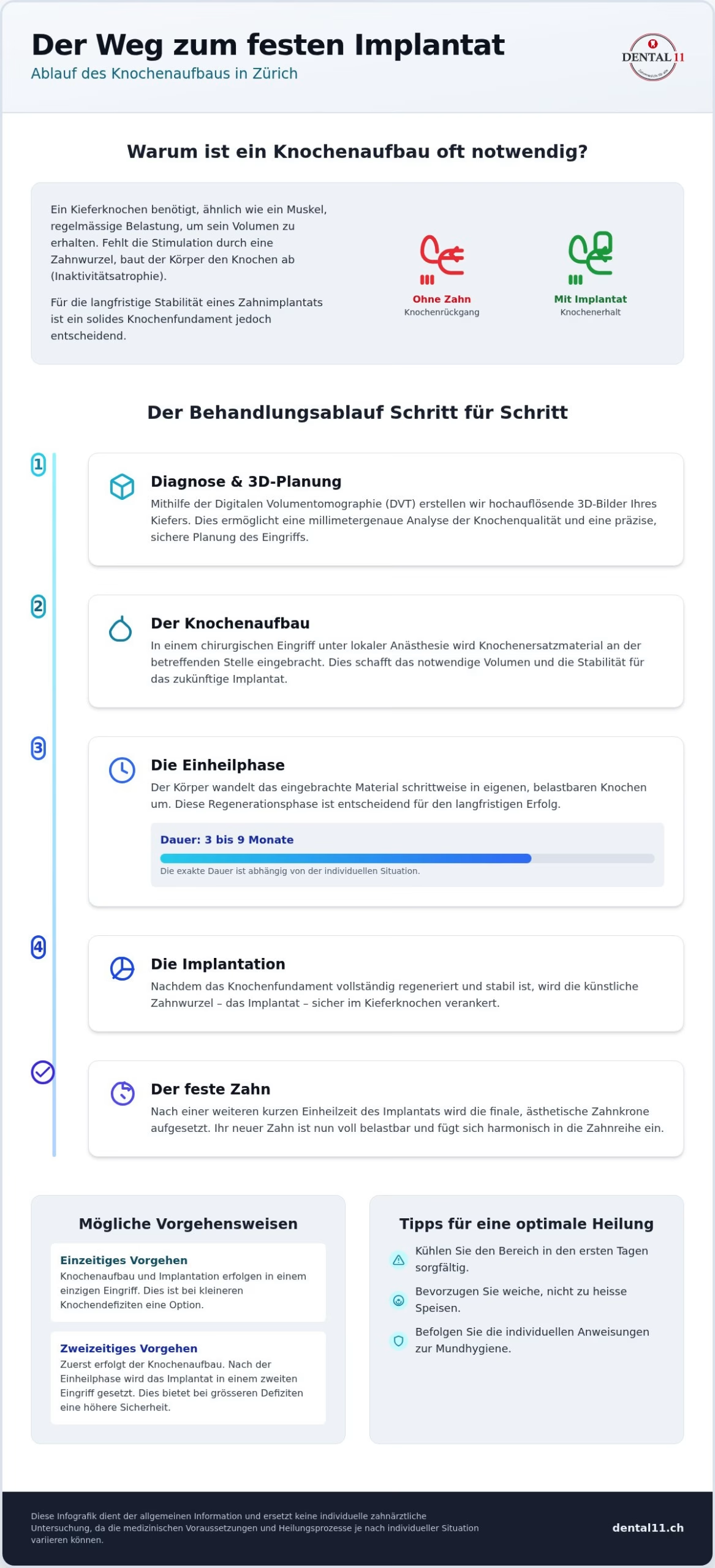
Our jawbone behaves much like a muscle: it needs regular loading to maintain its density and volume. If this natural stimulation from a tooth root is missing, the body begins to break down the tissue at that site. This biological process is known as disuse atrophy. Successful osseointegration, meaning the firm fusion of the artificial root with the tissue, requires certain minimum dimensions of bone. The usual aim is a width of about six millimetres and a height of eight millimetres, so that stability is maintained in the long term.
What is bone grafting? In principle, the procedure serves to create a stable foundation where the natural bone is no longer sufficient. Without this step, the implant could become unstable under daily chewing forces or even be lost. Healthy bone volume also ensures a harmonious gum line. This supports not only oral health but is also important for a natural appearance, as the gum is supported by the bone beneath it.
Preventing bone loss: the time factor
Time plays a central role in the extent of the procedure. The sooner we act after a tooth is lost, the less bone is usually lost. Individual factors such as age or chronic inflammation such as periodontitis can speed up the loss. In such cases, early, forward-looking planning is important to keep later treatment to a minimum and to make good use of the biological conditions.
The diagnostic basis in Zürich Enge
At our practice in Zürich Enge, we rely on digital planning. Using cone beam computed tomography (CBCT), we create high-resolution 3D images of your jaw. This precise diagnosis is the prerequisite for planning bone grafting before an implant accurately and safely. If you have already received a treatment proposal and are unsure, we are happy to offer you a second opinion on implants, so that all options can be discussed openly and calmly.
The timeline: from the first appointment to a fixed tooth
Bone grafting before an implant begins well before the actual procedure. At our practice, we place great importance on digital planning in advance using CBCT. This modern 3D technology allows us to assess bone quality and the available volume to the millimetre. This helps us avoid surprises during surgery and often makes the procedure gentler.
After precise planning, the graft material is placed. During the healing phase that follows, the body gradually converts this biological scaffold into its own load-bearing bone. During this time, new bone cells grow into the material until a stable unit has formed. The actual implant is placed only after a final check of the bone density.
The healing time: patience for long-lasting support
Patience is a decisive factor for success in this process. Depending on the anatomical starting point, the body needs between 3 and 9 months for complete regeneration. We distinguish between the one-stage approach, in which the implant is placed at the same time as the graft, and the two-stage procedure. For larger deficits, the two-stage route often offers greater safety, as the bone foundation can mature fully before it is loaded.
Preparing for the day of treatment
On the day of your appointment at our practice in Zürich Enge, you should arrive relaxed and after a light meal. The procedure is carried out under local anaesthesia, so during treatment you may only notice slight pressure or vibration. We provide a calm, non-judgemental atmosphere so that you feel safe and well looked after at all times. If you have questions about the timeline for your individual situation, you can easily book a consultation.
An overview of modern bone grafting methods
In the back tooth region of the upper jaw, the bone is often naturally thinner. This is where the sinus lift is used. We distinguish between the internal sinus lift, which is often carried out at the same time as implant placement when bone loss is minor, and the external sinus lift for larger deficits. In the latter, the floor of the maxillary sinus is carefully raised to create space for new bone tissue. This is often the only way to restore molars securely with implants.
Bone graft materials: safe and tested
Strict quality standards apply to medical materials in Switzerland. We use only certified graft materials with high biocompatibility. These act as a guide for your body’s own healing. Over time, your own bone cells gradually replace the material until a natural, load-bearing foundation has formed. Whether your own bone or a graft material is the better choice depends on your individual situation. Besides the choice of grafting material, many patients also ask about the material of the implant itself. If you would like to avoid metal, our article on the advantages and disadvantages of zirconia implants offers a sound basis for your decision.
Would you like to find out which method suits your situation? We are happy to show you the options in a personal consultation and advise you individually at our practice.
Aftercare and costs: what to expect after the procedure
Once the surgical part is complete, the most important phase begins for you: healing. In the first 48 hours after the procedure, physical rest is essential. Cool the affected cheek area regularly to reduce swelling. As for food, we recommend a soft diet and avoiding hot drinks while the local anaesthetic is still active. Another key factor for successful bone grafting is temporarily avoiding nicotine. Smoking considerably reduces blood flow to the gums and can put the healing of the graft material at risk.
The cost of bone grafting in Zurich depends on several factors, such as the method chosen and the volume of material required. In Switzerland, billing is transparent and based on the DENTOTAR tariff system, with the exact costs always depending on your individual situation. To make financial planning as easy as possible for you, we offer flexible financing through the Zahnärztekasse. This allows you to pay for your implant in instalments and focus fully on your recovery.
Managing risks and monitoring healing
At Dental11, we follow your progress closely with regular check-ups. Mild swelling or a slight feeling of pressure are completely normal in the first few days. If, however, unusually severe discomfort or redness occurs, we can be reached promptly. This keeps the entire process transparent and medically safe for you.
Your route to an implant consultation
Every jaw is unique, which is why a general statement is not possible without a prior examination. A detailed analysis of your anatomy forms the basis for a stable result. In a personal consultation, we answer all your questions about the timeline, costs and medical options. You can book your individual consultation in Zürich Enge online or by phone at any time.
A stable foundation for a better quality of life
A load-bearing jawbone is the essential basis for the long-term stability of your implants. With carefully planned bone grafting, we create the biological conditions your body needs for secure anchorage. Thanks to precise digital planning and individual care, this path can today be planned very accurately and safely. Patience during the healing period is a worthwhile investment in the durability of your dental restoration and pays off in the long term.
At our practice in Zürich Enge, a few minutes’ walk from Sihlcity, we respond to your concerns with empathy, which is particularly important for people with a fear of the dentist. We provide full transparency through detailed cost estimates based on the official SSO tariff, so that you can plan your treatment without financial uncertainty. Book your implant consultation in Zürich Enge now and take the first step together with us. We look forward to advising you personally and without time pressure.
Frequently asked questions
Is bone grafting for an implant painful?
The surgical procedure is carried out under local anaesthesia, so you do not feel pain during treatment. At our practice in Zurich, patients usually report only a slight feeling of pressure or vibration. Once the anaesthetic wears off, mild swelling or slight soreness may occur for a short time. These symptoms can be managed well with standard medication and cooling. We support you with care throughout the entire process and make sure you feel comfortable.
How long does healing take after bone grafting in the jaw?
The biological healing time varies between three and nine months, depending on the starting situation and the method chosen. During this phase, your body gradually converts the graft material into your own load-bearing bone. Only once the bone has reached this strength can the implant be anchored securely. Regular check-ups with us in Zürich Enge ensure that integration proceeds as planned. Patience is the key to long-term stability and to the success of your dental restoration.
What are the risks of bone grafting for dental implants?
As with any medical procedure, there are general risks such as swelling, post-operative bleeding or infection in the treated area. In rare cases, the bone graft material does not heal in as intended. Our precise digital planning with CBCT, however, reduces these risks considerably. Another important factor for success is your behaviour after the operation, in particular avoiding nicotine. We discuss all individual risks openly in advance during a personal consultation.
How much does bone grafting for an implant cost in Zurich?
The cost of bone grafting depends largely on the complexity of the case and the volume of material required. In Zurich, we charge transparently according to the official DENTOTAR tariff system. As every anatomical situation is unique, we prepare an individual cost estimate for you after a thorough examination. To make the cost easier to plan, Dental11 offers flexible instalment payments through the Zahnärztekasse. This way, the cost of your bone grafting remains clear to you at all times.
Can the body reject bone graft material?
A classic rejection reaction is very rare with the certified graft materials used today, as they are highly biocompatible. If a graft does not heal successfully, this is usually due to external factors such as infection or poor blood supply, for example from smoking. Your body uses the material as a scaffold for the growth of its own bone cells. We use only tested materials that meet strict Swiss standards, to create a sound basis for your implants.
This article is for general information only and does not replace an individual dental examination.