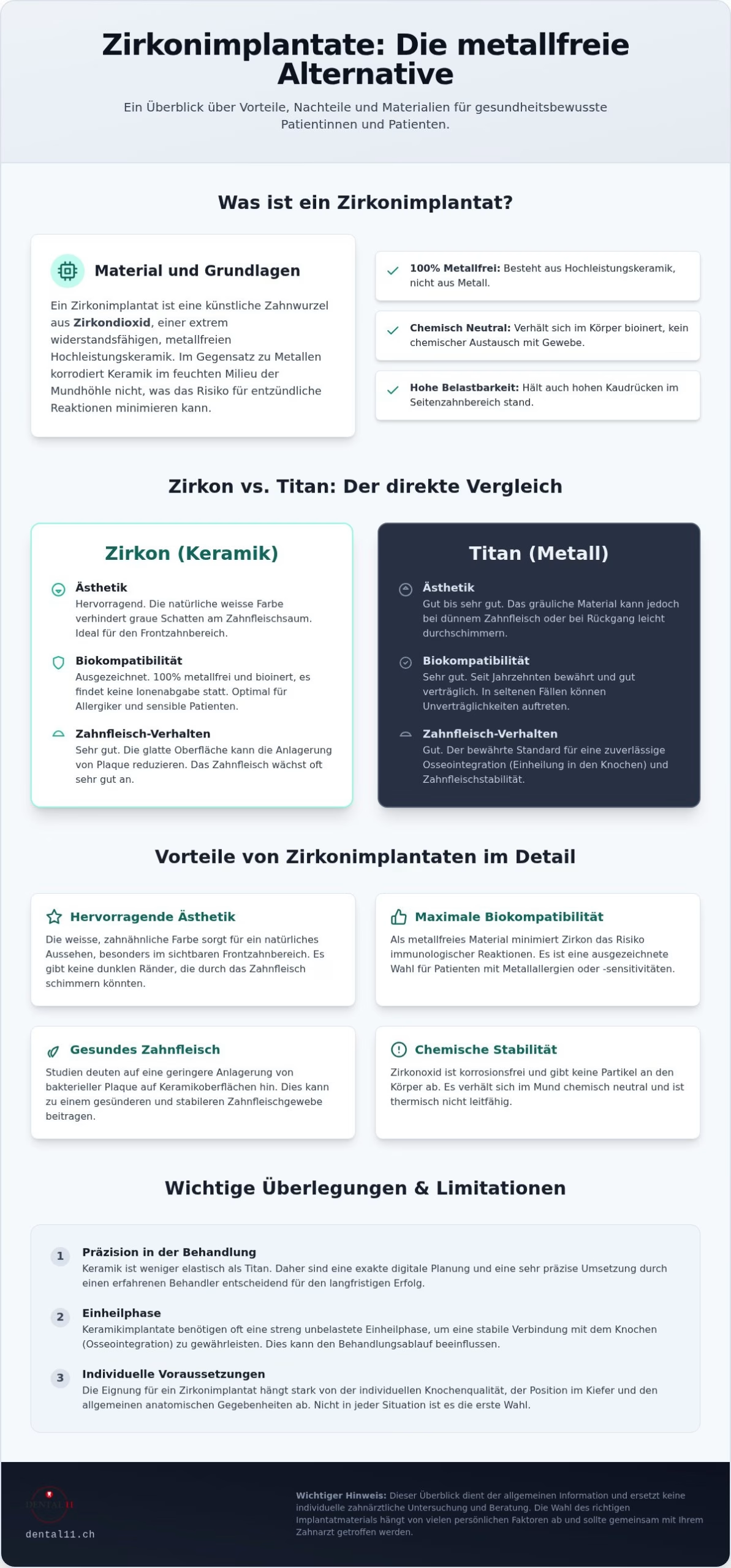
A zirconia implant is an artificial tooth root made of zirconium dioxide, a metal-free ceramic. Its advantages: a white colour with no grey margins at the gum line, no metal ions and good tissue compatibility. Its disadvantages: less long-term data than titanium, lower elasticity, usually a higher price and a longer healing phase without load.
We understand that choosing the right material is a very personal decision that calls for confidence and trust. This article sets out the advantages and disadvantages of zirconia implants clearly, so that you have a sound basis for your consultation. We give you an overview of the biocompatibility of zirconium dioxide, the current evidence on durability and the aesthetic benefits for patients in Zurich.
Key points
- Zirconium dioxide is a metal-free ceramic: white, bioinert and does not release metal ions.
- Main advantage in the front teeth: no grey margins, even with thin gums.
- Disadvantages: less long-term data than titanium, lower elasticity, a longer healing phase without load.
- At Dental11: implant with crown from CHF 4’600; ceramic implants usually cost more, and the price is stated in the written cost estimate.
What is a zirconia implant? Material and basics
What is a zirconia implant? Essentially, it is an artificial tooth root made of zirconium dioxide, a metal-free high-performance ceramic. The material is often wrongly compared with brittle porcelain. Zirconia, however, is a very resistant material that is even used in industry for components under high mechanical load. Since it became established in clinical practice, the material has been continuously developed. A key point is its chemical neutrality. Unlike metals, ceramic does not corrode in the moist environment of the mouth, which reduces the risk of inflammatory reactions.
In modern implant dentistry we use different design features. We distinguish between one-piece systems, in which the implant and abutment are made as a single unit, and more flexible two-piece systems. This distinction plays an important role when assessing the advantages and disadvantages of a zirconia implant. Two-piece solutions often allow us to align the future crown more precisely, which can be an advantage in complex gap situations.
Why zirconium dioxide in modern dentistry?
Its high mechanical strength makes zirconia a reliable material for fixed dental restorations. Its flexural strength allows it to withstand high chewing forces, even in the back teeth. At the same time, demand for biologically compatible solutions is growing in Switzerland. Patients are increasingly looking for ways to expose their body to as few foreign materials as possible. Zirconia offers an answer here that combines technical precision with gentle biological behaviour. You will find an overview of metal-free dental restorations in Zurich, from the all-ceramic crown to the ceramic implant, in our guide.
Metal-free vs. metal-containing: a brief overview
The classic standard in implant dentistry is titanium. It is robust and well researched. Nevertheless, there are situations in which a metal-free alternative is preferable. This applies in particular to patients with metal allergies or a general sensitivity to foreign materials. While titanium is a metal that can potentially release ions, zirconia is bioinert. This means there is no chemical exchange with the surrounding tissue. We decide on the right material together with you after a thorough analysis of your individual situation.
Advantages of zirconia implants: aesthetics and biocompatibility
The decision for a ceramic restoration is often driven by the wish for a particularly natural appearance. Because the material is white and translucent, it closely imitates the optical properties of a natural tooth. This is an important aspect when considering the pros and cons of a zirconia implant. Unlike dark metal posts, it does not cause grey shadows, even if the gum recedes slightly over the years or is naturally very thin.
Aesthetic advantages in the front teeth
In the visible area in particular, the way light behaves plays a central role. Zirconium dioxide conducts light deep into the tissue, much like natural tooth enamel. The result looks lifelike and harmonious, because no metal barrier blocks the light. For patients, this property gives a dependable visual result that is often difficult to achieve with conventional materials. The white base colour of the material effectively prevents a grey margin at the gum line.
Health aspects and soft tissue management
The biocompatibility of ceramic goes well beyond appearance. The soft tissue usually attaches very closely to the smooth ceramic surface, forming a stable barrier against bacteria.
- Less plaque build-up: bacterial deposits tend to adhere less strongly to the ceramic surface than to metal surfaces.
- Protection for people with allergies: being completely metal-free reduces the risk of immune reactions or intolerances, which is particularly important for sensitive people.
- Stable gums: the good tissue compatibility supports a healthy seal where the implant passes through the gum.
If you are unsure whether a metal-free restoration makes sense for your health situation, we will be happy to advise you in detail at our practice. You can book a consultation in Zurich here to discuss your individual options at your own pace.
Disadvantages of zirconia implants: limitations and risks
Every medical procedure has its limits. When weighing the pros and cons, you should be aware of the technical and biological challenges. One important aspect is the healing phase. Ceramic implants often need a longer period of osseointegration without load. This is especially critical with one-piece systems. Because the post protrudes directly into the mouth, tongue movements or accidental chewing can disturb healing. Modern two-piece systems offer more flexibility here, as they can heal protected under the gum.
The brittleness of the material remains a subject of research. Zirconia is very strong, but it is less elastic than titanium. Under extreme mechanical overload there is a theoretical risk of fracture. In addition, surgical placement is demanding. The dentist needs a great deal of experience, as the material properties require very precise positioning. Cost is also a factor. The complex manufacture of the high-performance ceramic is often reflected in a higher cost for the patient.
Challenges during healing
The success of treatment depends largely on the quality of the bone. In the sensitive first phase, the implant must sit completely still in the jaw. At our practice in Zurich we use digital planning methods to determine the best position in advance. Even so, a ceramic restoration often requires more patience during the recovery period than conventional procedures.
Long-term experience compared with titanium
Titanium has been clinically documented since the 1960s. For zirconia implants there is considerably less long-term data than for titanium, especially for periods of ten to twenty years or more. Regular check-ups are therefore essential to monitor the integrity of the restoration over the long term.
Zirconia or titanium? How to make the right decision
Choosing between zirconia and titanium is not a matter of “better” or “worse”, but of individual suitability. The question is which material best fits your anatomy and your personal health goals. An objective comparison of the pros and cons shows that both materials have their place. Titanium stands out for its high load capacity where little bone is available, while zirconia is often preferred by patients for whom being completely metal-free and high aesthetic standards are the priority.
At Dental11 we use fully digital planning to give this decision a solid basis. Three-dimensional imaging allows us to simulate bone quality and future loading precisely. This makes it possible to determine in advance whether the brittleness of the ceramic poses a risk in your specific case, or whether the biocompatibility of zirconium dioxide improves your chances of healing. Choosing the material thus becomes a transparent process based on facts rather than assumptions.
What speaks for titanium, and how its disadvantages can be offset
Titanium has been the standard since the 1960s: it forms an oxide layer on its surface to which the bone attaches directly (osseointegration), it is tough rather than brittle and can therefore be placed as a narrow or short implant even where there is little bone. Two-piece titanium systems also offer the widest choice of connecting parts for crowns, bridges and dentures. Its aesthetic disadvantage, the grey shimmer with thin gums, can often be avoided with a white zirconia abutment on the titanium implant (hybrid solution). Genuine titanium allergies are very rare; if you suspect a metal intolerance, you can have a lymphocyte transformation test (LTT) done beforehand. If you already have gold or amalgam fillings, please mention this, because different metals in the mouth can in rare cases cause a metallic taste. Titanium is not magnetic and is therefore MRI-compatible; it may only cause small artefacts in images of the jaw region. If an implant, whether titanium or ceramic, does not heal in, it is removed; after a healing phase a second attempt is usually possible.
The decision process at Dental11
At our practice in Zürich Enge we guide you step by step through the consultation process. We listen to you and analyse your needs. If you have already received a recommendation and are unsure, we are happy to support you with a well-founded second opinion. Our aim is for you to feel fully confident in your choice. In doing so, we look not only at the individual tooth but at your general health as a whole.
Financial transparency and planning
Quality and technical precision in Switzerland come at a corresponding cost. As costs can vary depending on the individual effort involved and the choice of material, we prepare a detailed breakdown for you. We are also happy to inform you about the option of paying in instalments through the Zahnärztekasse. For us, transparency also means that you have clarity about all financial aspects from the start.
Procedure and aftercare for a ceramic implant
The process is the same as for titanium: a check-up (CHF 99) with assessment of the gums and bone, a 3D X-ray if needed, a written cost estimate, placement under local anaesthesia, a healing phase of three to six months without load, and then the crown. Please bring your list of medications, any known allergies, previous X-rays and the details of your supplementary dental insurance to your first appointment. After the procedure, the first check-up follows after one to two weeks, with further check-ups during the first six months; after that, the usual check-ups and a dental hygiene appointment twice a year are sufficient. With ceramic, healing without load is particularly important: do not chew on the implant, do not play with the post using your tongue, and avoid nicotine.
Your path to a well-informed decision for your smile
Choosing the right implant material is a worthwhile investment in your long-term quality of life. As we have seen, zirconia implants combine advantages and disadvantages that carry different weight depending on the starting situation. While the metal-free aesthetics and the good tissue compatibility are convincing, the particular demands of the healing phase and the material properties call for particularly precise planning. The right solution always depends on the condition of your bone and your personal priorities.
At our practice in Zürich Enge we support you with modern digital diagnostics and prepare transparent cost estimates for your peace of mind. We take the time to answer your questions in a calm atmosphere. Book your implant consultation at Dental11 now to receive an assessment tailored to you. We look forward to welcoming you soon.
Frequently asked questions about zirconia implants
Are zirconia implants really metal-free?
Yes. Zirconium dioxide is considered a metal-free high-performance ceramic because, unlike pure zirconium, it forms a stable crystal structure without metallic properties. For patients in Zurich, this means no metal ions are released into the tissue. This is an important point when weighing the pros and cons, especially for people with a confirmed metal intolerance or those who prefer a biologically neutral solution.
How long do zirconia implants last compared with titanium?
Durability depends strongly on your oral hygiene and on the condition of your bone. While titanium implants have been documented over decades, there is considerably less long-term data for zirconia. This is why regular check-ups at our practice in Zürich Enge are particularly important to monitor stability over the long term.
Does health insurance in Switzerland cover the cost of ceramic implants?
In Switzerland, the cost of dental implants is generally not covered by compulsory basic health insurance (OKP). Exceptions apply only to serious illnesses or accidents defined by law. Depending on your policy, supplementary insurance may cover part of the costs. At Dental11 we prepare a detailed cost estimate for you, so that you can plan the finances clearly before treatment in Zurich begins.
Can zirconia implants fracture?
Every ceramic material carries a theoretical risk of fracture because of its material strength and lower elasticity compared with metals. Modern high-performance ceramics are, however, highly fracture-resistant and designed for high chewing loads. With our digital planning we reduce risks by analysing the load axes precisely in advance. Your individual anatomy and chewing habits play an important role in the long-term integrity of the implant.
Is healing more painful with zirconia?
How the healing phase feels does not differ significantly from treatment with titanium implants. Healing is a biological process that depends on your body's individual capacity to regenerate. We place great importance on a gentle approach and close follow-up care after the procedure. Because zirconia is very tissue-friendly, we often see the gum attach closely to the implant, which in many cases can support the healing process.
Can a zirconia implant be placed immediately after a tooth is extracted?
In selected cases, yes (immediate implantation), if the walls of the tooth socket are intact, there is no acute inflammation and there is enough bone for firm anchorage. With ceramic we are more cautious about this than with titanium, because the implant cannot tolerate any load during the healing phase. More often, the wound is first left to heal for eight to twelve weeks before the implant is placed. The examination after the extraction shows which timing is right for you.
Is a zirconia implant suitable for every gap?
No. What matters is the position of the gap, the available bone, the chewing load and whether a one-piece or two-piece system is suitable. With very little bone or heavy grinding, titanium is often the more robust choice; a bridge or removable dentures are possible alternatives. The choice of material follows the findings, not the other way round.
This article is for general information only and does not replace an individual dental examination.