
What if your decision for a new smile were shaped not by fear of the procedure, but by the confidence that comes with precise digital planning? Many people in Switzerland put off fixed tooth replacement because unclear cost structures or concerns about material quality leave them uncertain. A thorough dental implant consultation in Zurich addresses exactly this, giving you the reassurance you need through transparency and understanding.
It is entirely understandable that you want complete clarity about the procedures and costs involved in a surgical treatment. In this guide you will learn about the current digital options in 2026, from 3D diagnostics to digital planning. At Dental11, an implant with a crown costs from CHF 4’600, and you receive the cost estimate before treatment. We also explain the role that biocompatible materials such as titanium or zirconia play in long-term success.
We give you a detailed overview of the treatment process and clear decision criteria for your individual situation. This helps you find your way to a stable bite and an attractive smile that suits your needs.
Key points
- A thorough initial consultation forms the basis for successful treatment and ensures that all your questions about your oral health are answered in detail.
- Modern 3D imaging (CBCT) allows precise digital planning that visualises the surgical procedure step by step and can increase safety.
- The choice between titanium and metal-free ceramic depends on your aesthetic expectations and physical requirements, which we assess together.
- You gain insight into the structured treatment process, which we explain in detail during an individual consultation.
- Transparent costs and attentive care help you make an informed decision about your fixed tooth replacement.
Why a detailed dental implant consultation in Zurich is the first step
The path to a stable bite does not begin in the treatment chair, but in a trusting conversation on equal terms. A professional implant consultation is much more than a preliminary talk about technical details. It is a comprehensive medical assessment of your oral health, with your personal wishes and any worries at its centre. Many patients come to us with some scepticism or concern about the surgical procedure. We take these feelings seriously and create a calm atmosphere with room for all your questions.
Every smile is as individual as the person behind it. That is why modern implant dentistry has no one-size-fits-all solutions. To understand what a dental implant is, it helps to look at the biology: it is an artificial tooth root that fuses firmly with the jawbone. Together we clarify whether this solution is right for you or whether alternatives such as a conventional bridge or a partial denture suit your circumstances better. An honest consultation always looks at both sides: the benefits of high stability and good aesthetics as well as the necessary requirements and risks.
What does a sound initial consultation include?
At our practice in Zurich next to Sihlcity, we value a structured approach. A sound consultation always covers several key points:
- Detailed medical history: We discuss your general health, any medication you take and your expectations of the result.
- Clinical examination: We assess the condition of your jawbone and gums directly at the practice.
- Feasibility assessment: Based on the initial findings, we give you a realistic assessment of whether an implant can be placed directly or whether preparatory measures such as bone grafting are needed.
The role of transparency at Dental11
Trust comes from clarity. We know that cost structures in Switzerland are often seen as hard to follow. That is why we place great emphasis on cost transparency. After the consultation you receive a detailed treatment and cost plan that lists every step clearly. With us there are no hidden fees or unpleasant surprises at the end of treatment.
We involve you actively in the decision-making process. We explain the differences between materials and approaches so that you can make an informed choice. Our aim is for you to leave the practice feeling reassured and with complete clarity. When you are ready for this first step, you can book your personal consultation appointment online: Book an appointment.
Modern diagnostics: how digital planning makes implant dentistry safer
Technological progress has fundamentally changed dentistry. Whereas two-dimensional X-rays used to be the only basis for decisions, modern technology now gives us a virtual view beneath the surface. During the consultation we use these digital tools not for their own sake, but to increase the precision of the procedure and keep the strain on you as low as possible. They help us understand the anatomy of your jaw in fine detail before the actual procedure begins.
The safety of dental implants in particular benefits greatly from this development. Computer-assisted simulation allows us to determine a favourable position for the artificial root to the millimetre. This protects sensitive structures such as the mandibular nerve or the roots of neighbouring teeth.
3D X-ray (CBCT) compared with conventional X-ray
Cone beam computed tomography (CBCT) is an important standard in modern diagnostics. Unlike conventional 2D X-rays, CBCT provides three-dimensional sectional images of your jaw. This offers clear advantages:
- Precise bone analysis: We see not only the height but also the width and density of your bone.
- Lower exposure: Modern CBCT units work with significantly reduced radiation exposure compared with older systems.
- Better visualisation: We can show you on screen exactly where the implant will be placed. This builds trust and eases anxiety.
Guided implant surgery: precision to the millimetre
Once the digital data is available, we create a surgical guide where needed. This guide is 3D printed individually for you. It serves as a precise guide during surgery and ensures that the implant is placed exactly in the position we previously defined on the computer. This guided workflow often makes the procedure shorter and can be gentler, as incisions in the gum can usually be smaller. Exact positioning is also a good basis for even load distribution and therefore for the long-term stability of your tooth replacement.
We invite you to learn about these options in a personal conversation. In a calm atmosphere we will be glad to show you how we can plan your treatment individually. Book your appointment now for a non-binding examination.
Titanium or ceramic? Materials and requirements for your tooth replacement
After digital planning and diagnostics, the next step in the consultation is choosing the right material. Modern implant dentistry is no longer just about filling a gap. It is about finding a solution that is biologically compatible with your body while also meeting your aesthetic expectations. In our practice we follow the strict quality guidelines of the Swiss Dental Association (SSO) to provide you with care of a high standard.
The decision between titanium and ceramic is a very personal one. Titanium has been an established standard for decades. It is extremely resilient, biocompatible and fuses stably with the jawbone. For patients who want a metal-free restoration or who have very thin gums, zirconia ceramic offers a good alternative. A scientific comparison of titanium and ceramic implants shows that both materials can achieve high clinical success rates when used correctly.
Choosing the material to suit your needs
While titanium stands out for its high fracture resistance, ceramic offers aesthetic advantages because the white colour of the material resembles a natural tooth root. This can prevent dark margins from becoming visible if the gum recedes. In our practice we use only high-quality brand-name manufacturers, as the precision of the components and their clinical documentation are important for the long-term stability of your tooth replacement. During the consultation we assess your tissue structure and discuss which material seems most suitable for your individual situation.
Health requirements
For osseointegration, the process by which the implant fuses with the bone, to succeed, certain health conditions must be met. Factors such as heavy smoking or poorly controlled diabetes can affect the blood supply to the bone and thus increase the risk of delayed healing. A healthy foundation is just as important. Any existing gum inflammation should be treated before the procedure. Dental hygiene beforehand is essential here, to create a low-bacteria environment for the new tooth root.
If there is not enough bone for an implant, gentle bone grafting procedures are available today. Whether such a procedure is necessary depends on your individual bone density and volume, which we can determine using the CBCT diagnostics mentioned above.
The treatment process: from initial consultation to finished crown
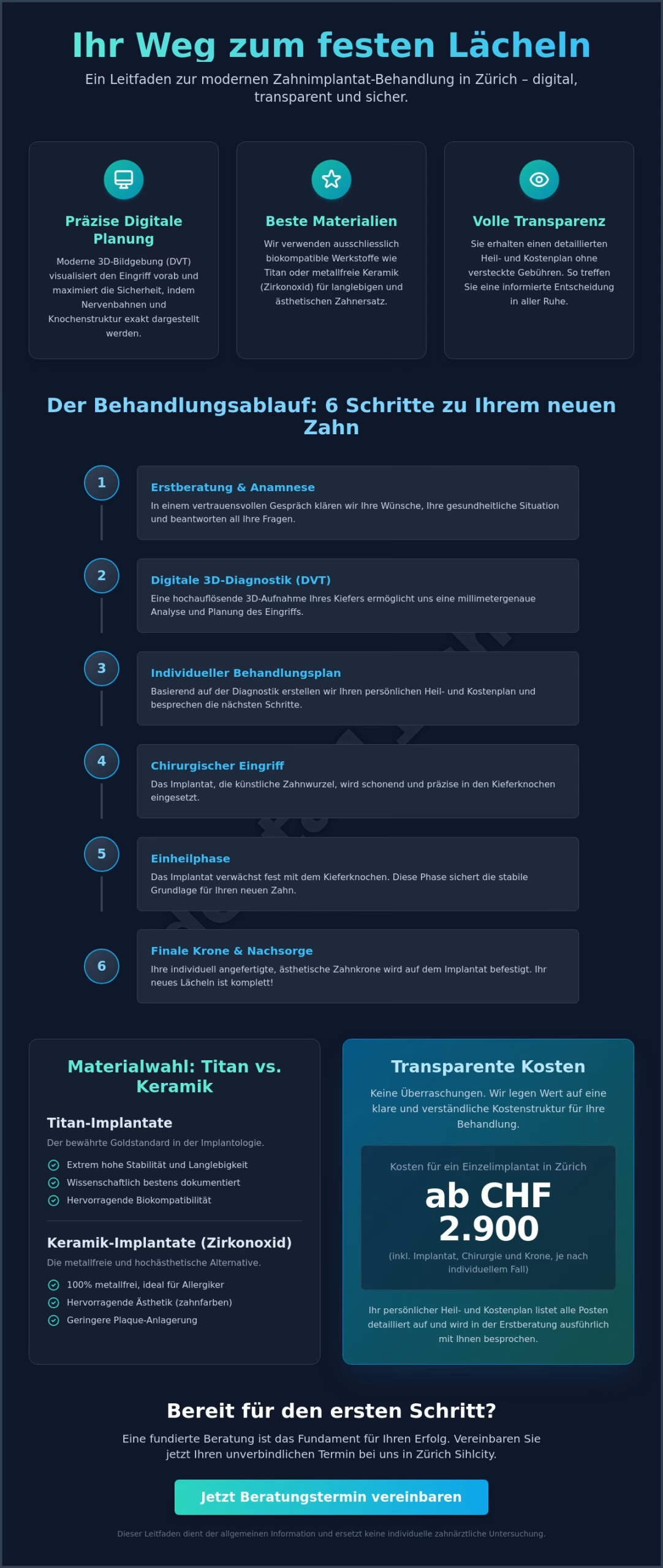
The path to fixed tooth replacement follows a clear protocol that puts your safety and the long-term result first. A careful consultation is the foundation for this. Once the diagnostic details and the choice of material have been settled, the actual treatment is divided into four main phases. This structured process means you know at every stage exactly what is happening and how you can support healing.
- Step 1: Planning. Based on the digital diagnostics, we draw up your individual treatment plan and discuss all the details.
- Step 2: Implant placement. In a usually short surgical procedure, the artificial tooth root is placed under local anaesthesia.
- Step 3: Healing. Over several months the implant fuses firmly with the bone, during which you can wear a high-quality temporary restoration.
- Step 4: Restoration. Once healing is complete, the final tooth replacement, such as a crown or bridge, is precisely fitted and fixed.
What happens on the day of implant placement?
On the day of the procedure, your comfort comes first. Many patients find the surgical part easy to tolerate. We work with modern local anaesthesia, which allows treatment with little pain. Depending on complexity, the procedure itself often takes only 30 to 90 minutes. If you are very anxious, please let us know. We will then plan in more time and breaks. After the procedure you receive detailed aftercare instructions from us and can usually return to your normal routine the next day.
Aftercare and long-term success
The first weeks after surgery are important for osseointegration. During this phase the implant stabilises in the jaw. We accompany you with regular check-ups to monitor healing closely. In the long term, durability depends largely on consistent oral hygiene. Professional teeth cleaning is a key requirement for preventing inflammation around the implant. Find out more about our philosophy and modern dentistry at Dental11, which combines technological precision with human care.
Would you like to take the first step towards a stable bite? We take time for your questions and plan your individual solution together. Book your personal consultation online now.
Your implant consultation at Dental11 in Zurich next to Sihlcity
Deciding on fixed tooth replacement is a significant step for your quality of life. At our practice in Zurich Enge, a few minutes' walk from Sihlcity, we take time for a thorough dental implant consultation. We know that a visit to the dentist often comes with mixed feelings. That is why we have created a place that combines technological precision with a calm, personal atmosphere. Our central location makes it easy to reach us by public transport or by car, so your appointment can begin in a relaxed way.
We attach great importance to an inclusive environment in which every patient feels welcome and understood. Whether you have questions about costs or suffer from dental anxiety, we take the time you need. Transparency is a key commitment for us. We communicate prices openly and fairly. We also offer flexible instalment payment options so that financial planning does not stand in the way of your health. Instead of a standard routine, you receive individual care that takes your specific circumstances into account.
Why choose Dental11 for your dental implant?
Our philosophy is based on combining modern digital technology with personal warmth. We use high-resolution diagnostic tools not for their own sake, but to make your treatment as safe and predictable as possible. Our experienced team advises you with patience and expertise, including in complex situations. We focus consistently on your long-term oral health. A quick solution is rarely the most sustainable one, which is why we plan every procedure with the coming decades of your smile in mind.
Next steps towards a stable bite
Getting your consultation appointment is straightforward. You can choose your preferred time directly through our online booking system. To prepare for the consultation, it helps if you bring any existing X-rays or a list of your current medication. We then discuss your wishes together and give you an initial assessment of your situation. Book your personal consultation now and let us look together at what modern implant dentistry can offer you.
Your path to a better quality of life and confidence
Modern implant dentistry today offers diagnostic options that were hard to imagine only a few years ago. With high-resolution 3D diagnostics and precise digital planning, the path to fixed tooth replacement becomes much more transparent and safer for you. A professional dental implant consultation in Zurich helps you choose the right material, titanium or ceramic, and understand every step of the treatment process.
At Dental11 in Zurich next to Sihlcity, we place great importance on you feeling well looked after at every stage. We offer fair prices based on the official SSO tariff and digital technology on site. Your wellbeing and honest communication come first for us. Please note that individual results and costs may vary depending on your health situation.
Take the first step towards a stable bite and a confident smile. We look forward to meeting you in person and answering your questions in a calm atmosphere. Book a consultation at Dental11 in Zurich now.
Frequently asked questions about dental implants
How much does a dental implant with a crown cost in Zurich?
The cost of a single dental implant including a crown varies depending on the work involved and the choice of material. At Dental11, an implant with a crown costs from CHF 4’600, and you receive the cost estimate before treatment. The final price depends largely on factors such as the chosen material (titanium or ceramic) and the complexity of the treatment. A detailed cost estimate after a personal examination gives you the transparency you need for your planning.
Does health insurance in Switzerland cover the cost of implants?
In Switzerland, compulsory basic insurance generally does not cover the cost of dental implants, unless the tooth loss is the direct result of a severe, unavoidable illness or an accident. Many patients, however, have private supplementary dental insurance which, depending on the policy, covers part of the costs. We recommend that you submit the treatment and cost plan to your insurer for review before treatment begins.
Is having a dental implant placed painful?
Implant placement is carried out under effective local anaesthesia, so the procedure itself is usually felt as pressure but not as pain. During the consultation we also discuss how we can make the procedure calm and include breaks for particularly sensitive patients. Once the anaesthesia wears off, mild swelling may occur, which can be managed well in the first few days with standard remedies and cooling.
How long does it take from consultation to the finished tooth?
The whole process usually takes three to six months, as healing in the bone needs time. After initial planning and the surgical phase comes a healing period in which the implant fuses firmly with the jaw. In the upper jaw this phase often takes somewhat longer than in the lower jaw. Once the artificial root is firmly anchored, the final crown is precisely fitted and permanently attached.
What are the risks of dental implant surgery?
As with any surgical procedure, there are general risks such as infection, impaired wound healing or, rarely, injury to neighbouring structures such as nerves. With modern 3D diagnostics, however, positioning can now be planned very precisely, which significantly increases safety. Careful aftercare and consistent oral hygiene after the procedure are essential to minimise the risk of inflammation around the implant in the long term.
How long does a dental implant last with good care?
With good oral hygiene and regular check-ups, dental implants can remain stable in the jaw for many decades. Scientific studies show a success rate of over 95 per cent over a period of ten years. Longevity depends largely on how consistently the surrounding tissue is protected from bacteria. Professional dental hygiene at least twice a year is therefore an essential requirement for long-term retention.
Can every jaw receive an implant?
In principle, implant placement is possible for most adult patients, provided there is enough healthy bone for stable anchorage. If the natural bone is not sufficient, gentle bone grafting procedures are available today to create a secure foundation. Certain health factors, such as unstable diabetes or heavy smoking, must however be assessed individually beforehand, as they can affect healing.
What is the difference between an implant and a bridge?
An implant is an artificial tooth root anchored directly in the bone, whereas a bridge has to be attached to neighbouring teeth that have been ground down. The key advantage of an implant is that healthy tooth structure in the neighbouring teeth is preserved and the jawbone is protected from shrinking through natural loading. The right solution depends on the size of the gap, the condition of the surrounding teeth and your personal aesthetic preferences.
This article is for general information only and does not replace an individual dental examination. Medical suitability and final costs always depend on your individual anatomical and health situation and may vary.