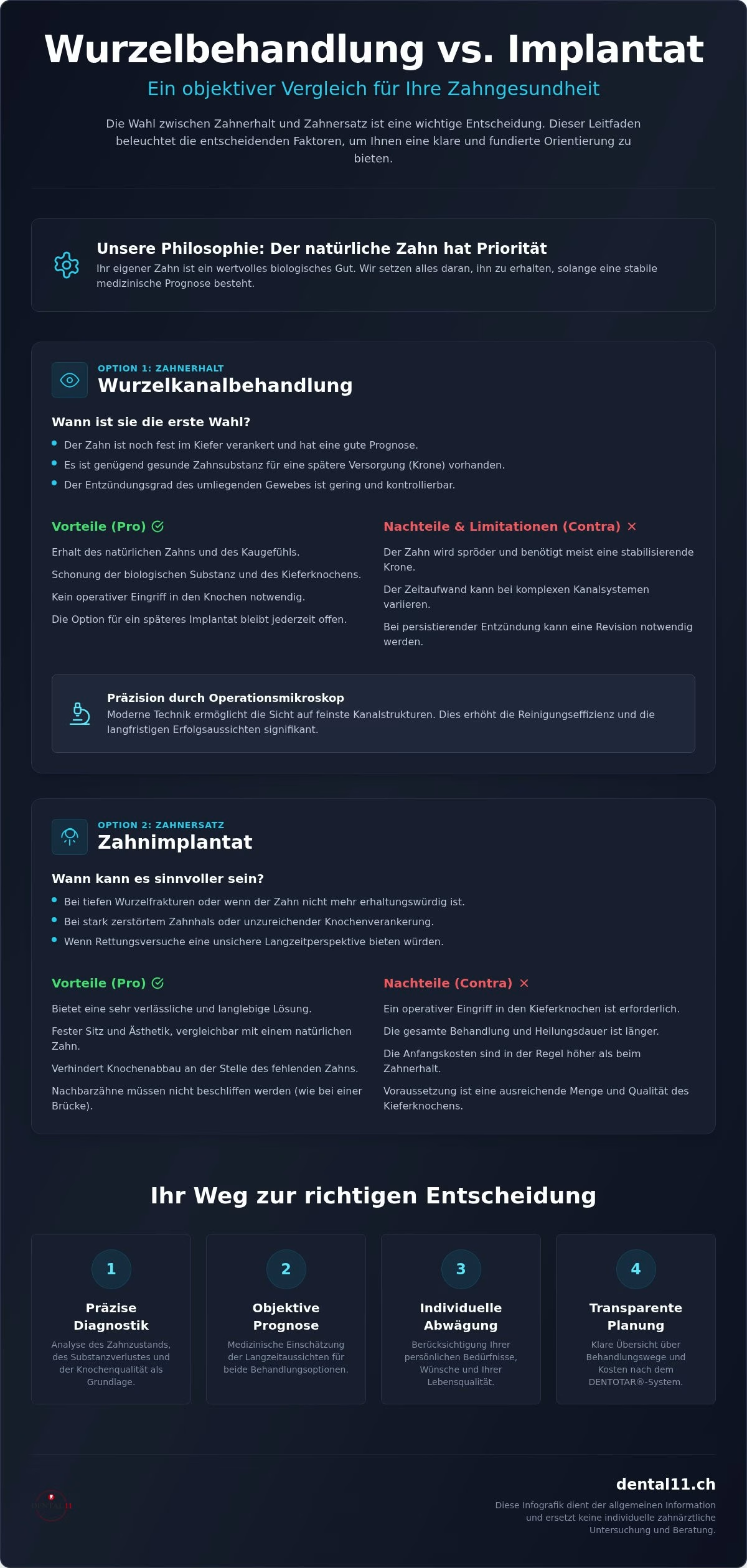
If the tooth is still firmly anchored in the jaw and has enough healthy structure left to support a crown, root canal treatment (at Dental11 from CHF 650) is usually the first choice. An implant (with crown from CHF 4’600) makes more sense with deep root fractures, a severely damaged tooth neck, or when a retreatment has not helped either. What decides is the remaining tooth structure, the available bone and the degree of inflammation, not the price alone.
This guide helps you weigh the pros and cons of saving a tooth versus replacing it objectively, so that you can make the decision that suits your individual situation. We look in detail at the prospects of success of both methods, explain cost transparency under the Swiss DENTOTAR system and show why the biological basis of your jaw is often the deciding factor. Find out how modern procedures can protect your appearance and wellbeing in the long term, without raising false expectations.
Key points
- Saving the tooth takes priority as long as the tooth and bone allow a stable prognosis.
- Root canal treatment from CHF 650 plus crown from CHF 1’400; implant with crown from CHF 4’600.
- The dental operating microscope makes even the finest canals visible and improves the chance of keeping the tooth for the long term.
- A root-treated tooth usually needs a crown; an implant needs three to six months to heal in.
Saving or replacing a tooth: a medical assessment
When decay or inflammation reaches the sensitive dental pulp, patients often face a difficult choice. At our practice, Dental11 in Zürich Enge, we follow a clear approach: your natural tooth is a valuable biological asset that we prefer to keep, provided the medical prognosis is stable. Deciding between root canal treatment and an implant is based on a careful analysis of the tissues that support your teeth. We check closely how much tooth structure has been lost and the condition of the surrounding bone. Early advice can make a real difference here, helping to keep later damage to the jawbone to a minimum.
When is root canal treatment the first choice?
Root canal treatment is usually the first choice when the tooth is still firmly anchored in the jaw and there is enough healthy hard tissue left for a crown later on. The aim is to remove bacteria completely from the canal system. The clinical stability of the remaining tooth plays a central role. As a rule, the less inflamed the surrounding tissue, the better the chances of healing. A preserved tooth also keeps its natural sensation when chewing and protects the bone structure.
When an implant may make more medical sense
Despite modern endodontics, there are situations in which an implant can offer a reliable long-term outlook. With deep root fractures or a severely damaged tooth neck, saving the tooth reaches its biological limits. In such cases it can be sensible to replace the tooth with a titanium or zirconia implant, to avoid lengthy rescue attempts that often fail in the end. Our detailed diagnostics allow us to assess the individual prognosis objectively. This gives you a transparent basis for your decision, one that protects your quality of life and appearance in the long term. You are welcome to book an appointment with us to discuss your personal situation calmly.
Root canal treatment under the microscope: pros and cons
The use of dental operating microscopes has brought significant progress to modern endodontics. Whereas treatment was often carried out without a direct view in the past, high magnification now makes the finest canals and complex structures visible. This is an important factor in the prognosis for saving the tooth. With modern root canal treatment with a microscope in Zurich, we can clean branches that remain hidden to the naked eye. This reduces potential risks such as undetected lateral canals or instrument fractures.
Advantages: why your own tooth remains valuable
A key benefit of saving the tooth is that biological tissue is preserved. No surgery on the jawbone is needed. The natural feel when chewing is fully retained, because the fine nerve fibres of the periodontal ligament remain active. The option of an implant also stays open for the future, should the tooth need to be replaced later after all.
Disadvantages and limitations of endodontics
Despite high precision, there are limits. The time required for complex canal systems can vary depending on the anatomy. Because the tooth is no longer vital after treatment, it becomes more brittle over time. A stabilising crown is therefore usually needed to prevent fractures. In individual cases, if inflammation persists despite careful cleaning, a root canal retreatment can make sense as a second chance. Overall, saving the original tooth is often the first recommendation. If you would like a professional assessment of your situation, you can easily book an appointment with us in Zürich Enge.
Dental implants as a modern alternative: when replacement makes sense
Dental implants act as a full replacement for the natural tooth root. At Dental11 we use biocompatible materials such as titanium or zirconia, which become firmly integrated into the jawbone. An important advantage at our practice in Zürich Enge is the fully digital workflow. Using cone beam computed tomography (CBCT), we plan the position in three dimensions and with precision before the actual procedure begins. In terms of appearance, implants are restored with individually made ceramic crowns that blend in naturally with your other teeth.
Advantages: security and appearance of the replacement
A key advantage over conventional bridges is that healthy neighbouring teeth do not need to be ground down. The artificial root transfers chewing forces directly into the jaw, which can help counteract bone loss. Even with larger gaps or complete tooth loss, implants provide a stable base that preserves your quality of life. If the biological base is not sufficient, bone grafting in Zurich may be needed to create a secure foundation.
Risks and financial aspects
As this is a surgical procedure, you need to allow for a healing phase. Problems with healing are rare, but depend greatly on individual aftercare. Consistent dental hygiene in Zurich is essential to prevent inflammation such as peri-implantitis around the implant. Although the initial cost is usually higher than for root canal treatment, the long-term load-bearing capacity is a strong argument in favour of the implant. To make your decision easier, we offer flexible instalment payments through the Zahnärztekasse. If you would like personal advice, you can book your appointment directly here.
Reaching the right decision at Dental11 in Zürich Enge
At our practice, choosing between saving and replacing a tooth is a structured process based on transparency and empathy. First, we carry out detailed diagnostics. We use digital X-rays or 3D imaging (CBCT) to record the anatomical conditions accurately. This is followed by an objective comparison of the two options, root canal treatment or implant. We discuss your individual prospects of success in line with the high quality standards of the Swiss Dental Association (SSO), so that you have a sound basis for your decision.
Cost transparency and instalment payments in Zurich
We know that financial aspects play a major role in this choice. That is why at Dental11 we value a clear breakdown of costs according to the DENTOTAR system. A comparison of long-term costs often shows that root canal treatment including a crown is a good solution in the short term, while an implant is a very durable long-term investment. To ease the strain on your budget, we work with the Zahnärztekasse. This allows you to pay in flexible instalments, so you can focus fully on your health. For us, transparency is the basis of treatment built on trust. You can find out what a dental implant costs in Zurich in our price overview. We explain the individual items in our price overview for root canal treatment in Zurich.
Your next step: arrange a consultation
The final decision depends largely on your individual biology and your personal wishes. For patients with dental anxiety in Zurich 8002 in particular, we take plenty of time to address all concerns in a calm atmosphere. A second opinion can often bring the clarity you need. Use our simple online booking to arrange a consultation. Together, we will find the approach that best preserves your appearance and chewing function.
Finding the right solution for your dental health together
Choosing between keeping your natural tooth and a modern implant is an important step for your long-term wellbeing. We have seen that microscopic precision now improves the chances of saving a tooth. At the same time, implants offer an aesthetically pleasing and durable alternative when the biological limits of saving the tooth have been reached. Every situation is different, which is why a transparent analysis of your bone structure and oral health forms the foundation of our work.
When you weigh up root canal treatment against an implant, we support you with professional expertise and a personal, caring approach. As a member of the Swiss Dental Association SSO, we treat patients in Zürich Enge according to clear quality standards. You can rely on honest advice and understandable cost planning, which we can supplement with flexible instalment payments on request. We look forward to meeting you in person and working out the right outlook for your dental health together.
Book your personal consultation at Dental11 in Zurich now
Frequently asked questions (FAQ)
What is the success rate of root canal treatment under the microscope?
The success rate of a careful first treatment is high; the tooth can be kept for many years. Using dental operating microscopes can increase precision considerably, as even the finest canals become visible. This can improve the prognosis for saving the tooth. However, the result always depends on the individual anatomy and the degree of the original inflammation. Proper aftercare and a stabilising crown are decisive for long-term success.
Does an implant last longer than a root-treated tooth?
An implant is often regarded as a very durable solution. A root-treated tooth can also be kept for many years, but without a nerve supply it is more brittle and more prone to fractures. With good care, both methods offer a long service life. Ultimately, the decision is based on the biological condition of your jaw.
How long is the healing phase for a dental implant?
The healing phase for a dental implant usually takes between three and six months. During this time the artificial root fuses firmly with the jawbone, a process known as osseointegration. The exact duration depends on bone quality and on whether bone grafting was needed beforehand. During this period patients usually wear a temporary restoration, so that appearance and chewing function are largely maintained in everyday life.
Does health insurance in Switzerland cover root canal treatment or implants?
In Switzerland, compulsory basic health insurance (OKP) does not normally cover the cost of root canal treatment or implants. Exceptions apply only to severe, unavoidable diseases of the masticatory system or after accidents. Most patients pay the costs privately or use supplementary dental insurance. We bill according to the DENTOTAR tariff and provide detailed cost estimates as well as instalment payments through the Zahnärztekasse, to ensure financial transparency and reliable planning.
What happens if root canal treatment fails?
If root canal treatment does not achieve the desired result, there is often a second chance through a retreatment. The old filling material is removed and the canal system is cleaned again. Another option may be an apicoectomy (root tip resection). If these measures are not enough, the tooth usually has to be removed. In that case, an implant is a proven solution for closing the gap in a functional and aesthetically pleasing way.
This article is for general information only and does not replace an individual dental examination.