
At Dental11 in Zürich Enge, a dental implant costs from CHF 4’600, including the crown. This includes the artificial tooth root, the connecting piece (abutment) and the laboratory-made crown. The cost rises if bone grafting is needed beforehand, if several teeth are replaced or if you choose a metal-free ceramic implant. You receive the exact amount as a cost estimate based on the Dentotar tariff before treatment begins.
This guide explains how the price is made up, what basic health insurance covers (usually nothing) and how payment in instalments through the Zahnärztekasse works.
Key points
- Implant with crown from CHF 4’600 at Dental11; bone grafting, ceramic implants and 3D X-ray (CBCT) are listed separately.
- Billing follows the Dentotar tariff: tax points per service multiplied by the practice's tax point value. The cost estimate lists every item.
- Basic insurance only pays for implants after an accident or in cases of severe disease of the masticatory system. Supplementary insurance covers part of the cost, depending on the policy.
- Payment in instalments is arranged through the Zahnärztekasse; the terms are set by the Zahnärztekasse.
What does a dental implant cost in Zurich? An overview of the factors
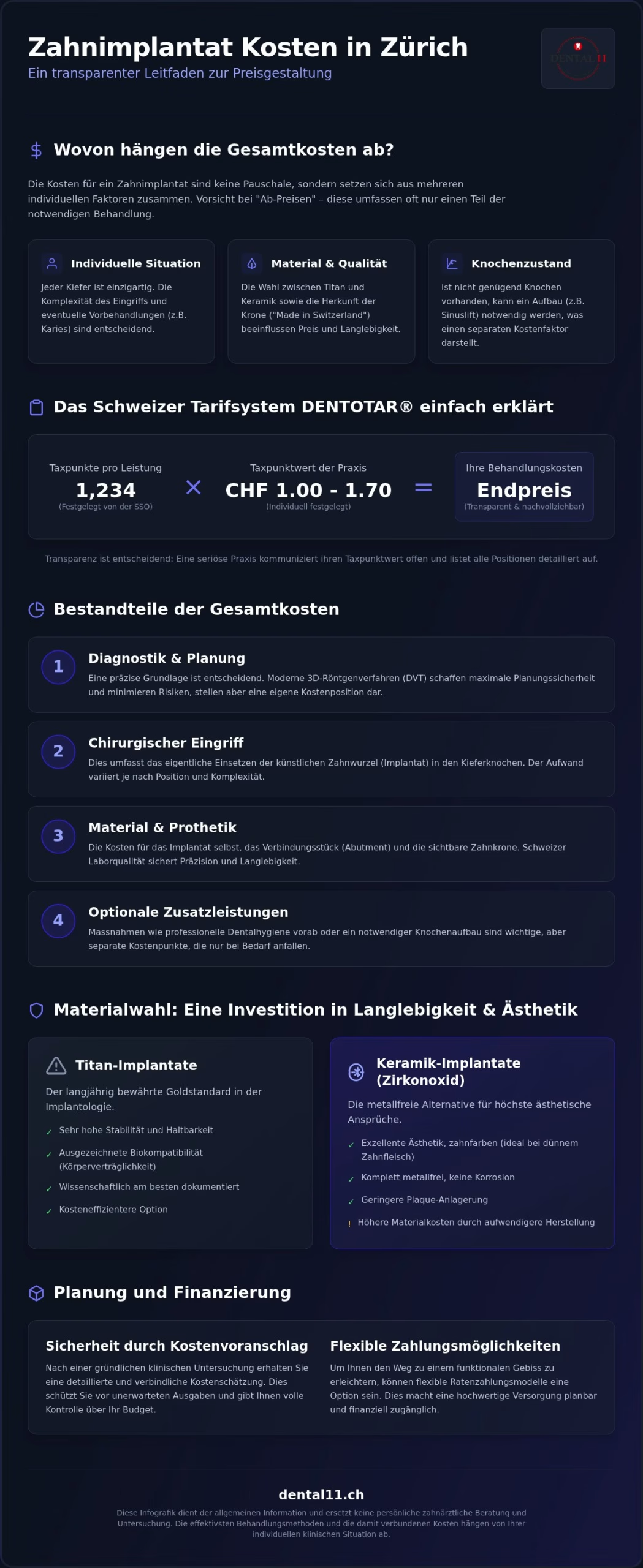
The question of what a high-quality dental restoration costs is complex, because the finished result consists of several components. At its core is an artificial tooth root that is surgically anchored in the jawbone. For a complete smile, however, the connecting piece, known as the abutment, and the visible crown are also needed. When researching the cost of a dental implant in Zurich, you will often come across attractive "from" prices that refer only to the surgical part. The Dental11 price (from CHF 4’600) covers the implant, abutment and crown. The actual total cost, however, depends largely on your individual starting situation, your bone density and the materials chosen. For a jaw without teeth, our guide to All-on-4 implants in Zurich shows what a fixed full restoration costs.
The Swiss tax point value explained simply
In Switzerland, dental services are billed according to the Dentotar, the tariff of the Swiss Dental Association SSO. Each treatment item is assigned a fixed number of tax points. The final price is these points multiplied by the practice's tax point value. For services paid by the social insurers (accident, military and disability insurance), a fixed tax point value applies; for private patients, each practice sets its own value. Dental11 shows the tax point value and every service item in the cost estimate.
Why flat-rate prices rarely work in implant dentistry
Every jaw is anatomically different, which is why rigid flat-rate offers often do not reflect reality. The surgical effort can vary considerably, especially if preparatory measures such as caries treatment or bone grafting are required. Thorough dental hygiene beforehand is also essential to create an inflammation-free environment for healing. As the costs depend on so many variables, a professional clinical assessment is the only way to a reliable cost estimate. This protects you from unexpected expenses and ensures that the treatment is tailored precisely to your needs.
Precise diagnostics form the foundation of any safe treatment. Modern methods such as 3D X-ray (CBCT) provide a three-dimensional view of the jawbone, which considerably improves planning reliability. This technical accuracy reduces risks during the procedure, but it appears as a separate item in the cost estimate. Another cost factor is where the prosthetics are made. Crowns made in Switzerland allow close coordination with the dental laboratory, which supports the long-term stability of your restoration.
Titanium or ceramic: an investment in appearance
The usual choice of material is between titanium and zirconia. Titanium is regarded as the long-established standard in implant dentistry. Metal-free ceramic implants made of zirconia are becoming more important, however, as they offer advantages particularly where aesthetic demands are high or the gum is very thin. Ceramic components are considerably more complex to manufacture, which is reflected in the material costs. The Implantat Stiftung Schweiz offers useful, neutral insight into the current scientific evidence. A detailed comparison of zirconia and titanium helps you make the right choice for your individual needs.
Bone grafting: when the foundation needs strengthening
If the natural bone volume is not sufficient for stable anchoring, augmentation procedures such as a sinus lift or soft tissue surgery are required. These procedures create the conditions needed for successful implant placement. As they require specialised surgical knowledge and often high-quality bone substitute material, they affect the total cost individually. Whether such preliminary treatment makes sense in your case can only be determined after a thorough clinical examination. For an initial assessment, you are welcome to book a consultation at our practice in Zürich Enge.
Implant or bridge: comparing costs over the years
A three-unit bridge is usually less expensive to begin with than an implant with a crown. In return, the two neighbouring teeth have to be prepared as abutment teeth, even if they are healthy, and without a root the bone under the bridge pontic slowly recedes. Bridges often have to be replaced after some years because abutment teeth develop caries or need root canal treatment. An implant replaces only the missing tooth, keeps the bone active and leaves the neighbouring teeth untouched. Calculated over ten or twenty years, it is therefore often the more economical solution. A bridge remains the right choice if a surgical procedure is not medically possible, if bone grafting is not wanted or if the neighbouring teeth need a crown anyway; it is also ready in two to three weeks, while an implant takes several months to heal. Which option makes sense for you is shown in the cost estimate, with both prices.
Preliminary treatments that belong in the cost estimate
An implant only heals properly in an inflammation-free environment. Active periodontitis is therefore treated before the implant is placed, and dental hygiene (CHF 99) reduces the bacterial load before the procedure. Both appear as separate items in the cost estimate, not as a surprise on the invoice. Please bring your list of medications to the consultation: bisphosphonates (for example for osteoporosis), blood thinners or poorly controlled diabetes affect planning and healing. Smoking slows healing and increases the risk of inflammation around the implant; we address this openly, without judgement.
Payment options and insurance in Switzerland
Compulsory basic health insurance in Switzerland only covers the cost of dental restorations in rare exceptional cases, for example after serious accidents or in cases of severe systemic disease. For most patients, the cost of a dental implant in Zurich is therefore a private investment in their own quality of life. Private supplementary insurance can absorb part of the financial burden, provided it was taken out in good time before treatment begins. Checking the annual cover limits and any waiting periods early on is essential for your planning.
Payment in instalments: implants as a monthly investment
Modern dentistry should be accessible to everyone. That is why Dental11 offers flexible financing options in cooperation with the Zahnärztekasse. These instalment plans allow you to pay the total amount in convenient monthly amounts. You keep full control over your expenses and can adapt the term to your financial circumstances. This makes the path to a fixed dental restoration predictable and secure.
For expats in Zurich in particular, it is worth looking at the details of international insurance policies. These often offer more extensive benefits than standard local plans. Another important aspect is tax deductibility. In many cantons, you can claim medical and accident costs that exceed a certain percentage of your income in your tax return. Keep all receipts and the detailed cost estimate in a safe place.
Supplementary insurance and implant costs
Before we start treatment, we prepare a cost estimate that you can use to obtain cost approval from your insurer. This document lists all planned steps precisely. This gives you certainty in advance about what share your insurer will cover. As individual circumstances vary, a clinical assessment beforehand is essential.
After an accident: report tooth loss immediately
If you lose a tooth through a fall, a blow or a cycling accident, accident insurance (UVG for employees, otherwise the accident cover of your health insurance) usually covers the cost of the replacement, including an implant. This requires a prompt accident report to your employer or insurer and dental documentation of the damage, ideally on the same day. We prepare the accident report with an X-ray and submit the cost estimate for cost approval; approval should be in place before treatment begins. The same procedure applies to supplementary insurance: submit the cost estimate, wait for written approval, then start.
Implant consultation at Dental11 in Zürich Enge
The path to an implant begins with a check-up (CHF 99) at our practice in Zürich Enge, a few minutes from Sihlcity and Enge railway station. We assess the gum, the available bone and the neighbouring teeth, with a 3D X-ray if needed. You then receive a cost estimate based on the Dentotar tariff with every item: implant, abutment, crown and any bone grafting. An implant with a crown costs from CHF 4’600. If you would like a second opinion before such an important procedure, we expressly support this; trust grows through clarity and professional confidence.
Modern diagnostics for your safety
We consistently use digital processes to make treatment as comfortable as possible for you. Instead of conventional, often unpleasant impressions, we use precise 3D scans. This technology allows us to plan the position of the implants accurately on the computer in advance. This digital precision makes an important contribution to cost certainty and a clear cost calculation. Careful preparation reduces unforeseen treatment steps, which protects against costly corrections in the long term. Efficient processes save time and allow us to focus fully on your wellbeing.
Your path to a new smile in Zürich Enge
You can reach our practice in Zürich Enge by tram 5, 13 and 17 (Waffenplatzstrasse stop), by S-Bahn via Enge railway station or by car via the Sihlcity car park. Appointments are available on Mondays and Tuesdays until 8 pm, and on Thursdays and Fridays from 8 am. An experienced team accompanies you with care through every step, from initial planning to the final crown. We place great importance on a non-judgemental environment in which you can feel safe. Whether an implant is suitable always depends on your individual clinical situation, which we analyse together.
Your path to financial clarity and a new smile
Choosing a fixed dental restoration is a significant investment in your quality of life and everyday wellbeing. As we have seen, the cost of a dental implant in Zurich depends largely on individual factors such as the choice of material and your anatomical starting situation. We create transparency through detailed estimates based on the Dentotar tariff, which give you planning certainty in advance: implant with crown from CHF 4’600. So that your wish for a secure smile does not fail because of financial hurdles, we are happy to support you with flexible instalment plans through the Zahnärztekasse. At our practice in Zürich Enge, we guide you through every step of treatment with patience and professional expertise. We invite you to ask your questions in a protected setting and to find the right solution for your needs together with us. Book your dental implant consultation in Zürich Enge now and take the first step towards renewed vitality. We look forward to welcoming you to our practice soon.
Frequently asked questions about implant treatment
Does health insurance cover the cost of a dental implant in Zurich?
Basic compulsory health insurance generally does not cover the cost of dental implants. The only exceptions are severe, unavoidable diseases of the masticatory system or accidents, provided no other insurance applies. Many patients therefore rely on private supplementary insurance, which covers part of the cost. It is advisable to obtain a cost approval before treatment starts. Suitability and cover always depend on your individual insurance policy and the clinical findings.
What is the average price of an implant including a crown in Switzerland?
At Dental11, a single implant including abutment and crown costs from CHF 4’600. As every treatment is planned individually, the amount can be higher depending on the effort and the material. Factors such as necessary bone grafting or the choice between titanium and ceramic have a significant influence on the final price. You will only receive a precise cost estimate after a personal examination at our practice.
Does Dental11 offer payment in instalments for implant treatment?
Yes, at Dental11 in Zürich Enge we offer our patients flexible financing options. In cooperation with the Zahnärztekasse, you can pay your treatment costs in monthly instalments. This allows you to have necessary treatment without a large immediate financial burden. We are happy to discuss the exact terms and durations openly during your consultation in Zürich Enge. This keeps your dental care predictable and suited to your personal financial situation.
Why do dental implant costs in Zurich vary so much?
Price differences arise mainly from the practice's individual tax point value and the complexity of the procedure. While simple cases take less time, difficult anatomical conditions or aesthetically demanding front tooth restorations require more work. The material costs of the implant system and the quality of the dental laboratory also play a role. High-quality dental restorations often offer greater precision, which is reflected in the calculation. The price therefore always reflects the individual quality and care of the treatment.
Is a cheap implant abroad a safe alternative?
Treatment abroad often attracts patients with low prices, but it carries specific risks. If complications arise or corrections are needed, warranty claims and communication are often difficult. There are also travel costs, which can reduce the savings. At our practice in Zürich Enge, we value long-term care and Swiss quality standards. Local treatment ensures continuous follow-up care and quick access if you have questions or need adjustments, which can be decisive for long-term success.
What does the cost estimate for an implant include?
The cost estimate lists every item. If an item is missing, ask whether it will be billed separately later. At Dental11, the implant, abutment and crown are included in the price from CHF 4’600; bone grafting and 3D X-ray (CBCT) are listed separately.
Does an implant in the front teeth cost more than in the back teeth?
Often, yes. At the front, appearance matters: the gum must run neatly around the crown, the crown is individually layered, and a temporary restoration is usually needed so that you do not show a gap during healing. In the back teeth, chewing function comes first; however, bone is more often missing there, which can make grafting necessary. The cost estimate shows which factor applies in your case.
What is the difference between a post crown and an implant?
A post crown (post and core with a crown) uses your own root-canal-treated tooth root as its anchor, so the tooth must still be present and the root stable. An implant replaces the root itself when the tooth is missing or can no longer be saved. A post crown is less expensive than an implant but requires a healthy remaining root; if it fractures, an implant is ultimately the only option left. The X-ray shows which option is possible for you.
What alternatives are there if the budget for an implant is not enough?
A fixed bridge or a removable partial denture can also close the gap. The bridge requires the neighbouring teeth to be prepared, while the partial denture is the least expensive but also the least comfortable solution. Another option is staging the treatment: first saving teeth and treating inflammation, then the implant later when it fits your finances. The important thing is that the gap does not stay open for years, as otherwise bone recedes and the neighbouring teeth tilt. We present both prices side by side; you do not have to decide in the treatment chair.
Is everything billed at once or by treatment phase?
By phase. You receive a first invoice after the implant is placed and a second one after the crown is fitted, about three to six months later. This spreads the amount over several months even without an instalment agreement. If you would also like to pay in instalments, you arrange this with the Zahnärztekasse, which issues our invoices.
What does implant aftercare involve, and what does it cost?
An implant needs the same care as a natural tooth, only more consistently: daily use of interdental brushes where it meets the gum, dental hygiene once or twice a year (CHF 99) with instruments that are gentle on implants, and an annual check-up (CHF 99) at which we examine the gum, the bone margin and the screw fit. This allows us to detect early peri-implantitis, an inflammation of the implant bed, before it causes bone loss. Aftercare is not included in the implant price but is billed separately like any check-up.
This article is for general information only and does not replace an individual dental examination.