Fear of the dentist can be overcome step by step: first a conversation with no treatment, then a gentle start with a check-up or dental hygiene session (CHF 99 each), an agreed stop signal and breaks. Treatment is carried out under local anaesthesia. At Dental11 in Zürich Enge, you can mention your anxiety when you book online, and we will then plan more time. Nobody judges the condition of your teeth.
In this article you will learn how digital diagnostics and caring support can help you on the way to a relaxed treatment. We give you an overview of low-pain procedures, transparent cost planning and how things work in a team that takes your concerns seriously.
Key points
- Feeling nervous is normal; a dental phobia with a racing heart and years of avoidance can be treated and is nothing to be ashamed of.
- First appointment for talking only: no instruments, no rush; mention your concerns when booking online and more time will be planned.
- Stay in control: a stop signal (raising your hand), breaks, a companion is welcome, and a 3D scan instead of impression material to avoid gagging.
- Costs in writing in advance based on the Dentotar tariff; a gentle start with a check-up or dental hygiene session for CHF 99 each.
Understanding dental anxiety: causes and symptoms of dental phobia
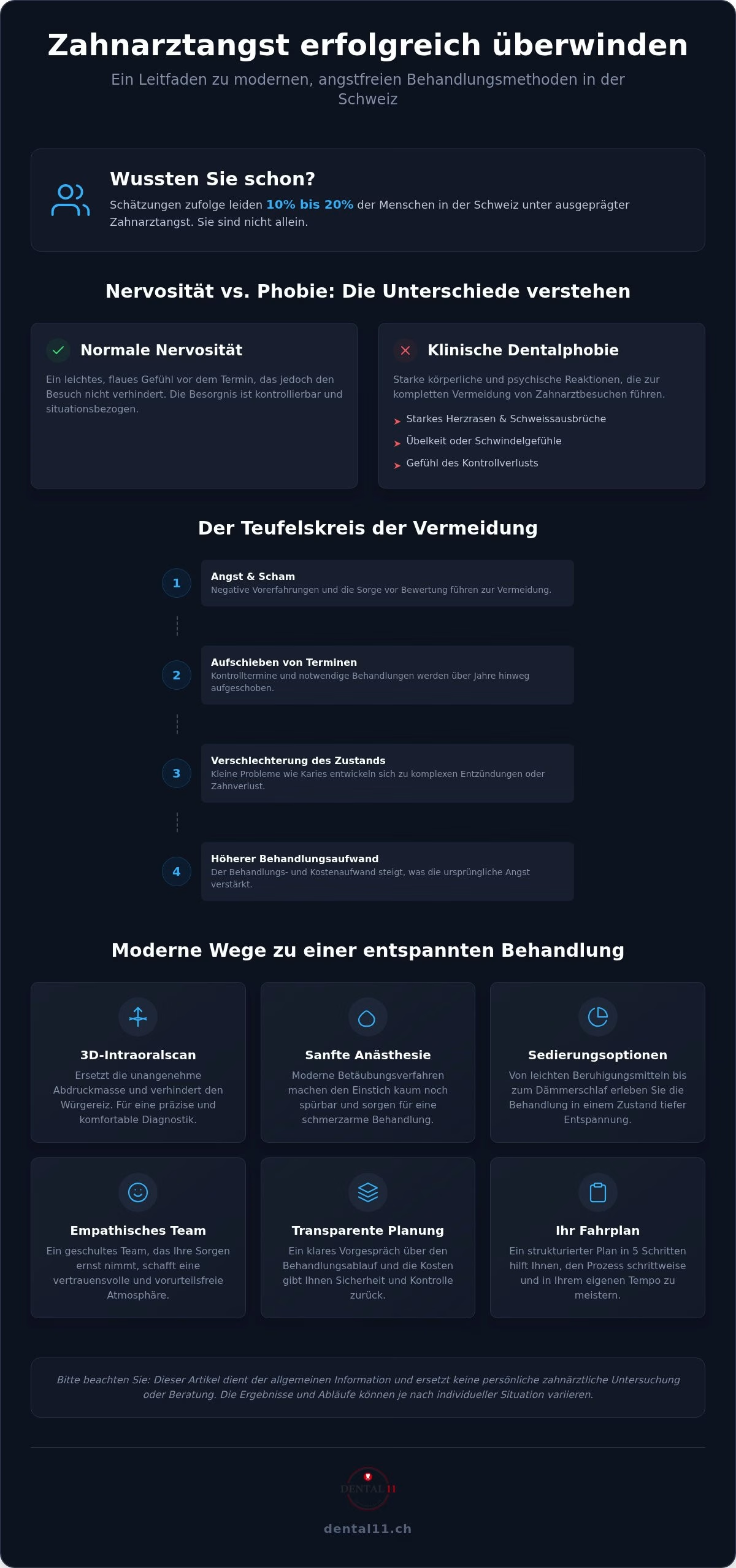
Many people know the uneasy feeling in the stomach before a visit to the dentist. Still, there is a clear difference between normal nervousness and a clinical dental phobia. To understand your own dental anxiety, it helps to look at the physical signals. People affected often experience a strongly racing heart, sweaty hands or nausea as soon as they even think of the dental chair. The cause is usually traumatic experiences in childhood or negative experiences with rough treatment.
Besides old trauma, shame plays a central role. Patients who have neglected their teeth for years are often afraid of being judged by the practice team. This shame becomes the biggest barrier. It is important to know, however, that a professional team treats every patient without prejudice and with respect, whatever the current state of their oral health. If you want to take the first step, you can mention your anxiety discreetly when you book your appointment online.
Why fear is a natural protective mechanism
Fear is originally a signal from our body meant to warn us of potential danger. In the dental chair, this stress often comes from a feeling of losing control. You are lying down and cannot see the instruments in your own mouth. Accepting that this reaction is human and understandable is the foundation for dealing with it successfully. If you admit to yourself that the fear is there, you can look for solutions in a focused way.
Consequences of putting things off for your oral health
Avoiding check-ups often leads to a distressing vicious circle. What starts as a small area of decay can develop into a painful inflammation without treatment. After a long wait, small fillings turn into complex root canal treatments. In addition, the worry about high costs for tooth replacement grows with every year that passes. Individual situations and treatment needs can vary greatly. An early conversation helps to keep the amount of treatment manageable.
Modern methods for managing anxiety in dentistry
Dentistry today increasingly combines technical precision with human empathy. A key factor is an initial conversation as equals, deliberately held without any treatment in a neutral consultation room. Here you have the space to describe your concerns without time pressure. Modern methods for managing anxiety also use digital technology to remove physical stress triggers. A 3D scanner, for example, replaces the conventional impression material that many people find oppressive. This prevents the dreaded gag reflex and makes diagnosis more relaxed.
In addition, low-noise instruments and a calm sound environment help to reduce the typical "dentist feeling". At Dental11 we work with local anaesthesia only; we do not offer sedation. If you would like more time or breaks, you can note this when booking so that the team can prepare accordingly.
Gentle anaesthesia and minimally invasive techniques
With modern anaesthetic methods, the injection is often barely noticeable today: a topical anaesthetic gel first numbs the gum, then the injection is given slowly with a fine needle. If you are afraid of the injection, tell us; we will explain beforehand what will happen, or keep the instruments out of sight if you wish. Minimally invasive techniques, supported by high-resolution microscopes, also allow very precise work on crowns or fillings. This protects the surrounding tissue and noticeably shortens healing times. Advances like these provide security and predictability. Individual results, however, always depend on the starting situation.
The importance of an empathetic practice environment
Thoughtful interior design with warm colours and comfortable seating lowers stress levels as soon as you walk in. Many practices also use psychological distractions such as music through headphones or screens on the ceiling. A specially trained team that pays attention to non-verbal signals and offers breaks during treatment without being asked builds trust. This sense of control helps you approach future appointments more calmly.
Your roadmap: 5 steps to a relaxed dental visit
A clear, reliable structure helps against fear. The first step is choosing a practice that has explicitly adapted to the needs of anxious patients. Look for signs such as empathy and non-judgemental communication. An important tip when choosing a practice: mention your concerns when you book your appointment online. This gives the team the chance to plan more time for your first conversation and to prepare for you individually.
The roadmap itself begins with a consultation-only appointment. In a neutral room, away from drilling noises and instruments, we discuss your wishes. Only then do we draw up a step-by-step treatment plan together. We often start with simple measures, such as gentle preventive care, to build trust. During every session you remain fully in control: with clear stop signals, such as raising your hand, we stop work immediately. This way you experience being in charge rather than being at someone's mercy.
Preparing for the first conversation
Good preparation gives you confidence. Write down all your questions or specific fears on a piece of paper beforehand. In the excitement of the appointment, such details are easily forgotten. It is also entirely legitimate to bring a person you trust for moral support. This companion can stay in the waiting room or, by arrangement, come into the treatment room to give you extra reassurance.
Transparency as a source of calm
Uncertainty is a major cause of stress. That is why we give detailed explanations of every single treatment step. You should understand why each measure is necessary. Financial clarity is just as important. We explain the cost planning transparently according to the Swiss dental tariff Dentotar, so that there are no unexpected bills. As every case is different, the length of treatment and the costs can vary depending on your individual situation.
Questions you can ask at the first consultation
A good first consultation answers your questions before you need to ask them. If not, feel free to ask. These questions have proved useful:
- What exactly have you found, and how urgent is it?
- What treatment options are there, and what happens if I do nothing for now?
- Can we split the treatment into short sessions, and what do we start with?
- What does each step cost, and will I receive the cost plan in writing?
- What stop signal shall we agree on, and may my companion come into the treatment room with me?
Take the note with the answers home with you. You do not have to decide anything in the treatment room; the next appointment can also be two weeks later.
Dental11 in Zurich: your partner for anxiety-free dentistry
Dental11 in Zürich Enge offers you a safe space where your concerns are taken seriously. At our practice, a few minutes from Sihlcity, we provide care without prejudice. We listen to you actively instead of judging the condition of your teeth. Many anxious patients fear the clinical distance of large hospitals. With us, by contrast, you will find an atmosphere that combines professional expertise with human warmth.
Financial certainty is an essential part of our approach. We know that uncertainty about costs causes additional stress. That is why you receive a written cost estimate before every treatment; payment in instalments is possible through the Zahnärztekasse. This lets you concentrate fully on your recovery without fearing financial surprises. The central location and flexible appointment times also allow a relaxed journey without time pressure.
Why we take time for your story
Every path to dental health is individual. Our team (German, English, Greek) deliberately takes time to understand your personal story and your specific fears. A careful dental hygiene session in Zurich is often an ideal, gentle start. It lets you get to know how we work and our modern, low-noise equipment in a low-stress situation before more complex treatment is planned.
Your path to a better quality of life
The aim of our work is to help you to a better quality of life. When you overcome your fear of the dentist, you regain not only your dental health but also a little more ease in everyday life. We accompany you step by step and at your own pace through the whole process. If you are ready for a first consultation with no obligation, you can book your appointment online.
Your path to relaxed appointments and better dental health
Today, the combination of digital technology and caring support enables many people to overcome their fear of the dentist. Whether by avoiding unpleasant impression material thanks to modern 3D scans or by staying fully in control with individual stop signals, current approaches consistently put your well-being at the centre of treatment. We value professional quality and tell you the costs before every procedure.
At our practice in Zürich Enge, a few minutes from Sihlcity and Enge station, we take the time you need to make your decision. Together we find solutions that fit your circumstances, while the length of treatment and the results always depend on your individual starting situation. Book a consultation with no obligation at Dental11 now and take the first step at your own pace. We look forward to welcoming you in a non-judgemental setting and accompanying you on your way.
Frequently asked questions about dental anxiety
What is the difference between dental anxiety and a phobia?
Dental anxiety usually describes general nervousness before an appointment. A dental phobia, by contrast, is a clinically recognised anxiety disorder that comes with strong physical reactions such as a racing heart or panic. People affected often avoid the dentist for many years. Understanding this difference helps you choose the right support. A professional diagnosis helps to find the support and treatment approach that suit your personal situation.
Can I ask for the first appointment to be a conversation only?
Yes, a consultation-only appointment is explicitly possible at our practice. This conversation is purely about discussing your concerns in a neutral setting and building trust with the team. No medical instruments are used. This careful approach helps you stay in control. A physical examination only takes place once you feel ready and give your explicit consent.
Does Dental11 offer sedation or general anaesthesia?
No. Dental11 works with local anaesthesia only; we do not offer sedation, laughing gas or general anaesthesia. If your anxiety is severe, we take more time, explain every step and agree on breaks and a stop signal.
How do I find a dentist in Zurich who does not judge?
When searching in Zurich, look for practices that explicitly emphasise a non-judgemental atmosphere and empathy. Practices in areas such as Zürich Enge often have teams trained specifically for the needs of sensitive patients. Membership of the Swiss Dental Association SSO is a sign of a reputable practice. A personal phone call beforehand can also give you a first impression of whether your concerns are taken seriously and whether you get on with the team. You can find more information on how to find a caring dentist in Zurich as an anxious patient and discover ways to relaxed treatment in our detailed guide. Another guide shows how you can overcome dental anxiety in Zurich in a targeted way and regain your trust step by step. If you are also considering fixed tooth replacement, our guide to a dental implant consultation in Zürich Enge explains how a relaxed first conversation prepares the way for your individual treatment plan. If you are also thinking about cosmetic corrections after your anxiety treatment, our guide to veneers before and after in Zurich explains how modern methods can create a balanced, natural-looking smile.
I am ashamed of the state of my teeth. What now?
You are not alone: at our practice, shame is the most common reason why people have stayed away for years. We have seen it all, and there is no condition that will prompt a remark. At the first appointment nothing is judged; we simply record the current situation. We plan the order of treatment according to urgency and to what you feel able to manage. Many patients tell us that, after the first conversation, the shame was much smaller than the fear beforehand.
What exactly happens at a first appointment at Dental11?
First, you note in your online booking that you are anxious; we then plan more time. Second, we talk, away from the treatment chair if you wish, and you tell us what happened to you in the past and what helps you. Third, only if you agree do we look into your mouth, with no instruments other than a mirror and a light; an X-ray or a 3D scan follows when you are ready. Fourth, you receive a written cost plan based on the Dentotar tariff and decide at home how to proceed. You can read more about how the process works specifically for anxious patients in Zurich in the companion article.
This article is for general information only and does not replace an individual dental examination.