
A root-treated tooth that has darkened can in many cases be whitened from the inside: the dentist opens the tooth from the back, places a bleaching agent inside and seals it temporarily. Usually one to three sessions a few days apart are needed. At Dental11 in Zurich Enge, the process starts with a check-up (CHF 99), during which we assess whether the root filling and the tooth are suitable for whitening and prepare a cost estimate for you. For comparison: external bleaching at our practice costs from CHF 299, a crown from CHF 1’400.
In internal whitening, a whitening agent is placed inside a tooth that has already had root canal treatment. Whether this approach is suitable can only be judged after a dental examination. This takes into account, among other things, the condition of the tooth, the root canal treatment and the existing restoration.
In this article you will learn how internal whitening differs from external bleaching, which factors go into a cost estimate and when a filling, a veneer or a crown can be discussed as an alternative. Which option suits you depends on the findings and on your wishes.
Key points
- Whether internal whitening is an option only becomes clear when the root-treated tooth and its restoration are examined.
- Internal whitening, external bleaching and restorative solutions such as veneers or crowns have different aims.
- Costs: check-up CHF 99, followed by a cost estimate based on the Dentotar tariff; for comparison, external bleaching costs from CHF 299 and a crown from CHF 1’400.
- An individual treatment plan helps you compare alternatives and costs in a transparent way.
Internal tooth whitening: what is it about?
A root-treated tooth can turn darker or greyish over time. This is particularly noticeable when the other teeth look lighter. Internal tooth whitening does not work on the tooth surface; it aims to treat the discolouration from the inside. Whether it is suitable depends on the condition of the tooth and the clinical findings. It does not replace any necessary treatment of a damaged tooth.
Why can a root-treated tooth become discoloured?
Discolouration can be related to the earlier condition of the tooth or to its treatment. An injury or changes inside the tooth may play a role. How the root canal treatment went is also important for the assessment. The cause cannot be reliably deduced from the colour alone. The examination makes it possible to assess the tooth and the existing restoration and to weigh up possible treatment options.
What does internal tooth whitening mean?
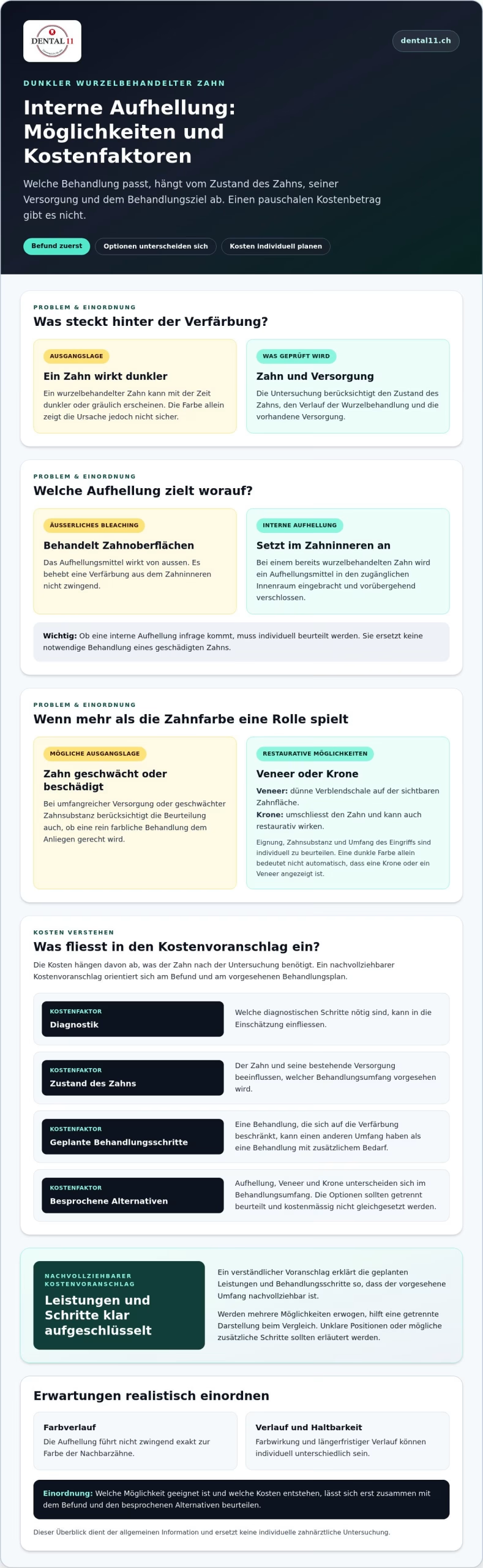
With external bleaching, the tooth colour is changed from the outside. With internal whitening, the dentist places a whitening agent in the accessible inner space of a tooth that has already had root canal treatment and seals it temporarily. This is what distinguishes the procedure from bleaching the visible tooth surfaces. Whether it is an option must first be checked individually. Relevant factors include the condition of the root canal treatment and of the tooth.
The treatment targets the discolouration and does not restore the inside of the tooth. Whether and how the tooth colour changes depends on the findings and on how the treatment progresses. It should therefore first be clarified whether the tooth is stably restored or needs further treatment.
Internal tooth whitening or a crown: what are the options?
The right treatment depends on whether it is mainly the colour that bothers you or whether the tooth also needs to be restored. Internal whitening targets discolouration inside the tooth. External bleaching treats visible tooth surfaces and is not automatically the right solution for a single tooth discoloured from within. Veneers and crowns are restorative options. Their suitability also depends on the findings.
- Internal whitening: can be considered for a suitable root-treated tooth if the discolouration comes from inside. The colour outcome and how long it lasts cannot be predicted in general terms.
- External bleaching: treats the tooth colour from the outside. It may be an option for discoloured tooth surfaces, but does not necessarily resolve discolouration from inside the tooth.
- Veneer: a thin shell can cover the visible surface of the tooth. Whether there is enough suitable tooth structure must be assessed individually.
- Crown: covers the whole tooth and can also have a restorative function. The preparation required and the condition of the tooth are part of the decision. At Dental11 from CHF 1’400.
When can a restorative solution be considered?
If a tooth is significantly weakened, damaged or already extensively restored, a treatment that only addresses the colour may not cover all your concerns. The remaining tooth structure and existing fillings are therefore part of the assessment. A crown or a veneer is not automatically indicated just because a tooth is dark. The benefits, limits and extent of each procedure should be discussed.
What expectations are realistic?
Whitening does not necessarily produce exactly the same shade as the neighbouring teeth. How the treatment progresses and how the colour holds in the longer term can also vary from person to person. The cost of internal whitening of a dead tooth can therefore only be put into context together with the findings and the alternatives discussed.
A personal examination helps you weigh up the options. At Dental11 in Zurich Enge, you can discuss your questions about the discolouration and possible treatments.
Internal tooth whitening: what do the costs in Switzerland depend on?
We do not quote a flat price for internal whitening, because the number of sessions and any preparatory work (such as renewing the root filling or taking an X-ray) determine the effort involved. The first step is fixed: the check-up for CHF 99. After that you receive a written cost estimate based on the Dentotar tariff, listing every item. For comparison: external bleaching at Dental11 costs from CHF 299, a crown from CHF 1’400.
The estimate may depend on which diagnostic steps are needed, on the condition of the tooth and its existing restoration and on which treatment steps are planned. If additional treatment turns out to be needed, the scope may be larger than for a treatment limited to the discolouration. Whether internal whitening is suitable at all is also part of the planning.
A crown or a veneer involves a different scope of treatment from whitening. The options should therefore be assessed separately and not treated as equivalent in terms of cost. Which of them is discussed depends on the condition of the tooth and on your treatment goal.
What should a clear cost estimate explain?
A clear cost estimate lists the planned services and treatment steps so that you can follow the intended scope. If different options are being considered, showing them separately makes it easier to compare services and costs. Ask if individual items or possible additional steps are unclear. That way you understand better what the estimate is based on.
How can cost questions be clarified before treatment?
An examination is the basis for an individual cost estimate. It allows the findings, the treatment goal and possible alternatives to be discussed. The cost of internal whitening of a dead tooth follows from the specific treatment plan, not from a general guide figure.
At Dental11 you can have the condition of a discoloured tooth assessed and discuss the costs of possible treatment steps.
Internal tooth whitening in Zurich: how the next step leads to a decision
Discolouration alone does not show which treatment is right. At an examination, the affected tooth is assessed first. You can then discuss the options, their limits and the likely scope of treatment. On this basis, an individual cost estimate can be prepared.
What questions does the dental examination answer?
The examination is used to assess the condition of the tooth and its existing restoration and to identify possible causes of the discolouration. It covers whether internal whitening is an option or whether another treatment should be considered. Possible limits and the likely costs are also part of the conversation. This way you can understand what the proposed course of treatment is based on.
External bleaching and internal whitening work in different places. This distinction helps to clarify the treatment goal but does not replace a diagnosis. The cost of internal whitening of a dead tooth can be estimated more accurately when the findings and the planned procedure are discussed together.
How can I book a consultation?
At Dental11 on Waffenplatzstrasse 11 in Zurich Enge, a few minutes from Sihlcity and Enge station, you can have the discoloured tooth assessed and discuss the next steps. The practice is easy to reach for patients from Enge and the surrounding neighbourhoods. If you have them to hand, bring any information about a previous root canal treatment or restoration. Also note down your questions about effort, alternatives and costs so that the important points are covered in the conversation.
If you would like to discuss your situation in person, book an appointment at Dental11.
Take the next step at your own pace
Discolouration can raise questions, but you do not have to decide on a treatment straight away. A personal conversation helps you sort out your concerns and raise open points before you choose a course of treatment. This way you can discuss the cost of internal tooth whitening based on your individual situation rather than a general estimate.
At Dental11 you receive a cost estimate before treatment; payment in instalments is possible through the Zahnärztekasse. The costs and treatment steps relevant to you are discussed individually. Take time to weigh up the options and their limits. An informed decision starts with a conversation in which there is room for your questions.
If you would like your situation assessed by a dentist, book a personal consultation at Dental11.
Frequently asked questions about internal tooth whitening
How much does internal whitening of a root-treated tooth cost?
The check-up, during which we assess whether the tooth is suitable, costs CHF 99. The price of the whitening itself depends on the number of sessions (usually one to three) and any preparatory work, and is set out in the cost estimate you receive after the examination. As a guide: external bleaching at Dental11 costs from CHF 299.
Can every root-treated tooth be whitened internally?
No, a previous root canal treatment does not automatically mean that internal whitening is suitable. What matters is the current condition of the tooth and its restoration. At the examination, let us know roughly when the root canal treatment took place and whether anything has changed since then. This information helps to put the history into context. Suitability can be assessed on the basis of the clinical findings.
How long does the result of internal tooth whitening last?
The result often lasts several years, although the tooth may darken slightly again over time. The whitening can then usually be repeated. During planning, discuss how the colour development will be assessed and whether a follow-up check is planned. If the discolouration becomes more noticeable again later, the dentist can reassess the situation and discuss possible next steps with you.
Is internal tooth whitening painful?
Usually not: the tooth no longer has a living nerve, so anaesthesia is generally not needed. If you feel tense during dental treatment or have had discomfort in the past, mention this before you start. The treatment team can take your needs into account when planning and explain what to expect during each step. If you have any discomfort after a treatment, please let the practice know.
How many appointments does internal tooth whitening require?
Usually one to three sessions are needed: the whitening agent is placed, checked after a few days and renewed if necessary. Finally, the tooth is sealed with a permanent filling. The exact number depends on how strongly the tooth is discoloured and how it responds to the whitening.
This article is for general information only and does not replace an individual dental examination.