
Medically reviewed by MDDr. Polydefkis Papaioannou, dentist, Dental11 Zurich. Updated 10/2026
Fixed dental work stays in your mouth permanently and is not taken out for cleaning. Three solutions are possible: a crown for a badly damaged tooth (at Dental11 from CHF 1’400), a bridge, which closes a gap using the neighbouring teeth, and an implant with a crown as an artificial tooth root (from CHF 4’600). Which solution is right depends on the condition of the neighbouring teeth, the available bone and your wishes. At Dental11 in Zürich Enge, we plan with 3D X-rays and a digital scan and prepare a written cost estimate in advance.
We understand that deciding on treatment often raises questions about long-term stability and financial transparency. In this article, you will learn about the different ways to restore stable chewing function, from precise single crowns to firmly anchored implants that feel natural. We give you a clear overview of the treatment process and explain how billing under the Dentotar system keeps costs fair and easy to follow. This gives you the confidence you need to plan your individual treatment.
Key points
- Crown: protects a badly damaged or root-canal-treated tooth; from CHF 1’400.
- Bridge: closes a gap using the prepared neighbouring teeth; quick, but costs healthy tooth structure; price according to the number of units in the cost estimate.
- Implant with crown: replaces the root, spares the neighbouring teeth and preserves the bone; from CHF 4’600, healing time usually three to six months.
- Materials: zirconia for stability in the back teeth, all-ceramic for the front teeth, both metal-free.
- Billing according to Dentotar, a written cost estimate, and payment in instalments through the Zahnärztekasse possible.
What is fixed dental work? Definition and options
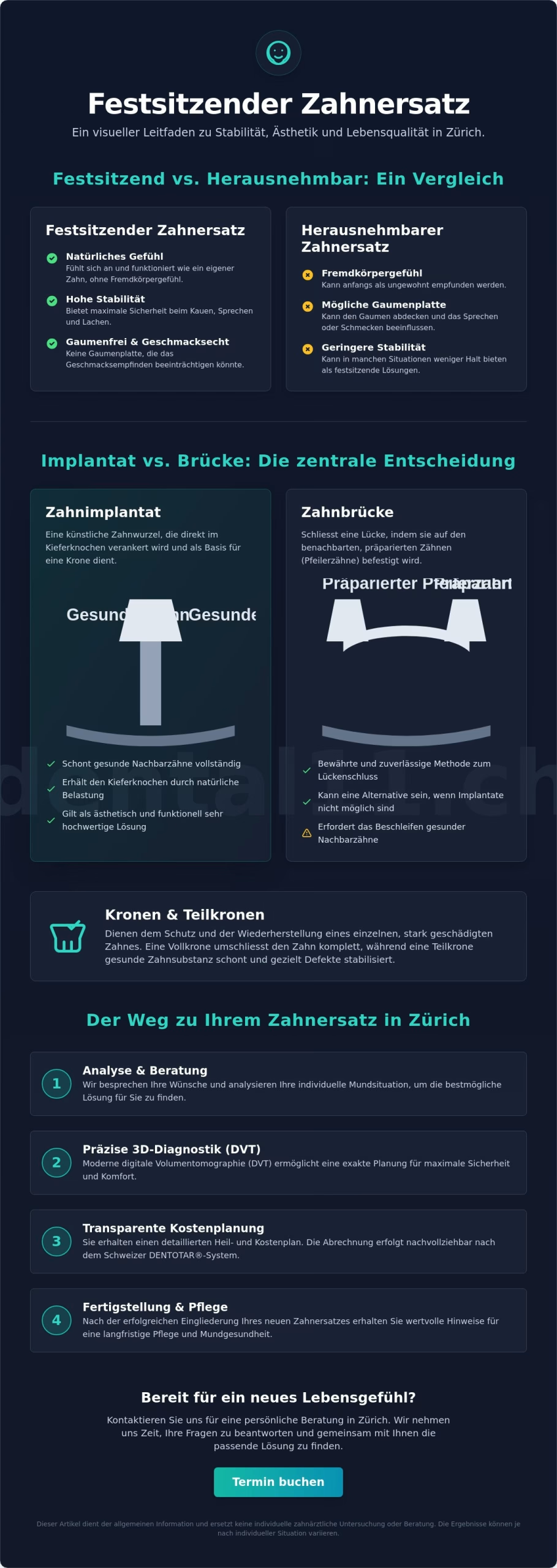
In modern dentistry, the term dental restoration covers all measures that replace lost tooth structure or entire teeth. This includes removable dentures as well as solutions that are firmly attached to the jaw or to the neighbouring teeth. When we talk about fixed dental work, we mean restorations that remain in the mouth permanently and do not need to be removed for daily cleaning.
This type of restoration comes closest to natural teeth. It offers a high degree of stability when chewing and speaking, and there is no palatal plate, which many people find uncomfortable as a foreign body. We basically distinguish between tooth-supported solutions, which are attached to existing tooth structure, and implant-supported options, which use artificial tooth roots as their base. Choosing fixed dental work is often an important step towards a better quality of life and more confidence in everyday life.
Crowns and partial crowns: protection for a single tooth
A crown is usually needed when a tooth has been so badly damaged by decay or an accident that a simple filling is no longer enough. A crown is also often advisable after root canal treatment to protect the remaining tooth from fracturing. While a full crown covers the entire visible part of the tooth, a partial crown preserves healthy tooth structure. This minimally invasive technique stabilises the damaged areas in a targeted way. The aim is always to restore the tooth’s function while keeping a natural appearance. At Dental11, a crown costs from CHF 1’400.
Dental bridges: closing a gap without an implant
Dental bridges are a proven method of closing one or more gaps. The teeth to the left and right of the gap serve as abutment teeth. They are prepared and carry the bridge unit, which fills the gap visually and functionally. This construction requires the anchor teeth to be sufficiently stable. Modern materials allow the bridge to blend in with the existing row of teeth, so that the transition is barely noticeable. Whether a bridge or an implant is the right choice depends on the health of the neighbouring teeth and your personal wishes. We are happy to advise you in detail; you can book your appointment easily through our online system.
Implants or bridges: which dental restoration suits you?
Choosing between a dental implant and a conventional bridge is a key decision in planning your treatment. If you are interested in fixed dental work, there are usually two fundamentally different approaches to choose from. Both methods aim to restore your chewing ability and appearance, but they differ considerably in their effect on the remaining tooth structure and the jawbone. There is no one-size-fits-all solution; your medical circumstances and personal priorities determine the right path.
One key difference lies in how the load is distributed. While an implant is anchored directly in the bone as an artificial tooth root, a bridge uses the neighbouring teeth as supports.
Advantages of dental implants as a base
Implants are often regarded as a particularly natural form of restoration, as they replace the natural tooth root in an almost identical way. A decisive advantage is that the jawbone is preserved. The direct transfer of force during chewing stimulates the bone, which can counteract natural bone loss. Your healthy neighbouring teeth also remain untouched; no healthy tooth structure has to be ground down for attachment. Many patients appreciate the feeling of having “their own teeth” again. At Dental11, an implant with a crown costs from CHF 4’600.
When a conventional bridge is the right choice
There are situations in which a bridge is the more sensible or preferred alternative. If there is not enough bone for an implant and bone grafting is not wanted, a bridge offers a stable solution. Treatment is usually much shorter, as there is no healing phase of several months as with an implant. If the neighbouring teeth already have large fillings or crowns, a bridge can also be a very cost-effective solution, as these teeth are stabilised at the same time during treatment.
Today, the long-term outlook is good for both systems. With consistent oral hygiene and regular preventive care, implants often last for decades; bridges can also last many years if they are looked after carefully. Factors such as smoking, general health or grinding your teeth at night play an important role in the choice.
We will be happy to discuss which solution suits your situation in a personal consultation. To talk through your options in detail, you can book an appointment at any time and receive comprehensive advice.
Fixed or removable? A comparison of quality of life
The choice of dental restoration affects far more than the appearance of your smile. It shapes how you eat, speak and feel in company. While removable dentures are often a proven basic solution, fixed dental work offers a level of comfort that comes very close to the feeling of your own teeth. One key difference lies in how the restoration feels in the mouth. Many removable partial or full dentures need a palatal plate in the upper jaw for stability. This additional layer can dull your sense of taste when eating and affect your speech during the period of adjustment.
With firmly anchored solutions, on the other hand, the palate remains completely free. This lets you enjoy food and drink without any change in taste. The psychological side also plays a major part in quality of life. With fixed options, the underlying worry that a denture could slip when you laugh heartily or during a business meal disappears completely. They are firmly connected to the chewing system and offer reliable stability in every situation. Daily care is different too: you clean fixed teeth naturally with a toothbrush, directly in the mouth, which makes everyday life much simpler. For a toothless jaw, All-on-4 implants in Zurich are a fixed alternative to a full denture.
Chewing force and a natural appearance
A major advantage of firmly anchored teeth is the way pressure is distributed. While dentures often transfer chewing pressure directly to the sensitive gums, fixed dental work spreads these forces evenly through the abutment teeth or implants. This helps to prevent painful pressure points, which can occasionally occur with removable solutions. With modern materials and precise colour matching, a harmonious overall result can be achieved that is hard to tell apart from your natural teeth.
A long-term investment in oral health
Choosing a solution that stays in your mouth usually means investing in a restoration that can last for many decades with good care. It protects the remaining teeth from incorrect loading and prevents healthy teeth from drifting into existing gaps. We are committed to transparent dentistry at Dental11 to give you a sound basis for decisions about your long-term oral health.
Your path to dental work in Zurich: procedure and planning
Careful planning is the foundation for a restoration that fits harmoniously into your chewing system. If you decide on fixed dental work, the process always begins with a detailed initial consultation (check-up CHF 99). During this consultation, we analyse your medical situation and discuss your personal expectations regarding appearance and function. To create a precise basis for further treatment, we use modern digital diagnostics. A 3D X-ray (CBCT) allows us to assess bone structures and the course of the nerves in detail, which increases safety, especially with implant-supported solutions.
After the planning phase, the teeth are prepared or the implants are placed. So that you do not have to go without your smile while your final restoration is being made, you receive a good-quality temporary restoration. It takes care of your appearance in the meantime and protects the prepared areas. Once your individual restoration has been made in the laboratory, it is fitted and your bite is finely adjusted.
Digital precision without unpleasant impressions
In the past, impressions taken with sticky materials and metal trays were unpleasant for many patients. Today, we use intraoral scanners that record your teeth digitally. This technology offers a very precise fit and forms the basis for an efficient workflow. The digital data are sent directly to the laboratory, which often shortens treatment times and reduces sources of error. The result fits precisely and feels natural.
Choice of material: zirconia and all-ceramic
Today, biocompatibility and appearance are the main considerations when choosing a material. Zirconia is a high-performance ceramic known for its great stability and durability. It is very well suited to bridges and crowns in the back teeth, as it withstands high chewing loads. All-ceramic, on the other hand, refracts light in a way that closely resembles natural tooth enamel. Both materials are metal-free and therefore well suited to people with allergies or patients who prefer a holistic approach. The right material depends on the position in the jaw and your aesthetic preferences.
The path to a stable and attractive restoration takes patience and professional expertise. We are happy to guide you through this process step by step and find the solution that suits your situation. You can easily book a personal consultation at our practice through our online booking system.
Your fixed dental work at Dental11 in Zürich Enge
If you decide on fixed dental work, the choice of practice matters just as much as the choice of method. Our practice in Zürich Enge, a few minutes from Sihlcity and Enge station, has modern equipment and is designed to make you feel safe and at ease. We know that the path to new teeth often comes with uncertainty. That is why we take the time you need to explain every step clearly and reliably. The central location with good public transport connections makes getting to your appointments straightforward.
Patients who feel uneasy about visiting the dentist in particular will find a non-judgemental environment with us. We rely on a respectful attitude and patience to break down barriers. Our aim is to use technology primarily as a tool to make you more comfortable.
Transparency about costs and financing
Financial transparency is a central part of our approach. Before any treatment begins, we prepare a detailed cost estimate according to Dentotar. As a guide: crown from CHF 1’400, implant with crown from CHF 4’600, extraction from CHF 180; the price of a bridge depends on the number of units. As good-quality restorations are an investment, payment in instalments through the Zahnärztekasse is possible. This keeps quality treatment accessible to a wide range of people without you having to compromise on your oral health.
Aftercare for a long-lasting restoration
Consistent aftercare is essential so that you can enjoy your new restoration for a long time. The durability of bridges and implants depends largely on the health of the surrounding tissue. We therefore combine your dental work with an individual preventive care plan. At our practice, you will learn how best to care for your fixed restorations. Regular dental hygiene in Zurich supports the long-term success of treatment and protects against inflammation such as peri-implantitis. Regular check-ups are also important to make sure the fit and function remain right over time.
Your wellbeing is our priority, from the first consultation to long-term care. We invite you to ask your questions in a personal consultation and to plan the path to a natural smile together. When you are ready for the next step, you can book your consultation in Zurich now. We look forward to welcoming you to our practice.
Your path to a stable and natural smile in Zurich
Choosing fixed dental work is a worthwhile investment in your long-term oral health and your everyday wellbeing. We have seen that modern solutions such as implants or bridges not only restore your chewing ability but also give you back the confidence to laugh freely. By using precise digital diagnostics at our practice in Zürich Enge and good-quality all-ceramic materials, we create restorations that blend harmoniously with your natural teeth.
Our team supports you with empathy and professional expertise through every step of planning. We attach great importance to financial transparency and charge for our services transparently according to the Dentotar tariff.
Arrange your consultation on fixed dental work at Dental11 now. We look forward to finding the right solution for your needs together with you and supporting you along the way.
Frequently asked questions about fixed dental work
How long does fixed dental work usually last?
With good care and regular check-ups, fixed dental work can last for many decades. The lifespan of bridges and crowns depends largely on the stability of the abutment teeth and on your oral hygiene. Not smoking and having your teeth cleaned professionally make a significant contribution to longevity. In the end, your individual situation determines how long the restoration lasts.
Is having fixed dental work fitted painful?
Treatment is usually carried out under local anaesthesia, so most patients tolerate the procedure well. After fitting, you may notice a slight feeling of pressure or temporary sensitivity. We take a gentle approach to keep any discomfort to a minimum. Modern techniques and careful aftercare help to make the healing phase comfortable. How it feels can, however, vary from person to person.
Roughly how much does fixed dental work cost in Zurich?
At Dental11, a crown costs from CHF 1’400 and an implant with a crown from CHF 4’600. The price of a bridge depends on the number of units and the material. We bill according to the Dentotar tariff. As every situation is different, we prepare an individual cost estimate after an examination. This gives you financial transparency and a reliable basis for planning before the actual treatment begins.
Does health insurance in Switzerland cover the cost of dental restorations?
Compulsory basic health insurance (OKP) covers the cost of dental restorations only in rare exceptional cases, for example in severe, unavoidable diseases of the masticatory system. In most cases, it is a private service. Contributions to costs are usually only made after accidents or under military insurance. Supplementary insurance can often help here.
Can fixed dental work be fitted for every patient?
In principle, fixed dental work is suitable for most adults, provided that the available bone and general health allow it. If bone volume is low, preparatory bone grafting may be necessary. Certain pre-existing conditions, such as uncontrolled diabetes or severe periodontitis, must be stabilised beforehand. A thorough preliminary examination is essential to assess suitability individually and to take possible risks into account early in planning.
How do I clean and care for my fixed teeth?
You clean them with a toothbrush just like your natural teeth, together with special aids. The areas under bridge units and around implant posts need particular attention. Interdental brushes or special floss help to remove plaque effectively. Check-ups twice a year and professional dental hygiene are essential to prevent inflammation of the gums or bone and to keep your dental work functioning in the long term.
Can you be allergic to materials such as zirconia or titanium?
Intolerances to modern dental materials such as zirconia or titanium are very rare. Zirconia is a metal-free high-performance ceramic with excellent biocompatibility and is therefore particularly suitable for people with allergies. Titanium has been used as a standard implant material for decades and is very well tolerated by tissue. If you have known allergies, we discuss alternative metal-free options with you in advance to ensure a restoration that is safe for your body.
What happens if an abutment tooth under a bridge becomes diseased?
If a supporting abutment tooth becomes diseased, the treatment has to be tailored to the extent of the damage. Often the tooth can be saved with root canal treatment without the whole bridge having to be removed straight away. With more serious problems, however, it may be necessary to replace the restoration or to switch to an implant-supported solution. Regular check-ups help to detect such developments early and treat them with as little effort as possible.
This article is for general information only and does not replace an individual dental examination.