
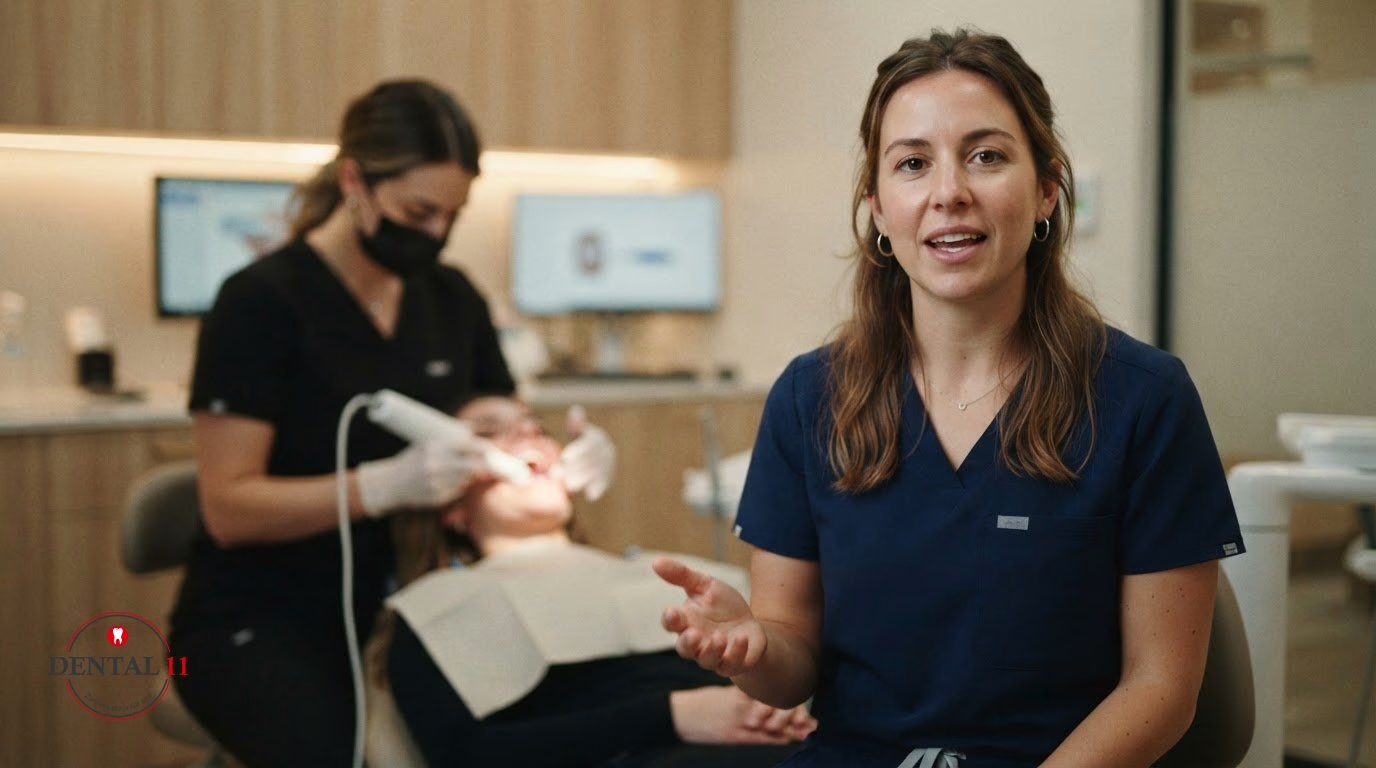
Does a dental crown really have to be prepared with impression material? Not necessarily: a digital 3D scan captures the surface of the teeth and jaw optically and takes the impression without any impression material. For a dental crown in Zurich Enge, a 3D scan can therefore be an alternative to the conventional impression.
Worrying about an unpleasant impression is understandable. During a digital scan, the dentist guides a small scanner along the teeth inside the mouth. This creates a three-dimensional model; an intraoral scanner can capture up to 6000 individual images per jaw for this. This describes the impression itself, not necessarily how the entire crown treatment feels.
Here you will learn how a digital impression works, what it is used for with a crown and what its limits can be. You will also read which factors play a role in choosing the approach and in the costs. This will help you judge what to expect from a 3D scan for a dental crown in Zurich Enge and which questions you may want to raise at a personal examination.
Key points
- Find out which steps lead from digital capture to the planning of the restoration.
- Understand which restorations can use a digital process and where individual planning matters.
- See why the length of treatment depends not only on the scan but also on the chosen restoration.
- Compare digital and conventional impressions so you can raise the comfort aspects that matter to you.
How a digital impression works
A digital dental impression captures the teeth and jaw optically instead of with impression material. For a crown, the data are used for planning and, depending on the approach, for making the restoration.
Digital capture with an intraoral scanner
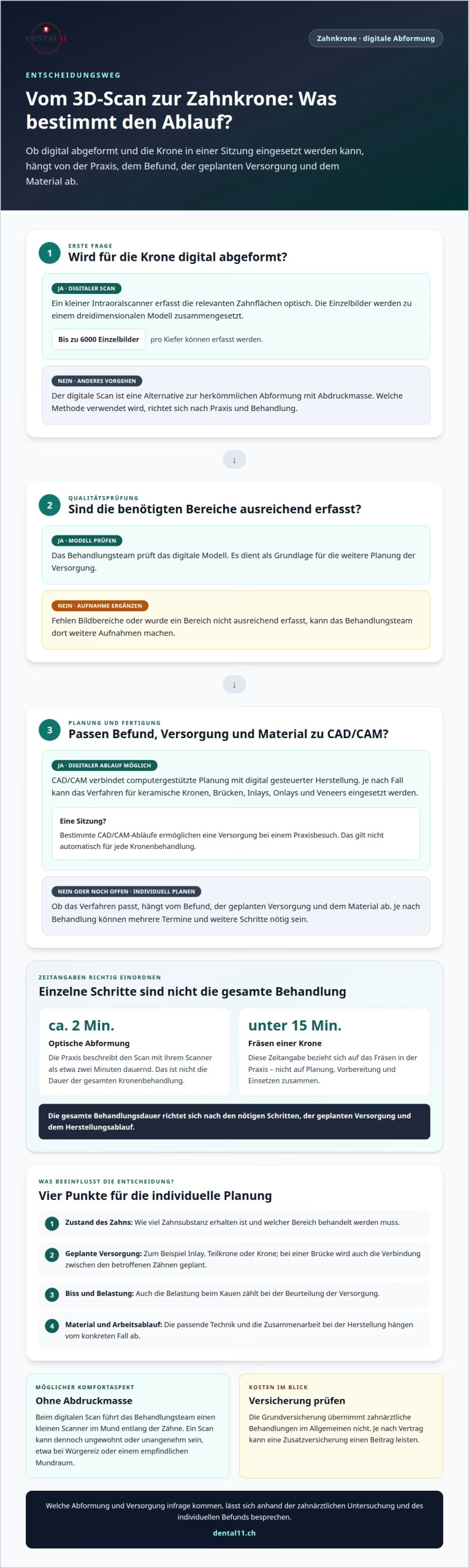
First, the dentist moves the intraoral scanner over the relevant tooth surfaces. The device takes numerous individual images and combines them into a three-dimensional model. A digital dental scan can capture up to 6000 images per jaw. This produces the impression for further planning. If an area has not been captured well enough, the treatment team can add to the scan there.
Digital treatment planning with CAD/CAM
CAD/CAM refers to a technology in which the impression, treatment planning and production of the restoration are controlled digitally. Whether the method is suitable depends on the findings, the planned restoration and the material.
Procedure and duration of the dental impression
The procedure begins with optical capture. The treatment team then checks the digital model and adds any missing image areas if needed. At Dental11, the scan with the 3Shape scanner takes about two minutes. This refers to the scan, not to the entire crown treatment. Further steps can include preparing the tooth and making the restoration.
A scan is used when it is needed to plan a restoration. At Dental11 in Zurich Enge, we work with a 3Shape intraoral scanner. To have your crown examined and discussed, book an appointment online or by phone.
A scan can feel unfamiliar or uncomfortable, for example if you have a gag reflex or a sensitive mouth. Any gaps in the images can be filled in. Basic health insurance generally does not cover dental treatment; depending on your policy, supplementary insurance may contribute.
Use for crowns, bridges, inlays, onlays and veneers
Digital impressions can support the planning of various types of dental restorations. Which restoration is suitable depends on how much tooth structure remains and which area needs treatment.
Inlays, partial crowns and crowns
An inlay replaces a defect within the biting surface. A partial crown also covers parts of the tooth surface. These differences affect treatment planning and the restoration required. A digital model can capture the shape of the affected tooth for production. The condition of the tooth and the load when chewing also count in the assessment.
Ceramic is one possible material for crowns and other restorations. Which material and type of crown suit your tooth depends on the findings. A full crown or a partial crown, for example, can be discussed. Veneers, thin shells for visible tooth surfaces, can also be included in digital planning. The specific choice is made as part of the dental examination.
CAD/CAM production of crowns and bridges
CAD/CAM combines computer-aided planning with the digital production of restorations. Depending on the case, the method can be used for ceramic crowns, bridges, inlays, onlays and veneers. With a bridge, planning also covers the connection between the teeth involved. The shape and extent of the restoration are prepared using the digital model. Whether the technique is suitable depends on the planned treatment.
At Dental11, the scan data are sent to a Swiss dental laboratory, which plans and makes the restoration digitally. What matters is that the planned restoration suits the tooth, the bite and the aim of treatment. An appointment to plan your crown gives you time to discuss materials and possible types of restoration.
When choosing crowns, bridges or inlays, your individual findings remain decisive.
Length of treatment: usually two appointments
A digital scan does not automatically shorten the entire crown treatment. What matters are the planned restoration, the treatment steps needed and the production process. At Dental11, a Swiss dental laboratory makes the crown. This is why we usually plan two appointments: one for preparation and the scan, and one to fit the crown.
The process runs from the prepared tooth through digital capture and planning to fitting the restoration. First, the dentist assesses the tooth and decides on the treatment. Then the images are taken with the scanner. A computer processes the data into a digital model and supports the planning of the crown. The Swiss laboratory then makes the crown, which we fit at the second appointment.
In CAD/CAM treatment, the impression, planning and production are controlled digitally. How many steps are needed depends on the findings and the intended restoration.
Digital planning helps to assess the shape of the planned crown based on the captured tooth. A before-and-after simulation is not a reliable prediction of the final treatment result. An implant requires additional treatment steps. A scan alone therefore tells you nothing about the overall length of treatment.
For patients with a gag reflex, avoiding conventional impression material can be more comfortable. The scanner is guided inside the mouth and the images are taken section by section. Depending on how you personally experience it, the scan may feel uncomfortable. Mention any sensitivities before the scan so that the treatment team can plan breaks and adapt the procedure.
Comfort compared with conventional impressions
An intraoral 3D scan captures the tooth surface optically and needs no impression material. This removes a step that some patients find unpleasant.
Impressions without impression material
For a digital impression, the treatment team moves a small scanner over the relevant teeth. The device captures their surface and creates a digital model from it. Unlike a conventional impression, no mouldable material is placed in the mouth. For people with a gag reflex, this difference can be important. The scan may still feel unfamiliar, for example because of the scanner in the mouth or the need to keep the mouth open.
Doing without conventional impressions
A digital impression can replace a conventional one if the planned restoration and the areas captured are suitable. The digital images support the planning and production of the restoration. Optical capture can be part of the process for a crown as well as for an inlay. However, it does not automatically shorten the entire treatment: the length also depends on the other treatment steps.
Comfort is individual. Some people find it a relief not to have impression material, while others find the closeness of the scanner or keeping the mouth open bothersome. Let the treatment team know if you are sensitive to impressions. They can then explain the procedure and plan breaks if needed. Depending on the restoration, a conventional impression may also be an option.
Digital data support planning, but they do not replace examining the tooth and assessing the intended restoration. Whether the method is suitable depends on the findings and the restoration required. Aesthetic requirements can also be taken into account in planning.
Digital impressions at Dental11 in Zurich Enge
At Dental11, we answer your questions about digital impressions and your planned crown in a personal consultation. During the examination, the condition of the tooth is assessed and we discuss which restoration is suitable. You can also find out what role a digital scan plays in your treatment.
During the consultation, you can also mention if you find conventional impressions unpleasant.
Book an appointment at Dental11 to discuss your questions about your dental crown in person.
Clarify your next treatment step
Deciding on a dental crown does not start with the scanner but with the question of what your tooth needs. In a personal consultation, you can raise your expectations, concerns and the treatment criteria that matter to you. These include the planned restoration, suitable materials and the costs. This gives you a clear basis for your decision.
If you are considering a 3D scan for a dental crown in Zurich Enge, discuss how the digital impression fits into your individual treatment plan. The examination shows which options are available for your tooth and which next steps make sense. General information can help you prepare for this consultation, but it does not replace a personal dental assessment.
Book an appointment with Dental11 to discuss your questions at your own pace. An open conversation helps you approach treatment well informed and with a clear view of your options.
Frequently asked questions about 3D scans for dental crowns
Is taking the impression painful or unpleasant?
How an intraoral scan feels varies from person to person. Some people find the scanner in the mouth or keeping the mouth open for a longer time unfamiliar. If you are sensitive or tend to gag, please mention this before we start. The treatment team will explain the procedure and take your feedback into account during the scan.
When is a scan useful?
A scan is useful when a digital model of the teeth is needed for a planned restoration, for example to plan a crown or an inlay. At a check-up with no restoration planned, it is not automatically required. What matters are the findings, the area to be treated and the information needed for further planning.
When is the CAD/CAM method an option?
CAD/CAM is an option when a restoration can be planned and produced digitally. Depending on the case, this includes ceramic crowns, inlays, onlays, bridges or veneers. The dentist assesses whether the affected area and the planned restoration are suitable for this process. The condition of the tooth, the load when chewing and the preferred material also play a role.
When is an intraoral scan needed?
An intraoral scan is needed when treatment requires a digital impression of the teeth. This can be relevant, for example, before planning a crown or another restoration. At Dental11, digital impressions are available with a 3Shape scanner. Whether the scan is needed for your treatment plan depends on the examination and the planned restoration.
How long does it take to make a dental crown with a 3D scan in Zurich?
The time needed depends on how the crown is made and on the treatment steps. A digital scan is only one part of the process and does not on its own tell you when the crown can be fitted. At Dental11, a Swiss dental laboratory makes the crown. This is why two appointments are usually needed: one to prepare the tooth and take the scan, and one to fit the crown.
How much does a dental crown with a 3D scan cost in Zurich Enge?
At Dental11, a crown from the Swiss laboratory costs from CHF 1’400. The final amount depends on your individual findings and the treatment steps required. On request, you will receive a written cost estimate before treatment. Basic health insurance generally does not cover dental treatment; depending on your policy, supplementary insurance may contribute. Please check your cover directly with your insurer.
This article is for general information only and does not replace a personal dental examination.


