
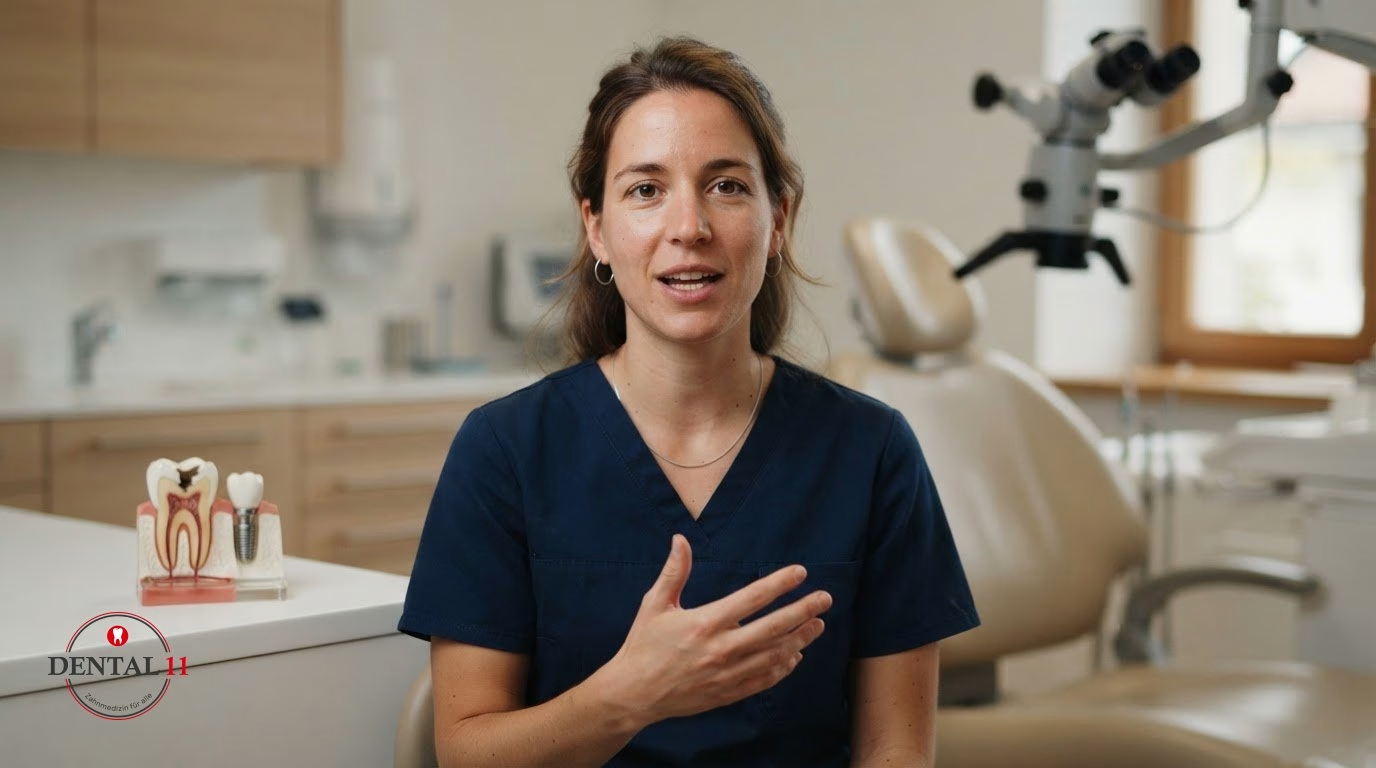
An implant is not automatically the obvious replacement for a root canal treatment. One possible alternative to a root canal treatment is to remove the affected tooth and later fill the gap with an implant. If the inflammation is still limited, partial removal of the dental pulp, known as a pulpotomy, may also be an option.
Wanting to avoid a root canal treatment is understandable. Which option makes sense depends on how badly the pulp is damaged and whether the tooth can be preserved. If a tooth is extracted, the resulting gap and how it will be restored later also need to be considered.
In this article you will learn which alternatives exist, when an implant may be considered after an extraction and which risks or exclusion criteria play a role. This makes it easier to compare keeping the tooth, a pulpotomy and a replacement tooth. Which treatment is right for you depends on the clinical findings and your individual needs.
Key points
- An implant replaces a tooth that has been removed, whereas a root canal treatment aims to preserve the natural tooth.
- If damage to the pulp is limited, partial removal, a pulpotomy, may be an option.
- Recurrent inflammation and persistent discomfort are among the possible complications; more severe pain or swelling should be assessed by a dentist.
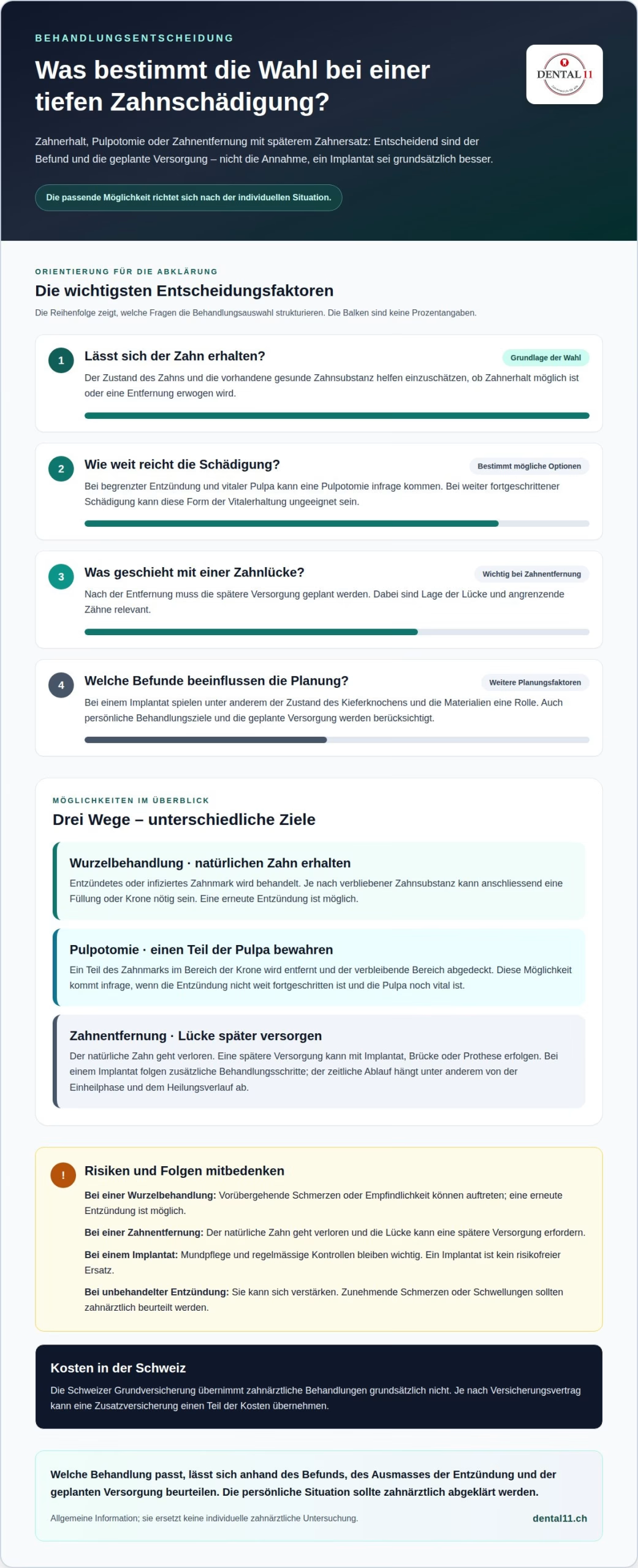
- Whether keeping the tooth, a pulpotomy or an implant is suitable depends, among other things, on the condition of the tooth and the extent of the inflammation.
Implant or root canal treatment: the difference
An implant may be considered when a damaged tooth is removed and the gap is to be filled. A root canal treatment has a different aim: inflamed or infected pulp is treated in order to preserve the natural tooth. With an implant, by contrast, the tooth is not kept but is replaced with a prosthetic tooth after extraction. Which option is suitable depends on the condition of the tooth and the planned restoration.
One possible advantage of extraction: no new inflammation of the root canal system can develop in a tooth that has been removed. In a root-filled tooth, inflammation can return if bacteria get into the canals again. However, an implant is not a risk-free replacement. The tissue around the replacement tooth also needs thorough oral care and regular check-ups.
Swiss basic health insurance generally does not cover dental treatment. Depending on your policy, supplementary insurance may cover part of the costs.
The decision should not rest solely on the assumption that an implant is generally better. If there is enough healthy tooth structure, keeping the tooth can make sense. If the tooth is badly damaged or no longer worth saving, extraction followed by a replacement tooth can be considered. The clinical findings, the position of the gap and the adjacent teeth are important here.
- Keeping the tooth: a root canal treatment aims to preserve the natural tooth.
- Replacing the tooth: an implant replaces a tooth that has been removed.
- Care: oral hygiene and check-ups remain important.
The materials and the condition of the jawbone also play a role in planning. An implant does not replace the treatment of a tooth that is still present. The right choice depends on the findings and your personal treatment goals. Talking through the pros and cons of each option helps you make a decision you understand.
Even after a root canal treatment, microorganisms can remain in fine root canals. Whether this leads to inflammation depends on various factors. During treatment the pulp is removed, which ends the blood supply through the pulp.
The claim that a root-filled tooth is an “interference field” that causes illness is not an established medical fact.
Alternatives to a root canal treatment
Which option is possible depends on whether the tooth can be preserved. With deep decay, keeping the tooth, extraction and a subsequent replacement tooth can all be discussed.
Extraction as an alternative
In an extraction, the damaged tooth is removed instead of its interior being treated. This can be an option if the tooth is not worth saving. The affected tooth then no longer remains as a possible source of further problems. However, a gap is created and its restoration has to be planned.
The gap can later be restored with an implant, a bridge or a denture. An implant replaces the tooth root in the jaw, whereas a bridge is supported by the neighbouring teeth. A denture can be removable and, depending on its design, replace several missing teeth.
After the extraction, the wound needs time to heal. The implant can then be placed and fitted with a replacement tooth. The healing phase affects the timeline. How long it takes depends on the treatment steps and how healing progresses.
Preserving vital pulp in deep decay
With deep decay, vital pulp therapy can attempt to preserve healthy pulp inside the tooth. In a pulpotomy, the dentist removes part of the pulp in the area of the crown. This is an option as long as the inflammation is not far advanced.
After the affected tissue has been removed, the remaining area is covered. A filling or further restoration then protects the tooth. Whether this way of keeping the tooth is possible depends on how far the damage extends and whether the pulp is still vital.
What follows the decision
A root-filled tooth can be preserved and, depending on the remaining tooth structure, needs a filling or crown. After an extraction, on the other hand, the restoration of the gap needs to be clarified. Before deciding on treatment, the dentist assesses the tooth, the surrounding tissue and the planned restoration.
For a personal assessment, you can book a dental appointment. The options for keeping or replacing the tooth can then be discussed on the basis of the findings.
Treatment risks and complications
Untreated inflammation inside the tooth can get worse. Possible consequences include increasing toothache, an abscess and tooth loss. However, symptoms are not a reliable indicator of how severe the inflammation is. A tooth nerve can also die without causing pain. Changes at the root tip sometimes only become visible on an X-ray.
In a root canal treatment, inflamed or infected tissue is removed. Pain or sensitivity can still occur afterwards. The tooth may initially be tender, especially when biting. Renewed inflammation is possible if bacteria get back into the root canal system. Retreatment can then be considered.
An extraction also has consequences: the natural tooth is lost, and the resulting gap may need restoring later. With an implant, further treatment steps are added. Which route is possible depends on whether the tooth can be preserved and which restoration is planned.
After a root canal treatment, the treated tooth continues to be monitored. The dentist checks its sensitivity and, if necessary, looks for changes at the root tip on an X-ray. This helps to put symptoms and unusual findings into context over time.
Pay attention to persistent or increasing symptoms. Prolonged sensitivity to cold or heat, spontaneous toothache, pain at night and pressure when biting can indicate inflammation. Swollen gums or pus are also possible signs. A dental examination can identify the cause and show whether there is decay, inflammation or another change.
More severe pain or swelling after treatment are reasons to contact the practice. Mild tenderness to pressure, on the other hand, can last for a few days up to a few weeks. What matters for the assessment are the course, the intensity and any accompanying signs. Which treatment is suitable depends on the findings and not on the chosen method alone.
Possible treatment risks include pain or sensitivity. Symptoms can persist. Further assessment depends on the individual course and the clinical findings.
Suitability and exclusion criteria
Whether keeping the tooth or extracting it is an option depends on the condition of the pulp and the remaining tooth structure. Dentistry distinguishes between vital tissue and a dead tooth nerve. Symptoms alone do not reliably show how far inflammation has progressed.
A pulpotomy may be an option in selected cases. Only the part of the pulp in the crown is removed, while the tissue in the root canals is preserved. It can be considered in cases of deep decay, reversible inflammation or sensitive teeth. It may also be an option for diseased young permanent teeth, as long as root growth is not yet complete.
If a tooth is dead or severely inflamed, treatment that preserves the pulp is often not a suitable option. If the tooth nerve is irreversibly damaged or has already died, a conventional root canal treatment can be considered. The canals are cleaned, disinfected and sealed to treat bacteria inside the tooth.
A pulpotomy can also be considered for adult permanent teeth, even though the root no longer grows. What matters is whether the inflammation can be contained and enough healthy tissue preserved. The examination therefore takes into account the tooth, the symptoms and, where appropriate, an X-ray. This makes it possible to assess whether keeping the tooth, a root canal treatment or extraction is the next step.
For patients this means: deep decay does not automatically lead to extraction. If the pulp is still vital and the inflammation is limited, partial removal of the pulp may be an option. With advanced inflammation or a dead nerve, this option is not suitable. At an appointment, the findings can be discussed in a way that is easy to understand.
Book an appointment for a dental assessment if you have symptoms or have received a diagnosis. It can then be clarified whether the tooth can be fully preserved and which treatment suits the findings.
Root canal treatment under the microscope at Dental11
At Dental11 we treat root canals under a dental microscope, with the aim of preserving your own tooth. A root canal treatment with a microscope costs from CHF 650. We discuss keeping the tooth and possible alternatives on the basis of the findings. If the tooth cannot be preserved, restoration with a dental implant can also be discussed.
A personal appointment helps to put symptoms, examination results and possible treatment steps into context together. You can ask questions about benefits, limits and possible risks. Which treatment is suitable depends on the condition of the tooth and your oral health.
If you would like an assessment of your tooth, book an appointment at Dental11.
Planning the next treatment step calmly
An alternative to a root canal treatment cannot be chosen on the basis of general information alone. Use any questions that remain after reading as a guide for the consultation: which findings are decisive, which options are there and what consequences do they have in everyday life? Clear answers provide a sound basis for a considered decision.
Your personal priorities also belong in the decision. Perhaps you would like to keep your natural tooth for as long as possible, or understand the treatment steps and their effects better. A clear comparison helps to bring your decision into line with the findings.
A careful assessment helps you plan the way forward step by step. This allows you to approach the next decisions well informed and with confidence.
Frequently asked questions about root canal treatment
Who is an alternative to root canal treatment suitable for?
Whether partial treatment of the dental pulp is an option cannot be judged from pain alone. At the appointment, your symptoms, how the tooth responds to testing and, where needed, X-ray findings are considered together. The age of the tooth and how far its root has developed can also play a role. Ask about the specific aim of the treatment, its possible limits and the follow-up check.
Will I lose the tooth if complications occur?
A complication does not automatically mean the tooth has to be removed. Further planning takes into account your symptoms, X-ray findings and the condition of the remaining tooth structure, among other things. Ask which findings speak in favour of keeping the tooth and which changes could make extraction more likely. This makes it clearer which next steps are worth discussing in your individual case.
What is a root canal treatment and what are its limits?
A root canal treatment aims to preserve a tooth whose pulp is severely damaged. It is not inherently problematic, but it has limits: the outcome cannot be predicted with certainty in every case, and later symptoms may require further assessment. Also discuss the planned restoration of the tooth, possible check-ups and what happens if symptoms persist.
What are the alternatives to a root canal treatment?
Depending on the findings, partial treatment of the dental pulp or an extraction followed by a replacement tooth can be discussed. To fill a gap, options include an implant, a bridge or a denture. When weighing them up, the neighbouring teeth, the jawbone and the type of restoration you would like matter as well as the affected tooth itself. Ask for the differences and possible consequences to be explained to you.
When can a root canal treatment be avoided, and when can the tooth no longer be saved?
Only an examination of the tooth and the surrounding tissue shows whether a root canal treatment can be avoided. How the tooth responds to testing and X-rays can help with the assessment. Cracks, the remaining tooth structure and the extent of the damage are also important for keeping the tooth. Ask for a clear explanation of which findings are decisive for the proposed treatment.
This article is for general information only and does not replace a personal dental examination.


